Public Opinion and the Making of Foreign Policy in the 'New Europe': A Comparative Study of Poland and Ukraine by Nathaniel Copsey
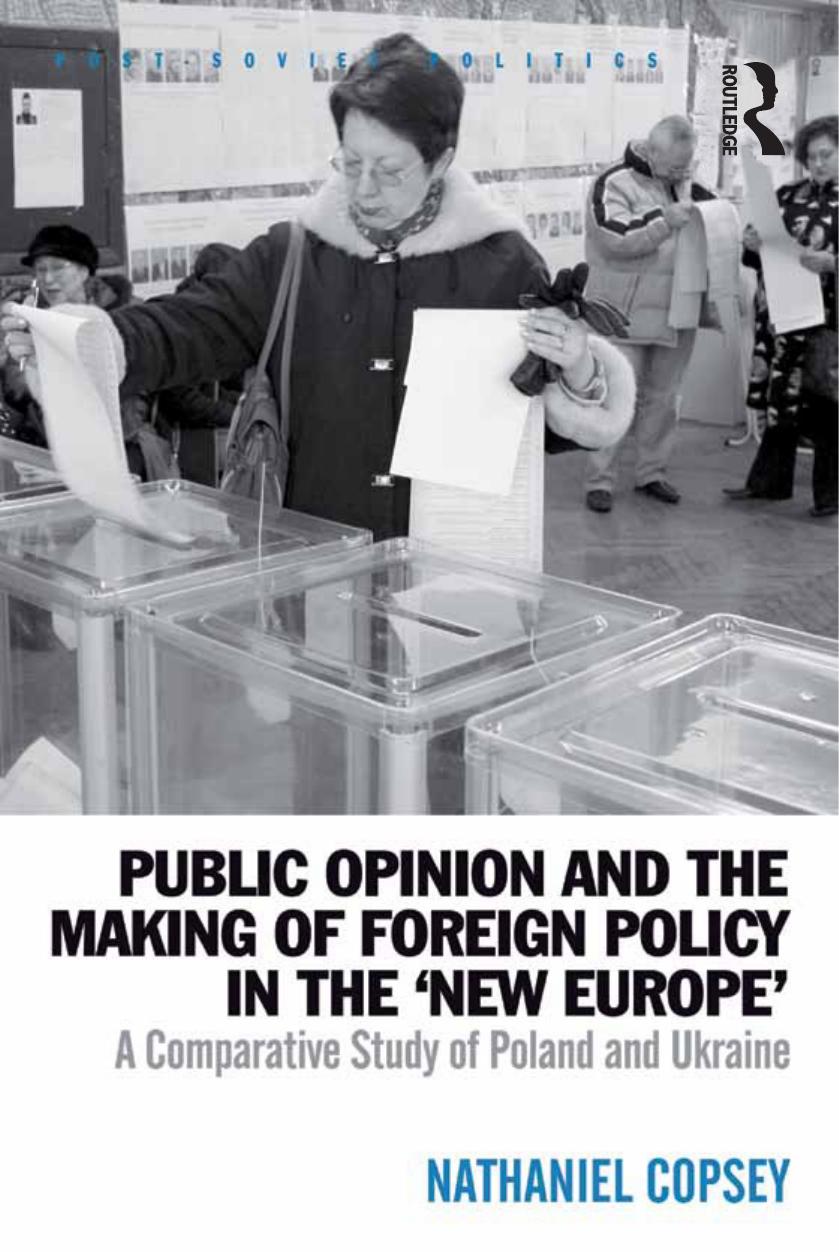
Author:Nathaniel Copsey [Copsey, Nathaniel]
Language: eng
Format: epub, pdf
Tags: Political Science, General
ISBN: 9781317073512
Google: AHoHDAAAQBAJ
Goodreads: 29998138
Publisher: Routledge
Published: 2009-12-01T00:00:00+00:00
The Struggle for the Borderlands
The central issue that dominated Polish-Ukrainian relations32 in the first half of the twentieth century was the question of borders. This question is also closely related to what happened in the 1940s; it is impossible to understand the ethnic cleansing of the 1940s without some reference to what took place in the 25 years that preceded it.
Poland has been described as a âcountry on wheelsâ whose borders roll forward one moment, and backward the next, keeping time with the politics of Berlin and Moscow. Ukraineâs borders have also been the subject of considerable revision in the past century, not only at the western edge of the country, but in the east and the south as well. Crimea only became part of Ukraine in 1954, and since the end of the Cold War, Western geo-strategists have occasionally speculated that Ukraine would âmake more senseâ as a polity within a somewhat revised and reduced geographical area.33 The border question becomes even more interesting when one recalls that states called âPolandâ or âUkraineâ did not formally exist on maps of Europe until after the First World War â and in the case of Ukraine, its reincarnation was in the form of a Soviet Socialist Republic, not as a fully independent and sovereign state.
The borders of the modern nation-state generally correspond to the areas inhabited by the nation these states represent. Prior to the First World War, Poland and Ukraine were partitioned between Austria-Hungary and the Russian Empire,34 both multi-national states, although the Polish-Ukrainian borderland was in effect under Austrian rule alone. The Commonwealth of the Two Nations was also a multi-ethnic state; the nation was composed exclusively of the nobles, the Polish speaking szlachta.35 As has been mentioned above, Poles and Ukrainians did not live in exclusively Polish or Ukrainian communities, they also lived variously alongside Germans, Jews, Russians, Belarussians, Lithuanians, Czechs, Armenians, Hungarians, Romanians, Slovaks, the so-called âtutejsziâ, the âpeople from hereaboutsâ, Rusyns, Caraims, and the occasional Moslem. In short, belonging to a particular nation was a complicated matter.36
The failure of the two gentry-led Polish uprisings against Russian rule in the nineteenth century, in 1830â1831 and 1863â1864, to attract the support of the Polish-speaking peasantry prompted some reconsideration in political thought about what it meant to be a Pole. Abridging history, two separate schools of thought had come into being by the end of the nineteenth century: the nationalist and the federalist. The Nationalist Endecja, led by Roman Dmowski,37 hoped to build a Polish state, based on Polish ethnicity, enforcing the assimilation of Belarusian and Ukrainian peasants â who they did not perceive as nations in their own right. Federalists, led by Józef PiÅsudski, looked to a resurrection of the Commonwealth of the Two Nations, with considerable devolution of power to Ukrainian, Belarusian and Lithuanian territories, although with Poles firmly in the driving seat. When in a more pragmatic frame of mind, federalists considered the idea of an ethnic Polish state in alliance with Belarusâ, Lithuania and Ukraine, and therefore strong enough to resist external interference.
Download
Public Opinion and the Making of Foreign Policy in the 'New Europe': A Comparative Study of Poland and Ukraine by Nathaniel Copsey.pdf
This site does not store any files on its server. We only index and link to content provided by other sites. Please contact the content providers to delete copyright contents if any and email us, we'll remove relevant links or contents immediately.
| Anthropology | Archaeology |
| Philosophy | Politics & Government |
| Social Sciences | Sociology |
| Women's Studies |
The Secret History by Donna Tartt(19058)
The Social Justice Warrior Handbook by Lisa De Pasquale(12187)
Thirteen Reasons Why by Jay Asher(8894)
This Is How You Lose Her by Junot Diaz(6877)
Weapons of Math Destruction by Cathy O'Neil(6267)
Zero to One by Peter Thiel(5789)
Beartown by Fredrik Backman(5737)
The Myth of the Strong Leader by Archie Brown(5500)
The Fire Next Time by James Baldwin(5432)
How Democracies Die by Steven Levitsky & Daniel Ziblatt(5216)
Promise Me, Dad by Joe Biden(5144)
Stone's Rules by Roger Stone(5081)
A Higher Loyalty: Truth, Lies, and Leadership by James Comey(4954)
100 Deadly Skills by Clint Emerson(4921)
Rise and Kill First by Ronen Bergman(4780)
Secrecy World by Jake Bernstein(4742)
The David Icke Guide to the Global Conspiracy (and how to end it) by David Icke(4709)
The Farm by Tom Rob Smith(4502)
The Doomsday Machine by Daniel Ellsberg(4484)
