Preventive War and American Democracy by Silverstone Scott A
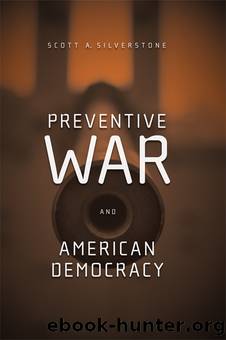
Author:Silverstone, Scott A.
Language: eng
Format: epub
ISBN: 978-1-135-92800-1
Publisher: Taylor & Francis (CAM)
6
Coercive Anti-Proliferation
From China 1964 to North Korea 1994
As we have seen, from the late 1940s to the early 1960s, the growth of Soviet and Communist Chinese power produced a strategic dilemma for the United States that seemed tailor-made for the logic of preventive war. Despite the magnitude of the relative power shift American leaders feared, preventive war was decisively rejected as a strategic option to arrest this change. Earlier chapters have shown that this decision was driven by a deeply engrained and widely held normative belief that preventive war was simply wrong, a violation of American principles and traditions that would cast the black mark of raw aggression on the United States. As President Dwight Eisenhower argued in 1955, it was better to accept the military dangers and increasing vulnerabilities created by an adversaryâs growing power than to take preventive military action and thus be guilty of initiating war. During the Cuba crisis of 1962, an exception to the anti-preventive war norm emerged to ease normative restrictions on preventive attack, but only for Soviet nuclear missiles in the Caribbean, and as long as the United States did not execute a surprise preventive strike reminiscent of the Japanese attack on Pearl Harbor. It was better to run the increased risks of issuing an ultimatum with a threatened attack, thereby allowing the Soviets to voluntarily withdraw the missiles, than to execute a normatively illegitimate surprise strike. Even though American leaders were willing to debate exceptions to the anti-preventive war norm in 1962, they still treated it seriously.
Over the next thirty years, however, something profound happened to the anti-preventive war norm. By the early 1990s, as the United States confronted the prospects of a nuclear armed North Korea, the anti-preventive war norm was virtually nonexistent as American leaders grappled with this new strategic problem. The Clinton administration explicitly considered the preventive attack option to destroy North Koreaâs nuclear infrastructure, and it did so without the slightest hint of normative hesitation. The most outspoken members of Congress and opinion leaders urged the administration to take a tougher line, including the use of preventive military force. Not a single prominent voice within the administration or in the broader American political system challenged the possible use of military force with the kind of normative language used forty years earlier. In the run-up to the Iraq war in 2002 and 2003, some members of Congress, scholars, and editorial writers did speak out against preventive war as a violation of long-held American norms. But as the Bush administration moved toward war it became obvious that the anti-preventive war norm was marginalized in the debate, and in the end was meaningless in the decision to launch the first preventive war in American history. What happened to the anti-preventive war norm during the final decades of the twentieth century? How did such a deeply and genuinely held belief about American foreign policy in mid-century become impotent by centuryâs end? This chapter seeks to answer these questions.
The core argument is that
Download
This site does not store any files on its server. We only index and link to content provided by other sites. Please contact the content providers to delete copyright contents if any and email us, we'll remove relevant links or contents immediately.
| Anthropology | Archaeology |
| Philosophy | Politics & Government |
| Social Sciences | Sociology |
| Women's Studies |
The Secret History by Donna Tartt(19476)
The Social Justice Warrior Handbook by Lisa De Pasquale(12297)
Thirteen Reasons Why by Jay Asher(9128)
This Is How You Lose Her by Junot Diaz(7060)
Weapons of Math Destruction by Cathy O'Neil(6476)
Zero to One by Peter Thiel(5953)
Beartown by Fredrik Backman(5948)
The Myth of the Strong Leader by Archie Brown(5631)
The Fire Next Time by James Baldwin(5592)
How Democracies Die by Steven Levitsky & Daniel Ziblatt(5333)
Promise Me, Dad by Joe Biden(5237)
Stone's Rules by Roger Stone(5196)
A Higher Loyalty: Truth, Lies, and Leadership by James Comey(5091)
100 Deadly Skills by Clint Emerson(5031)
Rise and Kill First by Ronen Bergman(4907)
Secrecy World by Jake Bernstein(4892)
The David Icke Guide to the Global Conspiracy (and how to end it) by David Icke(4854)
The Doomsday Machine by Daniel Ellsberg(4627)
The Farm by Tom Rob Smith(4614)
