Predictable surprises : the disasters you should have seen coming, and how to prevent them by Bazerman Max H;Watkins Michael 1956- & Watkins Michael 1956-
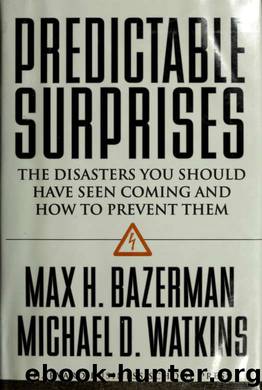
Author:Bazerman, Max H;Watkins, Michael, 1956- & Watkins, Michael, 1956-
Language: eng
Format: epub
Tags: Management decision making, Forecasting, Business/Economics, Business & Economics, Business / Economics / Finance, Strategic Planning, Management - General, Decision Making & Problem Solving, Disasters, Emergency management, Prevention
Publisher: Boston : Harvard Business School Press
Published: 2004-06-06T16:00:00+00:00
duct random audits of political campaigns (a responsibility revoked by Congress in 1979), increase the FEC's ability to seek out and eliminate loopholes (rather than promulgating them), change the number of commissioners from an even to an odd number to eliminate deadlock, and improve the selection process to ensure the appointment of qualified and experienced candidates. 93
Fourth, like Russ Feingold, Green supports one of the reforms that fell by the wayside during McCain-Feingold's long journey: giving candidates free or reduced-cost television advertising time as a means of reducing campaign fundraising. 94 Under the provisions of the Federal Communication Act of 1934, broadcasters are obligated to serve "the public interest, convenience, and necessity" in exchange for their free federal licenses. 95 Television and radio networks have never met this responsibility. Green puts forth Walter Cronkites 1982 market-based proposal of free broadcast vouchers that could be granted to all qualifying candidates and traded like commodities to ensure efficient distribution. The vouchers should be limited to candidates who accept spending limits, Green says. He also believes that those candidates who accept public funds should be required to debate their opponents.
While Green offers a number of concrete strategies to reduce the political barriers to surprise prevention, these ideas more broadly serve as a call for executives to ask themselves, 'What are the political barriers to surprise prevention in our organization?" In most organizations, one reason that executives fail to respond to predictable surprises is that some group of individuals will thwart an effective response in order to protect their self-interest. For example, we view the failure of many corporations to expense employees' stock options on their balance sheets as a predictable surprise.
A core problem is that the decision-makers who must to act to prevent the surprise are benefited, at least in the short-term, by the failure to expense stock options. Preventing predictable surprises requires changing traditional approaches to problems, and change inevitably creates winners and losers. Yet when the gains far exceed the losses, change should occur. The challenge to leaders is to block the destructive political behavior of those who will be negatively affected by the change—even if these people are the leaders themselves. In
Download
This site does not store any files on its server. We only index and link to content provided by other sites. Please contact the content providers to delete copyright contents if any and email us, we'll remove relevant links or contents immediately.
The Brazilian Economy since the Great Financial Crisis of 20072008 by Philip Arestis Carolina Troncoso Baltar & Daniela Magalhães Prates(133831)
International Integration of the Brazilian Economy by Elias C. Grivoyannis(110213)
The Art of Coaching by Elena Aguilar(53194)
Flexible Working by Dale Gemma;(23285)
How to Stop Living Paycheck to Paycheck by Avery Breyer(19719)
The Acquirer's Multiple: How the Billionaire Contrarians of Deep Value Beat the Market by Tobias Carlisle(12313)
Thinking, Fast and Slow by Kahneman Daniel(12267)
The Radium Girls by Kate Moore(12018)
The Art of Thinking Clearly by Rolf Dobelli(10455)
Hit Refresh by Satya Nadella(9126)
The Compound Effect by Darren Hardy(8949)
Tools of Titans by Timothy Ferriss(8368)
Atomic Habits: Tiny Changes, Remarkable Results by James Clear(8326)
Turbulence by E. J. Noyes(8040)
A Court of Wings and Ruin by Sarah J. Maas(7821)
Change Your Questions, Change Your Life by Marilee Adams(7760)
Nudge - Improving Decisions about Health, Wealth, and Happiness by Thaler Sunstein(7693)
How to Be a Bawse: A Guide to Conquering Life by Lilly Singh(7472)
Win Bigly by Scott Adams(7184)
