Precedents and Judicial Politics in EU Immigration Law by Marie De Somer
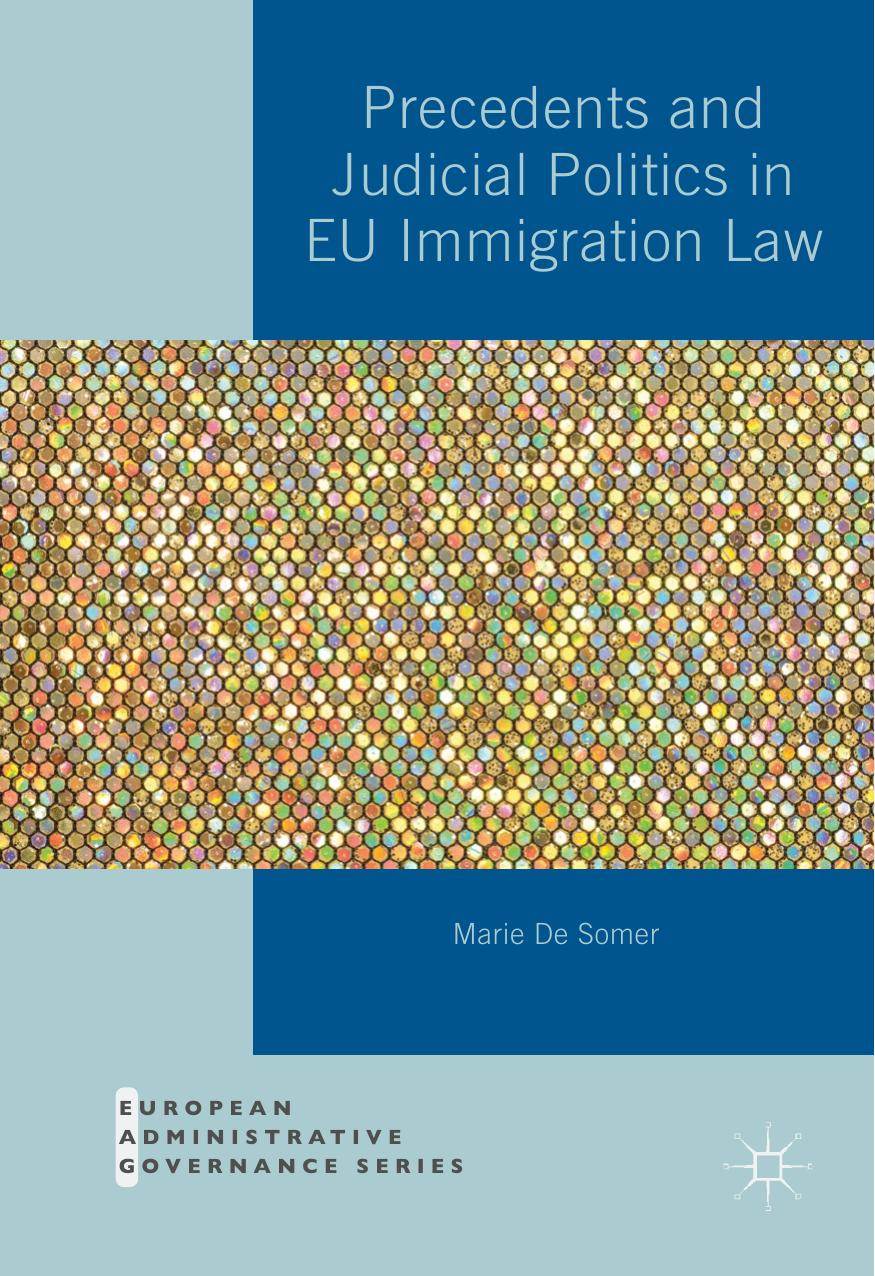
Author:Marie De Somer
Language: eng
Format: epub, pdf
ISBN: 9783319939827
Publisher: Springer International Publishing
7.3 The 1990s: The Internal Rule, ‘Effet Utile’, Fundamental Rights and EU Citizenship
As time progressed, the case law record became marked by a higher incidence of self-citation observations and, accordingly, more dominant patterns. Three dominant inward scores catch the eye in the period immediately following on from the earliest developments on account of their longitudinal nature. That is, particularly the inward scores linked to the Singh, Carpenter and Baumbast rulings display a long-lasting dominant pattern suggesting that these cases held a precedent relevance for a long line of cases that followed afterwards. Especially the dominant inward scores of Singh and Carpenter span almost the entire development of the case law record. Additionally, and entrenched by these three long structures, the inward citation scores linked to the MRAX ruling also display comparatively dominant values, albeit of a less long-lived nature. These four cases, Singh , Carpenter , Baumbast and MRAX and their follow-up citations are discussed in what follows.
To begin with, the 1992 Singh case concerned the situation of Mr. Singh, an Indian national married to Mrs. Singh, a British national. Previously, Mr. and Mrs. Singh had resided in Germany for two years where Mrs. Singh had been employed in exercise of her free movement rights. The couple had been back in the UK for five years. During this period, they had separated and at a later time their marriage was formally dissolved which resulted in the revocation of Mr. Singh’s right to remain under British domestic immigration law. Proceedings were lodged against this deportation order and the case was eventually referred to Luxembourg as the UK judiciary was uncertain whether, upon return from having exercised free movement rights in another Member State, EU free movement law continued to apply and whether its provisions could, hence, be invoked by Union nationals against their own state. Not the Treaties, nor any secondary legislation, were considered to provide stipulations that could guide the answer to such questions.
As registered in the decision’s report for the hearing, the UK government vehemently argued for a negative answer to the questions raised in the written observation that it submitted. To that purpose, it advanced a series of different arguments and rationales. To begin with, it referred to the Court’s earlier Morson & Jhanjan ruling to contend that Community law “does not apply to circumstances ‘wholly internal’ to a Member State”. More in particular, as it continued, “a national of a Member State or the spouse of such a person cannot rely on Community law to avoid the application to him or her of national legislation relating to immigration” (Report for the hearing Singh case, p. 4270). In that respect it also pointed out that Mrs. Singh’s right to return to the UK was conferred on her by British law. If, on the other hand, Community rules would be applied to her situation, the UK government stated, the British authorities would have been able “to refuse Mrs Singh the right of entry and residence on grounds of public
Download
Precedents and Judicial Politics in EU Immigration Law by Marie De Somer.pdf
This site does not store any files on its server. We only index and link to content provided by other sites. Please contact the content providers to delete copyright contents if any and email us, we'll remove relevant links or contents immediately.
| Anthropology | Archaeology |
| Philosophy | Politics & Government |
| Social Sciences | Sociology |
| Women's Studies |
The Secret History by Donna Tartt(19385)
The Social Justice Warrior Handbook by Lisa De Pasquale(12266)
Thirteen Reasons Why by Jay Asher(9057)
This Is How You Lose Her by Junot Diaz(7007)
Weapons of Math Destruction by Cathy O'Neil(6416)
Zero to One by Peter Thiel(5899)
Beartown by Fredrik Backman(5879)
The Myth of the Strong Leader by Archie Brown(5590)
The Fire Next Time by James Baldwin(5543)
How Democracies Die by Steven Levitsky & Daniel Ziblatt(5299)
Promise Me, Dad by Joe Biden(5208)
Stone's Rules by Roger Stone(5158)
A Higher Loyalty: Truth, Lies, and Leadership by James Comey(5045)
100 Deadly Skills by Clint Emerson(4994)
Rise and Kill First by Ronen Bergman(4863)
Secrecy World by Jake Bernstein(4825)
The David Icke Guide to the Global Conspiracy (and how to end it) by David Icke(4804)
The Doomsday Machine by Daniel Ellsberg(4584)
The Farm by Tom Rob Smith(4574)
