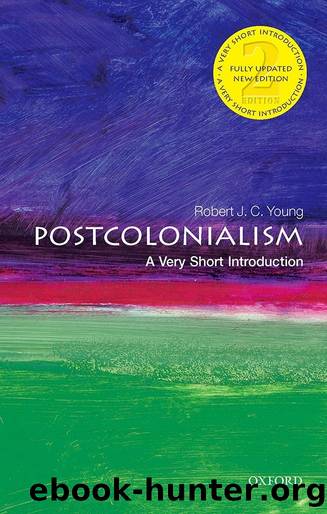
Postcolonialism: A Very Short Introduction (2nd Edition) by Robert J. C. Young
Author:Robert J. C. Young [Young, Robert J. C.]
Language: eng
Format: epub
ISBN: 9780192598912
Google: ey8DEAAAQBAJ
Amazon: 0192801821
Publisher: OUP Oxford
Published: 2020-10-21T23:00:00+00:00
Raï and Islamic social space
After the traumatic experiences of the Algerian War of Independenceâthe widespread torture of men, women, and children; the million-and-a-half Algerians killed by the French in their desperate attempt to retain their own privileges won by brutal military conquests in the 19th century, to maintain their occupation of a land whose diverse indigenous people were never subduedâthe emergence of raï music in Algeria in the 1970s was a particularly heartening phenomenon. Raï is often described as raw, rough, earthy (trab): it is also defiant, assertive, passionate. The singers throw themselves at its rhythms with an unimaginable intensity that gives raï its unique energizing passion.
Raï music has been described as a product of the contradictory conditions of postcoloniality, produced in the precarious fissures of repeated paradoxical situations. The ethnomusicologist Philip V. Bohlman describes it as follows:
Popular musicians sing against the institutions of the politically powerful, yet depend upon the connections of such institutions to the former colonizing nations, especially the recording industries of Paris and London. Popular music mobilizes the voiceless, but when the voiceless turn to Islam to enhance their mobilization, they cannot at the same time embrace popular music. Popular music enters the North African metropolis from the peripheries of tradition, but must sacrifice the past to enter the public sphere at the centre of urban society.
Raï has always been mobile and shifting as it changes its functions and locations, its instruments and its audiences. Its production is often casual and can be adapted easily according to specific needs. Its impromptu nature means that it never becomes fixed, that it always remains flexible and able to incorporate new contradictory elements.
Raï music began during the explosive population growth of the first generation of Algerians born after the end of the Algerian War of Independence in 1962. It came into its own in the late 1970s when singers, such as Sahraoui and Fadela, and Cheb Khaled, began to produce their own dynamic form of raï that drew on some of the sounds and rhythms of Western rock while reminiscent in its haunting self-expression of reggae and African-American blues. The emergence of raï is also associated with the migration of Algerians to the cities, and in that sense marks the appearance of a syncretic musical form that epitomizes the economic imperatives of modernity on its disenfranchised people. This involved much more than transactions of fusion, synthesis, or intermixture. People and cultures do not flow unimpeded and unchanged in the way that capital does. The social production of raï was not a single process, but rather involved histories of contested relations at every level of its production and consumption in Algerian society. To that extent, raï can work too as a broader metaphor for thinking about the complex relations of cultures to the forces of modernity.
As a musical form, raï originally developed soon after independence in the cosmopolitan port city of WahrÄn (Oran), in western Algeria, where the young chebs (male singers such as Cheikh Meftah and Cheikh Djelloul Remchaoui)
Download
This site does not store any files on its server. We only index and link to content provided by other sites. Please contact the content providers to delete copyright contents if any and email us, we'll remove relevant links or contents immediately.
| Anthropology | Archaeology |
| Philosophy | Politics & Government |
| Social Sciences | Sociology |
| Women's Studies |
The Secret History by Donna Tartt(19473)
The Social Justice Warrior Handbook by Lisa De Pasquale(12294)
Thirteen Reasons Why by Jay Asher(9122)
This Is How You Lose Her by Junot Diaz(7057)
Weapons of Math Destruction by Cathy O'Neil(6470)
Zero to One by Peter Thiel(5952)
Beartown by Fredrik Backman(5943)
The Myth of the Strong Leader by Archie Brown(5627)
The Fire Next Time by James Baldwin(5589)
How Democracies Die by Steven Levitsky & Daniel Ziblatt(5333)
Promise Me, Dad by Joe Biden(5230)
Stone's Rules by Roger Stone(5194)
A Higher Loyalty: Truth, Lies, and Leadership by James Comey(5090)
100 Deadly Skills by Clint Emerson(5023)
Rise and Kill First by Ronen Bergman(4906)
Secrecy World by Jake Bernstein(4889)
The David Icke Guide to the Global Conspiracy (and how to end it) by David Icke(4853)
The Doomsday Machine by Daniel Ellsberg(4624)
The Farm by Tom Rob Smith(4612)
