Populism and Its Limits by Prasanta Chakravarty;
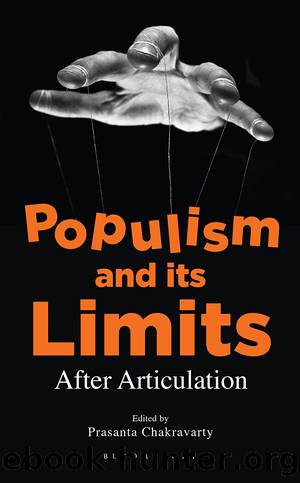
Author:Prasanta Chakravarty;
Language: eng
Format: epub
Publisher: Bloomsbury UK
As such, to âbecome-minorâ or to âbecome-revolutionaryâ is to âbecome-Ephesianâ. It is a matter of knowing and seeking out the many Hermodors, not to banish but to âdisrupt and transformâ.
Notes
1 According to Bonnie Honig, the problem with the idea of consensus is its tendency to exclude voices or leave âremaindersâ (Honig 1993, 5).
2 A useful point of comparison is Sandelâs (1982) critique of Rawls and his âoriginal positionâ.
3 In a recently published interview with Iñigo Errejón (2016), she repeats these arguments almost verbatim: âTo me itâs a consequence of neoliberalism, and that is why itâs accurate to say that we are living in âpost-democraticâ societies. Furthermore, the consensus at the centre that we discussed previously has contributed to the discrediting of left-wing politicsâ (Errejón and Mouffe 2016b, 119).
4 Mouffe acknowledges as much in an earlier essay:
An important part of my argument will be of a theoretical nature because I am convinced that in order to understand the appeal of right-wing populist discourse, it is necessary to question the rationalist and individualist tenets which inform the main trends of democratic political theory. (Mouffe 2005a, 51)
5 Although Mouffe occasionally makes statements that appear to claim that âthe agonistic tension between the liberal and democratic principles ⦠has been eliminatedâ as a result of neoliberal hegemony (Mouffe 2018, 16), I have chosen to overlook them as they are inconsistent with the ontological premise that the agon never ceases to exist in âthe politicalâ (Mouffe 2013, 2). One must presume that such statements have been aims for hyperbolic appeal rather than theoretical consistency.
6 While older theories of democracy and politics, in general, were conceived in relation to absolutes (âthe good lifeâ), the emphasis on pluralism as a âsocial factâ and as a sign of the âdissolution of the markers of certaintyâ is a discovery of the liberal-democratic model (Mouffe 1996, 246). It is, however, the failure to account for this âfactâ that Mouffe and other agonists bemoan. Though I have drawn chiefly from the works of Mouffe to substantiate my arguments, it must be noted that agonists such as Connolly and Honig tend to disagree with her on the specific nature of an agonistic democracy. Nevertheless, the critical objective of all their works is to theorize a model of pluralism that does not exclude or negate differences through collective abstractions.
7 In Democracy, Power and the Political (2005), Mouffe writes that only âwhen différance is construed as the condition of possibility of beingâ can a truly pluralist idea of democracy ever be realized (Mouffe 1996, 246). Variants of this idea lie at the heart of all her works.
8 William Connolly refers to this idea as âagonistic respectâ (Connolly 1991, 14).
9 Objectivity is impossible, Mouffe argues, because we already find ourselves in a social order conditioned by hegemony. The social is âconstituted by sedimented hegemonic practicesâ and is the âbattlefield where hegemonic practices confront each other without hope of a final solutionâ (Mouffe 2007).
10 Right-populist movements often tend to bring up a perceived historical oversight or a form of racial/ethnic essentialism to advance their demands for justice and equality.
Download
This site does not store any files on its server. We only index and link to content provided by other sites. Please contact the content providers to delete copyright contents if any and email us, we'll remove relevant links or contents immediately.
| Anthropology | Archaeology |
| Philosophy | Politics & Government |
| Social Sciences | Sociology |
| Women's Studies |
Born to Run: by Christopher McDougall(7127)
The Leavers by Lisa Ko(6948)
iGen by Jean M. Twenge(5416)
Sapiens by Yuval Noah Harari(5372)
Spare by Prince Harry The Duke of Sussex(5197)
The Kite Runner by Khaled Hosseini(5180)
Machine Learning at Scale with H2O by Gregory Keys | David Whiting(4313)
Bullshit Jobs by David Graeber(4191)
Never by Ken Follett(3957)
Goodbye Paradise(3810)
Livewired by David Eagleman(3775)
Fairy Tale by Stephen King(3399)
A Dictionary of Sociology by Unknown(3085)
Harry Potter 4 - Harry Potter and The Goblet of Fire by J.K.Rowling(3074)
The Social Psychology of Inequality by Unknown(3031)
The Club by A.L. Brooks(2926)
Will by Will Smith(2920)
0041152001443424520 .pdf by Unknown(2846)
People of the Earth: An Introduction to World Prehistory by Dr. Brian Fagan & Nadia Durrani(2739)
