Political Morality in a Disenchanted World by Abegg Edmund;
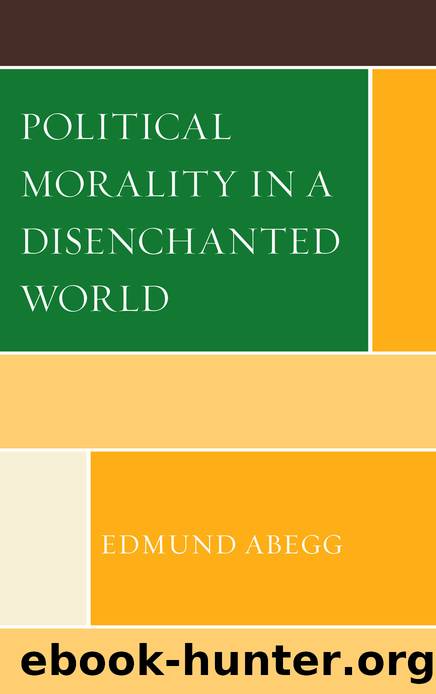
Author:Abegg, Edmund;
Language: eng
Format: epub
ISBN: 978-0-7618-6153-9
Publisher: UPA
NOTES
1. David Hume, An Inquiry Concerning the Principles of Morals (1957), part 1 of section 9, conclusion (especially p. 92), and appendix 2.
2. See Joseph Stiglitz, Freefall (2010), 243â46.
3. Ibid., 204.
4. Stiglitz, Freefall, 202. He says only that markets âundersupplyâ public goods, and he gives the example of knowledge. But knowledge can in part be packaged and marketed, e.g., in the sale of books. Perhaps in part he uses a broader meaning of âpublic goods,â one that includes important social values or goals, whether or not they might have to be available to all without an itemized fee (as opposed to the use of tax money and regulation to promote the goal).
5. Ibid., 12â18, 201.
6. Ibid., 289â90.
7. M. Friedman, Capitalism and Freedom (1962), chapter 9.
8. Ibid., chapter 8. See also Stiglitz, Freefall, 200â201.
9. Nozick, Anarchy, State, and Utopia (1974). Late in his life he slightly modified his extreme libertarian views. See David Schmidtz, review of Why Some Things Should Not Be for Sale, by Debra Satz, The Journal of Philosophy (April 2011): 219.
10. Nozick, Anarchy, State, and Utopia, chapter 7.
11. Howard Zinn, A Peopleâs History of the United States (2003), 262.
12. Rawls, A Theory of Justice (1971). His later Political Liberalism (1993) modified some of his early views.
13. Stiglitz, Freefall, xiii, chapter 9, especially 238, 241â48, 273â74.
14. Robert Solow reports that mid-twentieth century academic discussions about socialism emphasized devising ârules of behavior that would make a socialist economy function like a competitive market economy (perhaps more like one than any real-world market does).â âThe Serfdom Scare,â review of The Great Persuasion: Reinventing Free Markets since the Depression, by Angus Burgin, The New Republic, 6 December 2012, 42.
15. Stiglitz, Freefall, 152.
16. James Sterba, âWelfare Libertarianism,â in Political Philosophy, ed. Pojman (2002), 216â28.
17. Smith, The Wealth of Nations (1986), 265, in Heilbroner, ed., The Essential Adam Smith.
18. See, e.g., Jan Narveson, âA Critique of Sterbaâs Defense of the Welfare State,â in Op. Cit., ed. Pojman, 228â39.
19. M. Friedman, Op. Cit., chapter 3, especially 44â51.
20. Ibid., chapter 4, especially 73â74.
Download
This site does not store any files on its server. We only index and link to content provided by other sites. Please contact the content providers to delete copyright contents if any and email us, we'll remove relevant links or contents immediately.
| Anthropology | Archaeology |
| Philosophy | Politics & Government |
| Social Sciences | Sociology |
| Women's Studies |
The Secret History by Donna Tartt(19102)
The Social Justice Warrior Handbook by Lisa De Pasquale(12197)
Thirteen Reasons Why by Jay Asher(8918)
This Is How You Lose Her by Junot Diaz(6894)
Weapons of Math Destruction by Cathy O'Neil(6284)
Zero to One by Peter Thiel(5807)
Beartown by Fredrik Backman(5766)
The Myth of the Strong Leader by Archie Brown(5512)
The Fire Next Time by James Baldwin(5454)
How Democracies Die by Steven Levitsky & Daniel Ziblatt(5224)
Promise Me, Dad by Joe Biden(5157)
Stone's Rules by Roger Stone(5090)
A Higher Loyalty: Truth, Lies, and Leadership by James Comey(4966)
100 Deadly Skills by Clint Emerson(4931)
Rise and Kill First by Ronen Bergman(4797)
Secrecy World by Jake Bernstein(4756)
The David Icke Guide to the Global Conspiracy (and how to end it) by David Icke(4723)
The Farm by Tom Rob Smith(4517)
The Doomsday Machine by Daniel Ellsberg(4493)
