Pious Citizens by Ringer Monica M.;
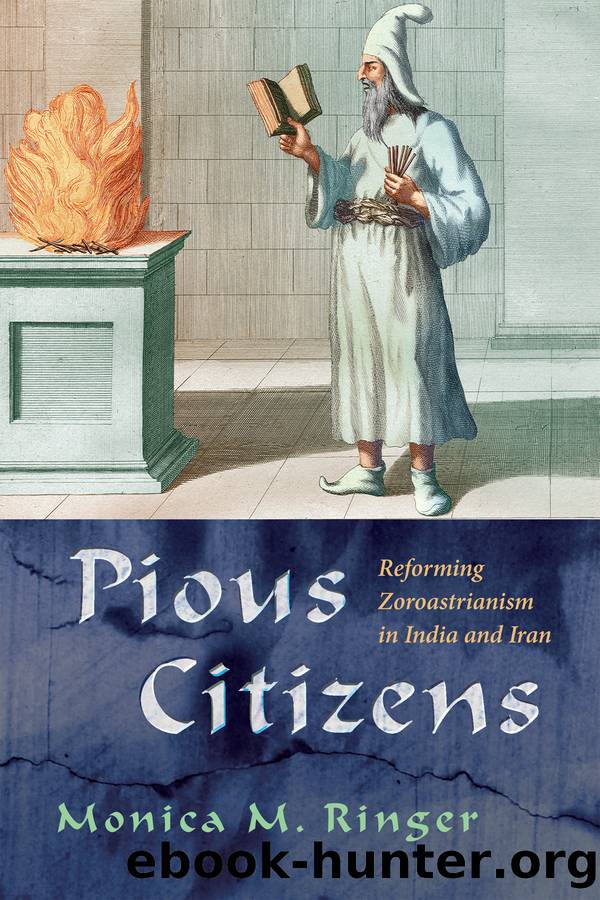
Author:Ringer, Monica M.;
Language: eng
Format: epub
Publisher: Syracuse University Press
Published: 2021-04-08T00:00:00+00:00
It was not only the priestsâ ignorance and commitment to orthodoxy, however, that threatened their position. Dhalla agreed with the scholarly consensus concerning the intrusion of foreign priests, the magi, into Zoroastrian tradition. Like other Reformists, he also stressed individual relationship to God, rather than priestly intermediation.
Dhalla was not alone. One of the sharpest criticisms of the Reformist position by the Orthodox, as most fully articulated by Sanjana, was the lessening of religious commitment that inevitably resulted.103 Others were also cognizant of the tightrope that they walked between recovering âtrueâ religion and dismantling faith altogether.104 One of the most vehement critics of the Reformist threat was Ardaser Sorabjee N. Wadia. âSometimeâ professor of English and history at Elphinstone College, Wadia was deeply critical of the Reformists who engaged in âmetaphysical subtleties and philological disputesâ that left the community confused and spiritually bereft .105 As discussed above, Dastur Sanjana was also concerned with divisiveness in the community caused by Reformist denunciation of tradition and ritual and believed that it was tantamount to âracial suicide.â J. J. Modi took a moderate position, advocating cautious change. He understood the intellectual and theological rationale for reform, yet also appreciated the needs of the Parsi community. Modi recognized that âoriginal good simple ideas of purity . . . are, at times, carried to tiresome extremes [that] tend to obscure the original good object.â106 Yet reform could be taken too far. Reiterating the words of French religious scholar Ernest Renan, Modi warned that âI fear that the work of the twentieth century will consist in taking out of the waste paper basket a multitude of the excellent ideas which the nineteenth century has heedlessly thrown into it.â107
Juggling theological imperatives with the needs of the community would remain a thorny issue for Reformistsâparticularly since they advocated a new conception of religion grounded not in identifiable practice but rather in an intellectualized, internalized consciousness. Reformists and Orthodox sought to make religion a more conscious spiritual relationship between individuals and God. Yet such a reconceptualization of living a religious life depended on moving away from ritual as representative of a simplistic understanding of God. The internalization of piety led to the de-emphasis of ritual performance.
Download
This site does not store any files on its server. We only index and link to content provided by other sites. Please contact the content providers to delete copyright contents if any and email us, we'll remove relevant links or contents immediately.
Professional Troublemaker by Luvvie Ajayi Jones(29663)
Empire of the Sikhs by Patwant Singh(23086)
Twilight of the Idols With the Antichrist and Ecce Homo by Friedrich Nietzsche(18635)
Plagued by Fire by Paul Hendrickson(17413)
The Sun and Her Flowers by Rupi Kaur(14518)
Norse Mythology by Gaiman Neil(13366)
A Journey Through Charms and Defence Against the Dark Arts (Harry Potter: A Journey Throughâ¦) by Pottermore Publishing(9276)
Fangirl by Rainbow Rowell(9252)
Adultolescence by Gabbie Hanna(8927)
Wonder by R.J. Palacio(8580)
Tools of Titans by Timothy Ferriss(8396)
Becoming Supernatural by Dr. Joe Dispenza(8217)
How to Bang a Billionaire by Alexis Hall(8156)
Wonder by R. J. Palacio(8113)
Crystal Healing for Women by Mariah K. Lyons(7931)
The Road Less Traveled by M. Scott Peck(7603)
The Lost Art of Listening by Michael P. Nichols(7506)
The Witchcraft of Salem Village by Shirley Jackson(7275)
The Institute by Stephen King(7038)
