Perspectives on World War I Poetry by Evans Robert C.;
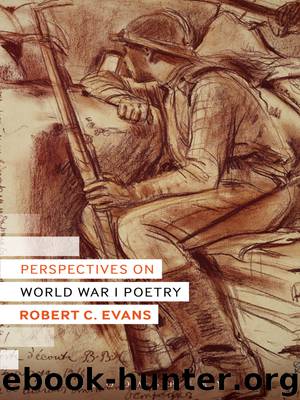
Author:Evans, Robert C.;
Language: eng
Format: epub
ISBN: 1637121
Publisher: Bloomsbury Publishing
Published: 2014-03-14T16:00:00+00:00
Teresa Hooley (1888–1973): “A war film”
A WAR FILM
I saw,
With a catch of the breath and the heart’s uplifting,
Sorrow and pride,
The “week’s great draw”—
The Mons Retreat; [5]
The “Old Contemptibles” who fought, and died,
The horror and the anguish and the glory.
As in a dream,
Still hearing machine-guns rattle and shells scream,
I came out into the street. [10]
When the day was done,
My little son
Wondered at bath-time why I kissed him so,
Naked upon my knee.
How could he know [15]
The sudden terror that assaulted me? . . .
The body I had borne
Nine moons beneath my heart,
A part of me . . .
If, someday, [20]
It should be taken away
To war. Tortured. Torn.
Slain.
Rotting in No Man’s Land, out in the rain –
My little son . . . [25]
Yet all those men had mothers, every one.
How should he know
Why I kissed and kissed and kissed him, crooning his name?
He thought that I was daft.
He thought it was a game, [30]
And laughed, and laughed.
A critic influenced by HORACE, who emphasized the writer’s need to please an audience, might praise this poem for various reasons. This text, for instance, does use words appropriate to its subject matter, and it does arrange them clearly. It says “only what needs to be said,” and, especially in lines 22–3, it gives novelty to “familiar words by a skillful setting” (p. 52). Above all, it exemplifies Horace’s assertion that it “is not enough for poems to be beautiful; they must be affecting, and must lead the heart of the hearer as they will” (pp. 52–3). “If you wish me to weep,” he later writes, “you must first feel grief yourself” (p. 53). Hooley’s poem also marks “the characteristics of each period of life” and presents “what is fitting to the various natures and ages” of different persons—in this case the mature mother and the immature child (p. 53). The ideal poetic style, Horace maintains, should “mold familiar material with such skill that anyone might hope to achieve the same feat” (p. 55), and Hooley’s poem, with its simple diction and straightforward structure, clearly satisfies these criteria.
A THEMATIC critic, interested in how literary works emphasize (and are organized by) key ideas, might say that one major theme of Hooley’s lyric is the idea that different people perceive and interpret the same event from different viewpoints. This theme of varied perceptions is implied immediately, and indeed much of the rest of the poem deals with the speaker’s perceptions, which are clearly the most important perceptions the poem records and expresses. Right from the start the speaker’s reactions are complex, mingling “Sorrow and pride” (3), although as the poem develops sorrow is emphasized more than pride. Meanwhile, other persons’ perceptions are also implied: the owners of the theater see this filmed news about the war as “The ‘week’s great draw’” (4) that will attract paying customers, while the reference to the English army as “Contemptibles” (6) alludes to the German Kaiser’s dismissive perception of British forces. Yet those very forces proudly adopted the Kaiser’s term and nick-named themselves
Download
This site does not store any files on its server. We only index and link to content provided by other sites. Please contact the content providers to delete copyright contents if any and email us, we'll remove relevant links or contents immediately.
4 3 2 1: A Novel by Paul Auster(12360)
The handmaid's tale by Margaret Atwood(7739)
Giovanni's Room by James Baldwin(7309)
Asking the Right Questions: A Guide to Critical Thinking by M. Neil Browne & Stuart M. Keeley(5745)
Big Magic: Creative Living Beyond Fear by Elizabeth Gilbert(5733)
Ego Is the Enemy by Ryan Holiday(5400)
The Body: A Guide for Occupants by Bill Bryson(5067)
On Writing A Memoir of the Craft by Stephen King(4923)
Ken Follett - World without end by Ken Follett(4712)
Adulting by Kelly Williams Brown(4558)
Bluets by Maggie Nelson(4541)
Eat That Frog! by Brian Tracy(4507)
Guilty Pleasures by Laurell K Hamilton(4430)
The Poetry of Pablo Neruda by Pablo Neruda(4084)
Alive: The Story of the Andes Survivors by Piers Paul Read(4013)
White Noise - A Novel by Don DeLillo(3998)
Fingerprints of the Gods by Graham Hancock(3982)
The Book of Joy by Dalai Lama(3965)
The Bookshop by Penelope Fitzgerald(3833)
