Party of One by Chun Han Wong;
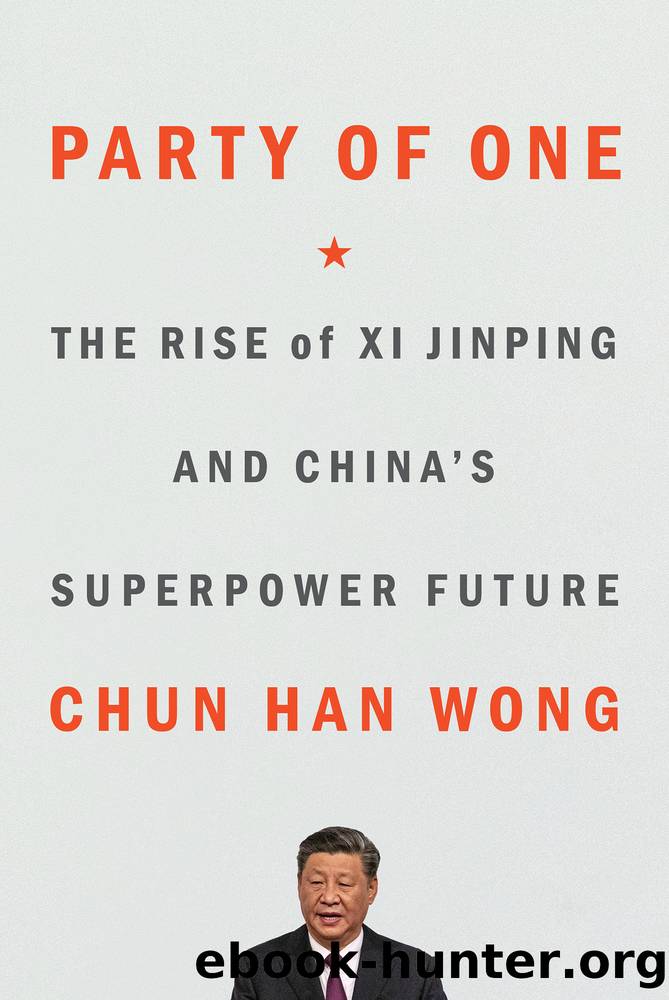
Author:Chun Han Wong;
Language: eng
Format: epub
Publisher: Simon & Schuster
Published: 2023-05-23T00:00:00+00:00
FIGHTING WORDS
THE PEOPLEâS REPUBLIC WAS BARELY a month old when its premier and foreign minister, Zhou Enlai, assembled the bulk of his newly constituted diplomatic corps to celebrate the birth of Communist Chinaâs foreign ministry. Some 170 people gathered that evening in November 1949 at the ministryâs new premises, an elegant European-style guesthouse in central Beijing that once hosted German royalty and the revered revolutionary Sun Yat-sen.17 Zhou had yet to meet many of his new charges, and the premier wanted to offer a personal welcome, and inspire them for the tasks ahead.18
These novice diplomats were a disparate bunchâlocal officials, university graduates, and peasant soldiers more comfortable with pulling triggers than pushing papers. Many hadnât traveled abroad before and couldnât speak any foreign language. But for Zhou, these were minor issues. Professional skills could be learned, but what every member of the foreign ministry must possess was the gumption to fight. âWe must seize the initiative, have no fear, and be confident,â Zhou told his audience. Echoing earlier remarks where he declared that âdiplomatic cadres are the Peopleâs Liberation Army in civilian dress,â the premier reiterated his demands for a combative spirit.19 âDiplomacy is the same as military affairs,â he said. âDiplomacy is just fighting with words.â20
This martial ethos would animate Chinese foreign policy throughout the Mao era, as the Communist government battled for legitimacy in a hostile world. Only nine states had recognized the Peopleâs Republic when Zhou spoke that November evening, with most countries still regarding Chiang Kai-shekâs Kuomintang regime as the rightful government of China.21 As the âcivilian armyâ of a fledgling nation-state, Zhou and his foreign ministry shouldered an existential mission: secure international backing for Maoâs revolution and keep foreign threats at bay.
The party picked military commanders to lead many of Chinaâs new embassies abroad, with twelve of Beijingâs first seventeen ambassadors drawn from senior PLA ranks.22 The aim, as one former diplomat explained, was to have these âambassador generalsâ apply their âstrategies, tactical ideas and experience in military and political struggles toward the practice of diplomatic struggle,â and ensure that âthe party and militaryâs fine traditions and style take root in the diplomatic corps.â23 The party also tapped PLA officers for key roles such as political counselors and military attachés, alongside civilian administrators and language specialists.24 They learned how to dress, dine, and dance, and attended lectures on politics, economics, and international law. Many turned to counterparts from fellow communist states like the Soviet Union and Poland for pointers on protocol and day-to-day embassy work.25
Zhou and his team soon proved their mettle. They held their own against the U.S., Britain, and France during postâKorean War talks in Geneva and won friends at the 1955 Bandung Conference, a landmark diplomatic assembly of twenty-nine Asian and African states that laid foundations for the Non-Aligned Movement. Zhouâs appeals for peaceful coexistence, mutual noninterference, and solidarity among developing nations persuaded more governments to recognize the Peopleâs Republic.
Maoâs radical campaigns and antagonism toward the post-Stalin Soviet Union threatened to unravel Zhouâs gains.
Download
This site does not store any files on its server. We only index and link to content provided by other sites. Please contact the content providers to delete copyright contents if any and email us, we'll remove relevant links or contents immediately.
| Arms Control | Diplomacy |
| Security | Trades & Tariffs |
| Treaties | African |
| Asian | Australian & Oceanian |
| Canadian | Caribbean & Latin American |
| European | Middle Eastern |
| Russian & Former Soviet Union |
The Secret History by Donna Tartt(19103)
The Social Justice Warrior Handbook by Lisa De Pasquale(12197)
Thirteen Reasons Why by Jay Asher(8919)
This Is How You Lose Her by Junot Diaz(6894)
Weapons of Math Destruction by Cathy O'Neil(6285)
Zero to One by Peter Thiel(5808)
Beartown by Fredrik Backman(5768)
The Myth of the Strong Leader by Archie Brown(5513)
The Fire Next Time by James Baldwin(5454)
How Democracies Die by Steven Levitsky & Daniel Ziblatt(5225)
Promise Me, Dad by Joe Biden(5157)
Stone's Rules by Roger Stone(5091)
A Higher Loyalty: Truth, Lies, and Leadership by James Comey(4967)
100 Deadly Skills by Clint Emerson(4932)
Rise and Kill First by Ronen Bergman(4797)
Secrecy World by Jake Bernstein(4756)
The David Icke Guide to the Global Conspiracy (and how to end it) by David Icke(4724)
The Farm by Tom Rob Smith(4517)
The Doomsday Machine by Daniel Ellsberg(4493)
