Pakistan: the Taliban, Al Qaeda, and the Rise of Terrorism by Topich William J.;
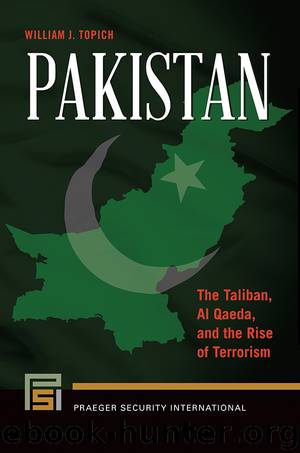
Author:Topich, William J.;
Language: eng
Format: epub
Publisher: ABC-CLIO, LLC
Published: 2018-05-10T16:00:00+00:00
The Demise of Militancy in the Swat Region
Further negotiations aimed at convincing the militants to vacate areas where they had consolidated control in, such as Swat, Buner, and Dir, proved unsuccessful. Alarm both within Pakistan and from abroad led to a policy change by the Musharraf regime. By April 2009, the Pakistani military decided to launch their most ambitious operation thus far. Civilians were evacuated in advance with approximately 2.5 million people leaving the area close to militant control (Khattak, 289–290).
In the subsequent fighting from April to July 2009, the Pakistani military achieved substantial gains across the region. Numerous Taliban commanders were killed, along with approximately 1,300 fighters. In addition, hundreds of militants were arrested, including Taliban spokesman Muslim Khan. A large storage depot of arms was discovered at the recently captured town of Piochar. The militants were forced to flee from virtually all of the captured territories. Local fighters took up arms against the militants in support of the Pakistani operation. In numerous towns, including Mingora, Kanjoo, Matta, Kalam, Manglawar, and Khwazakhela, the bodies of dead militants were left in plain sight as a warning to potential Taliban recruits. As 2009 progressed, the violence subsided but sporadic attacks and occasional suicide missions did occur.
By the end of 2009, it was apparent that a significant shift away from the Pakistani Taliban in Swat had taken place. The brutal tactics of the Taliban militants, including the targeting of civilians and public executions, played a role in turning the population against the extremists (Khattak, 306–308). Polling data gathered in the region stated that less than 10 percent of the population was in favor of a Taliban-style governing structure.
In addition, the Pakistani military made a more sincere effort to sweep the Taliban out of the region. This was really the first time that the government forces entered an area with few restrictions placed on them. The entire Swat region was attacked during the operation putting the militants on the defensive very quickly. Civilians were given fair warning and had the opportunity to clear out of the area prior to the launching of the full-scale military operations.
The Awami National Party took power in the region during 2008 and failed to secure any concessions from the Pakistani Taliban. This sign of weakness only emboldened the militants and may have made them overconfident. More daring attacks were staged, and high-profile operations were undertaken. The growing concern from the ANP gave the military a clear green light to take more aggressive action in the area.
Following the Pakistani military success in Swat, the remaining Pakistani Taliban leadership fled to neighboring Afghanistan to seek sanctuary. Fazlullah promised renewed military operations in the Swat region. Many of his commanders were killed in the operation or imprisoned. Once the region was firmly under government control, it was a return to the status quo. The regime continually neglects the region, failing to provide for the basic needs of the citizens. Education is underfunded and the economy is in shambles from several years of intense fighting (Yousafzai, 194–196).
Download
This site does not store any files on its server. We only index and link to content provided by other sites. Please contact the content providers to delete copyright contents if any and email us, we'll remove relevant links or contents immediately.
| Arms Control | Diplomacy |
| Security | Trades & Tariffs |
| Treaties | African |
| Asian | Australian & Oceanian |
| Canadian | Caribbean & Latin American |
| European | Middle Eastern |
| Russian & Former Soviet Union |
The Secret History by Donna Tartt(19058)
The Social Justice Warrior Handbook by Lisa De Pasquale(12187)
Thirteen Reasons Why by Jay Asher(8894)
This Is How You Lose Her by Junot Diaz(6877)
Weapons of Math Destruction by Cathy O'Neil(6267)
Zero to One by Peter Thiel(5789)
Beartown by Fredrik Backman(5737)
The Myth of the Strong Leader by Archie Brown(5500)
The Fire Next Time by James Baldwin(5432)
How Democracies Die by Steven Levitsky & Daniel Ziblatt(5216)
Promise Me, Dad by Joe Biden(5144)
Stone's Rules by Roger Stone(5081)
A Higher Loyalty: Truth, Lies, and Leadership by James Comey(4954)
100 Deadly Skills by Clint Emerson(4921)
Rise and Kill First by Ronen Bergman(4780)
Secrecy World by Jake Bernstein(4742)
The David Icke Guide to the Global Conspiracy (and how to end it) by David Icke(4709)
The Farm by Tom Rob Smith(4502)
The Doomsday Machine by Daniel Ellsberg(4485)
