Our Divided Political Heart by E. J. Dionne Jr & Michael Kramer
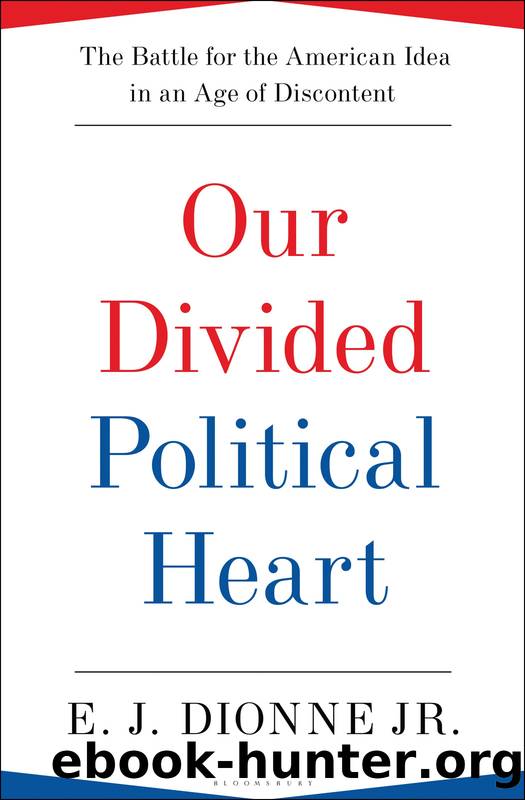
Author:E. J. Dionne Jr & Michael Kramer [Dionne, E. J. Jr & Kramer, Michael]
Language: eng
Format: epub
ISBN: 9781616578008
Publisher: Tantor Audio
Published: 2012-09-15T00:00:00+00:00
II
The great transformation of the Republicans from the party of national action to the party of statesâ rights and a restricted view of what the Constitution allows the federal government to achieve is simultaneously well known and underappreciated.
The partyâs shift toward conservatism is certainly a given in our discourse. Javits himself conceded as much when he acknowledged in his book how often he was asked: âIsnât it illogical for you to be a Republican?â Whatâs missed is how profound this shift in the Republican worldview actually was, how much of a break it represented from the partyâs history, and how radically the definition of what constitutes âconservatismâ had changed and narrowed. Liberal though he was in conventional terms, Javits was not wrong to insist that the conservativeâs task in politics always involves âexplaining why the complexities of existence stand in the way of utopian solutions to all problems, and why in so many hard cases the best we can hope for is a succession of provisional compromises or accommodations, subject to change as circumstances change.â This is the conservatism of prudence and complexity that acknowledges human imperfection.
But I have offered Javits his say here for a larger reason. By emphasizing the ideas of Hamilton and Clay and their role in the early American story, his account underscores the flaws in currently popular historical understandings. Those understandings go something like this: The United States spent its first century or so after the Founding as a nation in which the federal government played an exceedingly limited role in public life. The Constitution was read as placing severe limits on government action. Economic life was left in the hands of individuals and entrepreneurs. Government âgot out of the wayâ and let the market operate freely in a nation where individualism was the single, dominant American characteristic.
According to this view, it was only during the Progressive Era administrations of Theodore Roosevelt and Woodrow Wilsonâand then, more dramatically, under Franklin Rooseveltâs New Dealâthat the federal government became an active player in American economic life. And it was only with the Supreme Court decisions of the later New Deal years and after that this rapid growth of government was sanctioned as constitutional. Not for nothing have judicial conservatives spoken of âthe Constitution in exile,â by which they mean the Constitution as it was understood before New Deal jurisprudence opened the way for federal power to exert itself.
As in most conventional accounts, this one is based on certain important truths. The Progressive and New Deal Eras were breakthroughs, as I will be arguing later. Progressives signaled this when they amended the Constitution to allow for an income tax, to provide for the direct popular election of senatorsâoverturning the system of elections by state legislatures that was both elitist and deferential to statesâ rightsâand also by extending the right to vote to women. The FDR years changed the country profoundly as the federal government assumed a much larger role in regulating the workings of banking and commerce and the relations between employers and employees.
Download
This site does not store any files on its server. We only index and link to content provided by other sites. Please contact the content providers to delete copyright contents if any and email us, we'll remove relevant links or contents immediately.
| Anthropology | Archaeology |
| Philosophy | Politics & Government |
| Social Sciences | Sociology |
| Women's Studies |
The Secret History by Donna Tartt(19477)
The Social Justice Warrior Handbook by Lisa De Pasquale(12297)
Thirteen Reasons Why by Jay Asher(9130)
This Is How You Lose Her by Junot Diaz(7060)
Weapons of Math Destruction by Cathy O'Neil(6482)
Zero to One by Peter Thiel(5953)
Beartown by Fredrik Backman(5950)
The Myth of the Strong Leader by Archie Brown(5631)
The Fire Next Time by James Baldwin(5592)
How Democracies Die by Steven Levitsky & Daniel Ziblatt(5333)
Promise Me, Dad by Joe Biden(5237)
Stone's Rules by Roger Stone(5196)
A Higher Loyalty: Truth, Lies, and Leadership by James Comey(5092)
100 Deadly Skills by Clint Emerson(5032)
Rise and Kill First by Ronen Bergman(4907)
Secrecy World by Jake Bernstein(4892)
The David Icke Guide to the Global Conspiracy (and how to end it) by David Icke(4854)
The Doomsday Machine by Daniel Ellsberg(4627)
The Farm by Tom Rob Smith(4614)
