On Their Own by Goebel Allison;
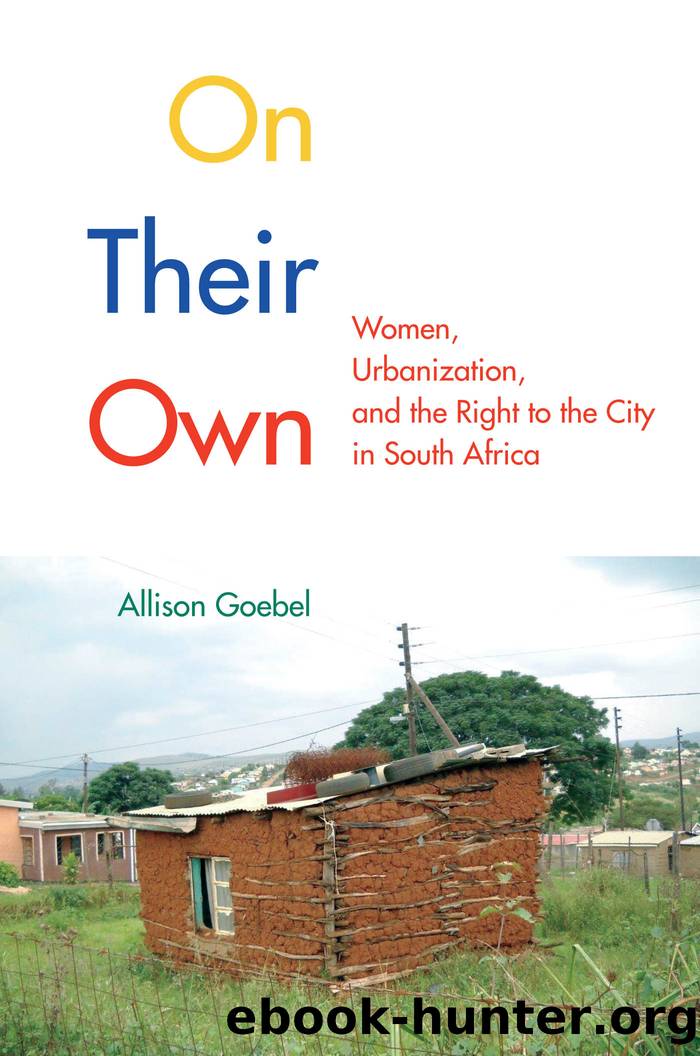
Author:Goebel, Allison;
Language: eng
Format: epub
Publisher: McGill-Queen's University Press
Published: 2015-08-15T00:00:00+00:00
CONCLUSIONS
This discussion leads to a qualified acknowledgement of some positive outcomes for women and gender justice under a rights framework in South Africa, but also a recognition of the powerful social and cultural currents that hamper full achievement and recognition of women as equal rights bearing citizens. The effect of programs such as housing subsidies and social welfare, while addressing constitutional rights, also work to reduce women to their roles as mothers and care givers, compromising their position as full and equal persons. The state is also hampered by neoliberal pressures under globalization in its ability to deliver on its constitutional obligations. Rights are indeed an incomplete vehicle to address the âcomplexities that these conditions create for womenâ (Gouws 2005a, 2). While women are recognized, or âseenâ by the state in some of their difference and their particular needs, the kind of citizenship produced through the major mechanisms of connection between women and the state (housing subsidy and welfare) move the discourse from ârightsâ to âneeds.â This system produces women primarily as âthe vulnerableâ and the needy, not as rights bearing citizens actively engaging in their own transformation and empowerment. In Fergusonâs terms, women may be viewed more as clients of state dispensing patronage under African communitarian values than as rights-bearing citizens (Ferguson 2013).
Despite these critiques, few scholars (or activists) are prepared to abandon rights as a strategy or as an aspect of citizenship. Wendy Brown, writing about feminist rights in the United States, emphasizes that rights claims are one of the most powerful discourses in the liberal democratic imagination. Rights claims are deeply problematic and contradictory, and âalmost always serve as a mitigation -- but not a resolution -- of subordinating powersâ and âvanquish neither the regime nor its mechanisms of reproductionâ (Brown 2002, 422). Further, rights specified to women in North America have often fenced them in as defined by their subordinated status, and while offering some protection, usually do not âenable the escape of the subordinated from the site of that violationâ (ibid.). Nevertheless, rights offer something irresistible. Borrowing from Gayatri Spivak, Brown indicates that even within the limits of equality rights, âwe cannot not wantâ them (421). Rights constitute the language of liberal democracy, an imperfect and incomplete means through which injustice can be made visible: âRights function to articulate a need, a condition of lack or injury, that cannot be fully redressed or transformed by rights, yet within existing political discourse can be signified in no other wayâ (431).
Similarly, returning to the South African context, Desai acknowledges that âthere would be little civic resistance at all today in South Africa if it was not for expectations of dignity, human rights and a dignified lifeâ (2002, 146). As Ballard et al. point out, âacknowledging second-generation rights in the constitution allows for material gains to be constructed as rightsâ (2006a, 17). Zuern (2011) also points out that most community based protests in South Africa focus on material needs, or socioeconomic rights. Thus, while rights-based discourses are of
Download
This site does not store any files on its server. We only index and link to content provided by other sites. Please contact the content providers to delete copyright contents if any and email us, we'll remove relevant links or contents immediately.
| Anthropology | Archaeology |
| Philosophy | Politics & Government |
| Social Sciences | Sociology |
| Women's Studies |
The Secret History by Donna Tartt(19088)
The Social Justice Warrior Handbook by Lisa De Pasquale(12190)
Thirteen Reasons Why by Jay Asher(8910)
This Is How You Lose Her by Junot Diaz(6887)
Weapons of Math Destruction by Cathy O'Neil(6280)
Zero to One by Peter Thiel(5802)
Beartown by Fredrik Backman(5754)
The Myth of the Strong Leader by Archie Brown(5508)
The Fire Next Time by James Baldwin(5446)
How Democracies Die by Steven Levitsky & Daniel Ziblatt(5219)
Promise Me, Dad by Joe Biden(5153)
Stone's Rules by Roger Stone(5088)
A Higher Loyalty: Truth, Lies, and Leadership by James Comey(4964)
100 Deadly Skills by Clint Emerson(4925)
Rise and Kill First by Ronen Bergman(4789)
Secrecy World by Jake Bernstein(4753)
The David Icke Guide to the Global Conspiracy (and how to end it) by David Icke(4720)
The Farm by Tom Rob Smith(4513)
The Doomsday Machine by Daniel Ellsberg(4490)
