On power, its nature and the history of its growth; by Jouvenel Bertrand de 1903-1987
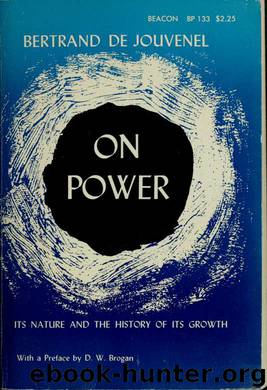
Author:Jouvenel, Bertrand de, 1903-1987
Language: eng
Format: epub
Tags: Authority, State, The
Publisher: Boston, Beacon
Published: 1962-01-05T16:00:00+00:00
of books and speeches, irony and argument, about politics. Qui learned men, with infinite care and subtlety, have constructed genealogical trees for the ideas of the century down to their final flowering. They make stimulating studies. For the elucidation of history, however, it is less important to listen to what men say than to observe what they do.*
Action in politics is in the last resort administration. Let who will open the administrative dossiers from the reign of Louis XIV to that of Napoleon. The continuity of Power will then strike his eye; the obstacles which it encountered and the true direction of events will then stand revealed.
The officials of the monarchy had one constant policy: that of Richelieu and Mazarin; it consisted of the struggle, going back to Louis XI, against the House of Habsburg. The deep-laid schemes of Mazarin, adapted and realized by Louis XIV, had driven the Habsburgs from the throne of Spain. In both Spain and Italy Bourbons were installed in the place of Austrian princes. Vienna still had to be opposed, not from need to destroy a state that was no longer dangerous, but because, in opposing her, France became the natural rallying-point of the German princes, who feared the Emperor, and in that way not only prevented the union of Germany under the Habsburgs, who were no longer formidable, but also and above all its crystallization around an internal centre of resistance, Prussia, which would, it was certain, fill the role of protector from the moment that France abandoned it.
In that policy, as simple as it was far-sighted, the French officials never wavered. But they could not maintain it, because noble wirepullers, having made their way into the employments of ambassador and minister, worked against French policy, whether because vanity made them want to cut a figure or because, as in the case of Choiseul, they made of a foreign court a rallying-point for the defence of themselves and their faction against the incessant intrigues of Versailles.
If Marie Antoinette was hated as was no other queen of France before her, the main reason for it certainly was that she represented the Austrian alliance, which had brought on France the disasters of
* "We cannot," said Dr. Johnson, "pry into the hearts of men, but then-actions are open to observation."
Download
This site does not store any files on its server. We only index and link to content provided by other sites. Please contact the content providers to delete copyright contents if any and email us, we'll remove relevant links or contents immediately.
The Secret History by Donna Tartt(19053)
The Social Justice Warrior Handbook by Lisa De Pasquale(12187)
Thirteen Reasons Why by Jay Asher(8893)
This Is How You Lose Her by Junot Diaz(6877)
Weapons of Math Destruction by Cathy O'Neil(6265)
Zero to One by Peter Thiel(5787)
Beartown by Fredrik Backman(5737)
The Myth of the Strong Leader by Archie Brown(5500)
The Fire Next Time by James Baldwin(5431)
How Democracies Die by Steven Levitsky & Daniel Ziblatt(5215)
Promise Me, Dad by Joe Biden(5141)
Stone's Rules by Roger Stone(5081)
A Higher Loyalty: Truth, Lies, and Leadership by James Comey(4954)
100 Deadly Skills by Clint Emerson(4921)
Rise and Kill First by Ronen Bergman(4780)
Secrecy World by Jake Bernstein(4741)
The David Icke Guide to the Global Conspiracy (and how to end it) by David Icke(4709)
The Farm by Tom Rob Smith(4502)
The Doomsday Machine by Daniel Ellsberg(4484)
