Occupy Pynchon by Carswell Sean;
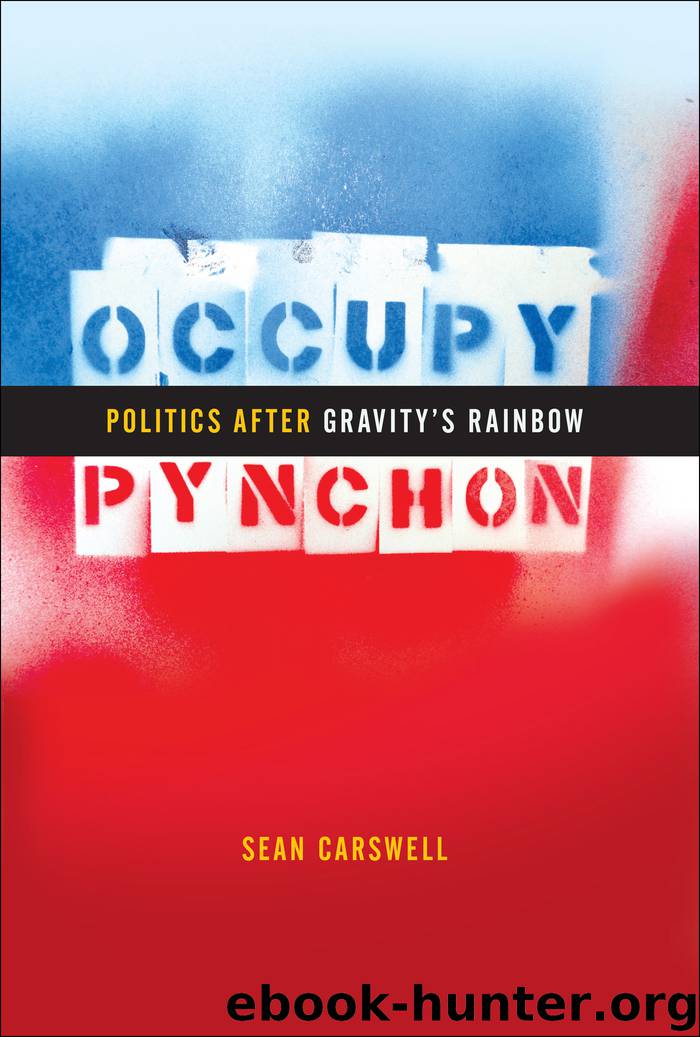
Author:Carswell, Sean;
Language: eng
Format: epub
Publisher: University of Georgia Press
Published: 2017-05-24T16:00:00+00:00
If Wall Street Is the 1 Percent, We’re Everybody Else
Pynchon’s act of situating the climax of the gunplay around the coal miners’ strike in Ludlow in 1913 and 1914 is significant, also. Pynchon’s representation of the events in Ludlow is faithful to the historical event. He employs the names of real people who were active in the event. His dates, places, and basic summary of actions all adhere fairly closely to the historical record. In Ludlow, Colorado, during what Howard Zinn described as “perhaps the most violent struggle between corporate power and laboring men in American history” (“The Ludlow Massacre” 184), coal miners were forced to engage in violent resistance when hired gunmen operating under the auspices of the National Guard attacked.6 Pynchon clearly takes sides in this shootout. When Jesse Traverse and his friend meet the hired gunmen face-to-face, the narrator describes the boys recognizing in the gunmen “a level of evil neither boy had quite suspected in adults till now” (1010). The lieutenant in charge of the hired gunmen is described as a man “with a high forehead, lidless long eyes and mouth in a slit, a lizard’s face” (1013). One of the miners declares the lieutenant to be “the devil” (1013). Contrasting these portrayals of the gunmen as villains, Pynchon represents the miners who shot back at the gunmen not only sympathetically but heroically. Nonetheless, Stray and Jesse, then later Frank, all must flee the scene of the strike when they are outnumbered by the corporate army and without hope of anything resembling a victory. As it is portrayed in the novel, the historical event at Ludlow ended poorly. The strike was called off without the coal miners’ union gaining recognition. Several strikers, their wives, and their children were murdered. Neither Rockefeller nor any of his hired gunmen were ever convicted of a crime. The event is known to history—through what little representation it receives in traditional histories—as the Ludlow Massacre. It was a massacre. Pynchon’s choice to situate this historical event as the climax for Traverse gunplay reinforces the idea that Pynchon’s revolutionaries articulated in Vineland: if you cannot match Empire’s armies with equitable, regimental strength, then it is best to find another path of resistance.
Howard Zinn’s conclusion in his historical essay on Ludlow brings this argument back to the original concept of bilocation. Zinn argues, “If [the Ludlow Massacre] is read as a commentary on larger questions—the relationship of government to corporate power and of both to movements of social protest—then we are dealing with the present” (201). The history of the Ludlow Massacre can live in both places—it can bilocate—because it both is and is not commensurate with the present.7 For example, nineteenth-century liberalism has distinctive differences from twenty-first-century neoliberalism. The economic liberalism that Polanyi describes in The Great Transformation is characterized by an almost religious faith in unregulated markets. Contemporary neoliberals do not seem to share this faith. As David Harvey demonstrates, contemporary neoliberals continue to preach this faith in unregulated markets and the “freedom” that accompanies them.
Download
This site does not store any files on its server. We only index and link to content provided by other sites. Please contact the content providers to delete copyright contents if any and email us, we'll remove relevant links or contents immediately.
| African | Asian |
| Australian & Oceanian | Canadian |
| Caribbean & Latin American | European |
| Jewish | Middle Eastern |
| Russian | United States |
4 3 2 1: A Novel by Paul Auster(12629)
The handmaid's tale by Margaret Atwood(7925)
Giovanni's Room by James Baldwin(7576)
Big Magic: Creative Living Beyond Fear by Elizabeth Gilbert(5911)
Asking the Right Questions: A Guide to Critical Thinking by M. Neil Browne & Stuart M. Keeley(5901)
Ego Is the Enemy by Ryan Holiday(5645)
The Body: A Guide for Occupants by Bill Bryson(5313)
On Writing A Memoir of the Craft by Stephen King(5065)
Ken Follett - World without end by Ken Follett(4888)
Eat That Frog! by Brian Tracy(4699)
Adulting by Kelly Williams Brown(4698)
Bluets by Maggie Nelson(4696)
Guilty Pleasures by Laurell K Hamilton(4579)
The Poetry of Pablo Neruda by Pablo Neruda(4244)
Alive: The Story of the Andes Survivors by Piers Paul Read(4157)
The Book of Joy by Dalai Lama(4126)
Fingerprints of the Gods by Graham Hancock(4120)
White Noise - A Novel by Don DeLillo(4100)
The Bookshop by Penelope Fitzgerald(3964)
