Nuclear Decisions by Lisa Langdon Koch;
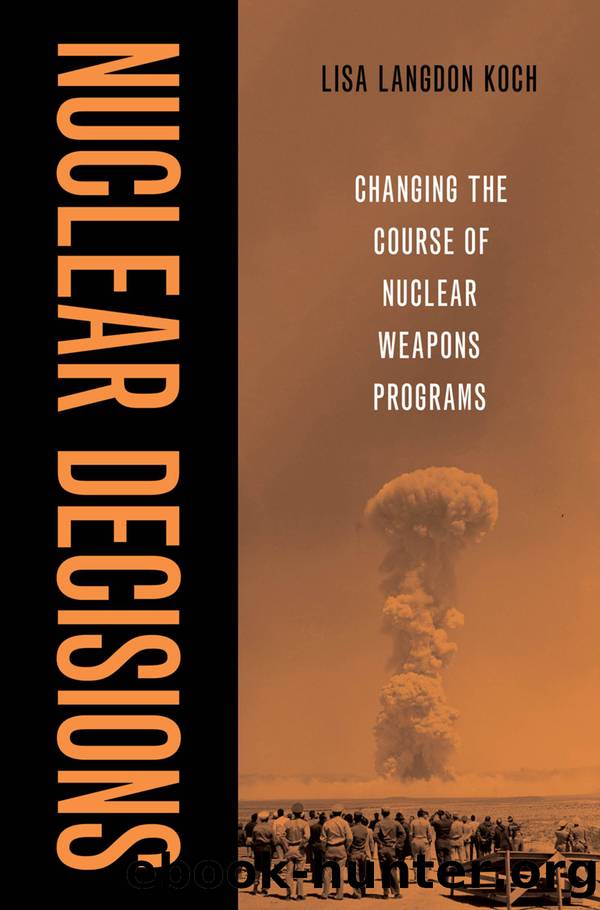
Author:Lisa Langdon Koch;
Language: eng
Format: epub, pdf
Publisher: Oxford University Press USA
Published: 2023-06-15T00:00:00+00:00
The nuclear organization had failed to produce civilian power as quickly and inexpensively as it had promised, and the nuclear budget was facing cuts. A political decision to proceed toward a test would revitalize the program and further scientific progress and discovery. The nuclear organization was able to influence Gandhi in part because Gandhi herself sought out the advice of director Raja Ramanna, whom she highly trusted.114
Indiaâs military, on the other hand, played no role in shaping Gandhiâs perceptions about the value of nuclear testing. Indeed, the military had been kept out of the nuclear program from the start. When India had achieved independence from Great Britain and established national domestic institutions, the military had been deliberately excluded from national security decision-making. Nehru had feared that the rise of a powerful Indian military would pose a threat to governance and made sure the military organization would be politically disempowered, even during armed conflicts. Civilians made decisions about defense policy and military strategy, and the military was given no political or institutional avenue by which to attempt to influence state decision-making.115 And the AEC had no reason to invite the military in, preferring to maintain sole control over the nuclear program.116
If the military had been able to offer advice, what would it have been? First, at the time the Indian military was generally skeptical of the nuclear scientistsâ ability to develop nuclear weapons.117 Second, Stephen Cohen argued that the Indian military of the 1970s saw the nuclear weapons program as âinstitutionally disruptive.â118 Officers worried about the impact the introduction of a nuclear arsenal would have on conventional war strategy and targeting. Both the army and the air force were concerned that a nuclear weapons program would be funded at the expense of conventional weapons systems, which they saw as more important to Indian security.119 Yogesh Joshi confirms this, citing a document showing that even in the immediate wake of Indiaâs PNE, military advisers, in assessing the threat to India, still argued that conventional missiles, not nuclear weapons, would dominate the future battlefield.120 The Indian military was more concerned with planning for the likely scenario of conventional conflict with Pakistan rather than the unlikely possibility of nuclear conflict with, or a surprise invasion from, China.121
Indiaâs precarious security environment led the military not to prefer investing in nuclear weapons but to prefer stability and continuity as the best way to see India through a dangerous time. However, Gandhi did not seek out the militaryâs preferences and had no discussion with her Ministry of Foreign Affairs about security or diplomatic concerns. In 1974 Gandhi and the scientists made the decision to proceed with the test.122 In the aftermath of the PNE, Gandhi enjoyed a brief boost in popularity at home but faced strong international backlash. The PNE constituted a shock to the emerging nonproliferation regime and demonstrated the importance of international safeguards; recall that the plutonium for the PNE had come from unsafeguarded Canadian reactor technology supplied with unsafeguarded American heavy water. The United States and Canada cut off all nuclear cooperation with India.
Download
This site does not store any files on its server. We only index and link to content provided by other sites. Please contact the content providers to delete copyright contents if any and email us, we'll remove relevant links or contents immediately.
| Arms Control | Diplomacy |
| Security | Trades & Tariffs |
| Treaties | African |
| Asian | Australian & Oceanian |
| Canadian | Caribbean & Latin American |
| European | Middle Eastern |
| Russian & Former Soviet Union |
The Secret History by Donna Tartt(19090)
The Social Justice Warrior Handbook by Lisa De Pasquale(12190)
Thirteen Reasons Why by Jay Asher(8912)
This Is How You Lose Her by Junot Diaz(6887)
Weapons of Math Destruction by Cathy O'Neil(6281)
Zero to One by Peter Thiel(5802)
Beartown by Fredrik Backman(5755)
The Myth of the Strong Leader by Archie Brown(5508)
The Fire Next Time by James Baldwin(5447)
How Democracies Die by Steven Levitsky & Daniel Ziblatt(5219)
Promise Me, Dad by Joe Biden(5154)
Stone's Rules by Roger Stone(5088)
A Higher Loyalty: Truth, Lies, and Leadership by James Comey(4964)
100 Deadly Skills by Clint Emerson(4926)
Rise and Kill First by Ronen Bergman(4789)
Secrecy World by Jake Bernstein(4753)
The David Icke Guide to the Global Conspiracy (and how to end it) by David Icke(4720)
The Farm by Tom Rob Smith(4514)
The Doomsday Machine by Daniel Ellsberg(4490)
