Not Quite Adults: Why 20-Somethings Are Choosing a Slower Path to Adulthood, and Why It’s Good for Everyone by Settersten Richard; Ray Barbara E
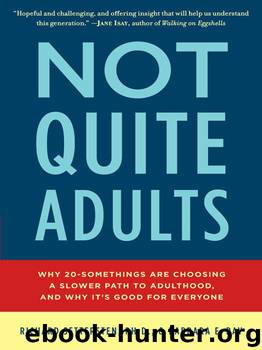
Author:Settersten, Richard; Ray, Barbara E. [Settersten, Richard; Ray, Barbara E.]
Language: eng
Format: epub
Publisher: Bantam
Published: 2010-12-28T05:00:00+00:00
Communities of Like Minds
As school is extended and marriage and parenting are delayed, friends have become more prominent, and for a longer time, in the lives of young people. Therefore, the role of social networks has gained more importance. In the not-so-distant past, some of life’s biggest decisions were made across the dinner table from a spouse. Today, those decisions are more often being made in the company of friends, across the table in a café. To get a handle on this change, consider this. In 1980, about 40 percent of twenty-somethings were married between ages twenty and twenty-four. Today, half as many young adults are married at that age.1 Likewise, the number of young people living on their own or with roommates, and not with their parents, has skyrocketed. In 1970, only about 16 percent of young adults ages twenty through twenty-nine were never married and living on their own. Today, the figure has just about doubled.2 As the sitcoms have so aptly recorded with each passing decade, we’ve moved from Father Knows Best to All in the Family to Friends, Sex and the City, and Entourage.
Craig, a twenty-seven-year-old New Yorker working on his master’s degree, captures this shift in his description of a perfect weekend. “I’d play sports,” he says, “go out to drink some beers, maybe go out to dance, have a fun time. Sunday I get up at eight in the morning and I go to play baseball till like one o’clock. That’s basically my free time. Since I got into grad school, I picked up sailing, surfing, golfing. Recently I’ve been going golfing almost every day.” No wife, no children, no obligations other than graduate school. Until the 1980s, there would have been all three. The median age when women have their first child has risen dramatically over the past few decades, and the share of women who are childless at age thirty has risen significantly as well. Among those who turned thirty in 1984, only about 15 to 18 percent of women of all racial and ethnic groups were childless. In 2000, nearly 50 percent of white women and 25 percent of black and Hispanic women were childless at age thirty. Just twenty years ago, a man like Craig would be spending his weekends with his wife and kids. Instead, Craig hangs out with his friends.
Friends take center stage for other reasons as well. Many young adults have also just come out of one of the most intensely social periods of life, especially if they were in college or the military. Dorms, platoons, and foxholes—all these factors contribute to bonding and strong friendships. Young adults are also more mobile. Unencumbered by family and responsibilities, they can pack up and move across country or to new cities for jobs and a new start in life. Once there, they must make an effort to meet new people—and they do.
To Mia, her loose networks of friends work perfectly for her at this time in her life. At
Download
This site does not store any files on its server. We only index and link to content provided by other sites. Please contact the content providers to delete copyright contents if any and email us, we'll remove relevant links or contents immediately.
Doing It: Let's Talk About Sex... by Hannah Witton(9275)
Thirteen Reasons Why by Jay Asher(8893)
The Girl Without a Voice by Casey Watson(7885)
The Incest Diary by Anonymous(7681)
Should I Stay or Should I Go? by Ramani Durvasula(7654)
The Lost Art of Listening by Michael P. Nichols(7494)
The Leavers by Lisa Ko(6945)
The Space Between by Michelle L. Teichman(6929)
The Testaments by Margaret Atwood(6881)
The Four Agreements by Don Miguel Ruiz(6744)
Rich Dad Poor Dad by Robert T. Kiyosaki(6612)
The Rosie Project by Graeme Simsion(6378)
Beartown by Fredrik Backman(5737)
We Need to Talk by Celeste Headlee(5608)
Ego Is the Enemy by Ryan Holiday(5414)
Men In Love by Nancy Friday(5234)
Spare by Prince Harry The Duke of Sussex(5176)
Hunger by Roxane Gay(4922)
Suicide Notes by Michael Thomas Ford(4822)
