New Trends in Development Theory by Preston Peter;
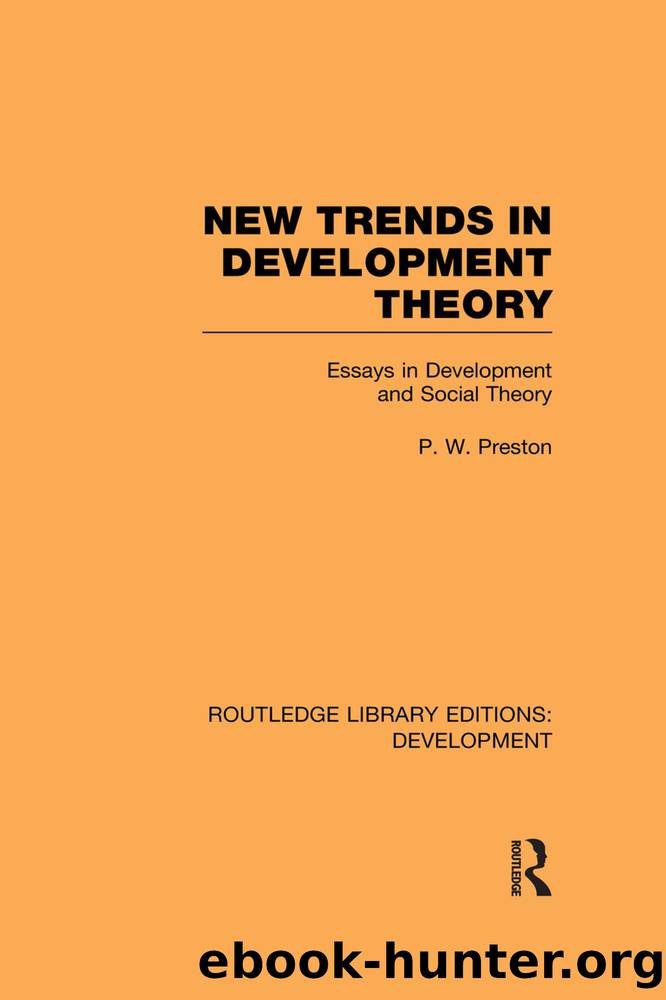
Author:Preston, Peter; [Preston, P. W.]
Language: eng
Format: epub
Publisher: Taylor & Francis Group
Published: 2022-08-15T00:00:00+00:00
3.2
I want to return now to the consideration of material drawn from my studies in the history of theories of development and to the business of presenting 'heuristic strategies' for ranking ideologies. In this section I offer an extended ranking scheme derived from reflections upon social theorizing taken as ideology construction.
If the production of delimited-formal ideologies is taken as the prime case of social theorizing, it is clear that there is much that could be said about the production process. Elsewhere31 I have argued that any exercise in ideology construction can be regarded as involving the deployment of a morally informed categorial frame: which procedure properly moves from the rationalist conceived 'general' to some set of empirically relevant 'particulars'. The resultant product can then be analysed in terms of conception and intent. So I have two complementary approaches to reflection upon the character of delimited-formal schemes. The former line is how I have argued that ideologies are constructed, and the latter line is how I have said that completed, extant, schemes can be analysed.
I want now simply to juxtapose these two approaches and try to extend the strategy used for analysing completed products. Thus as regards 'conception' I ask how this notion can be extended in light of the slogan presented in respect of construction - deployment of a morally informed categorial frame. Similarly I can ask how the notion of intent might be extended. In addition to these two lines of analytical commentary it should also be noted that as ideologies are here taken to be exercises in argument construction, then the usual rules of intellectual discourse hold. The upshot of this attempt to refine the analytical power of an approach derived from a simple sociology of knowledge can be presented, in line with my remarks about the scheme's heuristic status, as a check list.
This check list involves three main elements: the matter of conception, the matter of intention and the business of the exchange between the two. These we can now review.
(1) As regards conception it can be asked whether or not the product in question displays 'reflexive consistency' in the crafting of argument. Briefly, is the scheme being considered actually acknowledged by its authors to be an ideology? There seem to be three readily identifiable sorts of 'reflexive consistency'. In addition there is the business of consistency ordinarily understood.
(a) Reflexive consistency I (Internal). Here we can ask: Does the product in question acknowledge its own value engagement? Is there, in the text, a routine demonstration of an awareness of social theorizing as issuing in value-suffused products? It can be noted both that claims to the status of 'objectivity', taken as displayed by the natural sciences, are simply fatuous and similarly that pro-forma declarations are unsatisfactory. I have already said, following Bernstein, that Mannheimian-style claims to the relativity of value informed schemas are unacceptable.
(b) Reflexive consistency II (External). Here we ask: Does the stance in question specify an agent of theory execution whereby the effort can latch onto
Download
This site does not store any files on its server. We only index and link to content provided by other sites. Please contact the content providers to delete copyright contents if any and email us, we'll remove relevant links or contents immediately.
| Anthropology | Archaeology |
| Philosophy | Politics & Government |
| Social Sciences | Sociology |
| Women's Studies |
The Secret History by Donna Tartt(19088)
The Social Justice Warrior Handbook by Lisa De Pasquale(12190)
Thirteen Reasons Why by Jay Asher(8910)
This Is How You Lose Her by Junot Diaz(6887)
Weapons of Math Destruction by Cathy O'Neil(6280)
Zero to One by Peter Thiel(5802)
Beartown by Fredrik Backman(5754)
The Myth of the Strong Leader by Archie Brown(5507)
The Fire Next Time by James Baldwin(5445)
How Democracies Die by Steven Levitsky & Daniel Ziblatt(5218)
Promise Me, Dad by Joe Biden(5153)
Stone's Rules by Roger Stone(5088)
A Higher Loyalty: Truth, Lies, and Leadership by James Comey(4964)
100 Deadly Skills by Clint Emerson(4925)
Rise and Kill First by Ronen Bergman(4789)
Secrecy World by Jake Bernstein(4753)
The David Icke Guide to the Global Conspiracy (and how to end it) by David Icke(4719)
The Farm by Tom Rob Smith(4509)
The Doomsday Machine by Daniel Ellsberg(4490)
