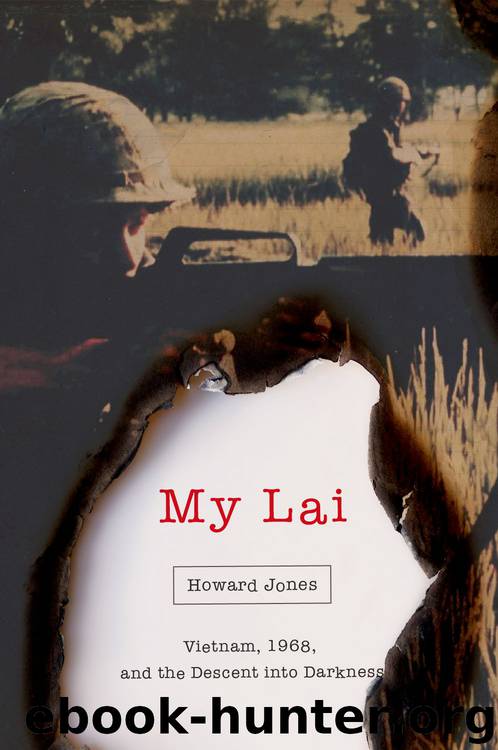
My Lai: Vietnam, 1968, and the Descent Into Darkness (Pivotal Moments in American History) by Howard Jones
Author:Howard Jones
Language: eng
Format: epub
ISBN: 9780190228781
Publisher: Oxford University Press
Published: 2017-06-01T23:00:00+00:00
V
In mid-February 1970, Peers sent a preliminary summary of the panel’s findings to Secretary Resor and General Westmoreland. He had hoped to lighten the shock of the revelations, but in explaining what happened at My Lai 4 and My Khe 4, he admitted to using “abrupt and brutal terms” that hit Resor “like a bolt out of the blue.” The Secretary of the Army did not want to either diminish the tragedy or manipulate the final report released to the public, but he hoped to soften its language. Instead of referring to the victims as elderly men, women, children, and babies, could he say “noncombatant casualties”? Might he also be less graphic in describing the rapes?74
After making numerous revisions, the Peers commission beat the March 15 expiration of the statute of limitations by one day when it submitted The Report of the Investigation (known as the Peers Report) as the first of four volumes of its work to the army. The last three volumes of the collection, titled The Report of the Department of the Army Review of the Preliminary Investigations into the My Lai Incident, were not yet available for public perusal, but CID could use them in its ongoing investigation.75
On the eve of the press conference set for the morning of March 17 to announce the conclusions of the Peers Inquiry, the Pentagon raised an objection to the use of the term “massacre” in Peers’s prepared statement. Peers resisted. As he explained in his own account years afterward, “I was not about to present a watered-down version and in effect said that if that was what they wanted, please leave me out.” Less than a half hour prior to the conference, however, he reluctantly agreed to replace “massacre” with “a tragedy of major proportions.”76
The Pentagon press conference began with Peers, Robert MacCrate, and Jerome Walsh seated behind a table while Resor opened the proceedings, with Westmoreland standing beside him, all of them facing a sea of cameras and newspeople jammed into the room. The army had distributed copies of the 225-page final report, extensively censored to protect the legal rights of the defendants.77
After Resor furnished background on the formation of the commission, he noted that The Report of the Investigation contained some “minor deletions.” Everything was there except the footnotes referring primarily to the contents of volumes 2 and 4, which were not yet released.78
Resor then introduced Peers, who briefly summed up the inquiry’s work before taking questions.
One of the first questions, of course, involved the central task of the commission from the beginning. Was there a cover-up at higher levels? “No,” Peers replied. He explained that the panel had collected sufficient “testimony and evidence to indicate that certain individuals, either wittingly or unwittingly, by their actions, suppressed information from the incident” and kept it from passing up the chain of command. Ordinary daily reports went all the way up the command ladder—even to the National Military Command Center in the Pentagon—but “as for the knowledge of what
Download
This site does not store any files on its server. We only index and link to content provided by other sites. Please contact the content providers to delete copyright contents if any and email us, we'll remove relevant links or contents immediately.
| Anthropology | Archaeology |
| Philosophy | Politics & Government |
| Social Sciences | Sociology |
| Women's Studies |
The Secret History by Donna Tartt(19098)
The Social Justice Warrior Handbook by Lisa De Pasquale(12195)
Thirteen Reasons Why by Jay Asher(8917)
This Is How You Lose Her by Junot Diaz(6892)
Weapons of Math Destruction by Cathy O'Neil(6283)
Zero to One by Peter Thiel(5806)
Beartown by Fredrik Backman(5764)
The Myth of the Strong Leader by Archie Brown(5511)
The Fire Next Time by James Baldwin(5452)
How Democracies Die by Steven Levitsky & Daniel Ziblatt(5223)
Promise Me, Dad by Joe Biden(5156)
Stone's Rules by Roger Stone(5089)
A Higher Loyalty: Truth, Lies, and Leadership by James Comey(4965)
100 Deadly Skills by Clint Emerson(4929)
Rise and Kill First by Ronen Bergman(4796)
Secrecy World by Jake Bernstein(4755)
The David Icke Guide to the Global Conspiracy (and how to end it) by David Icke(4721)
The Farm by Tom Rob Smith(4516)
The Doomsday Machine by Daniel Ellsberg(4492)
