Mongolia's Economic Prospects by Helble Matthias;Hill Hal;Magee Declan;
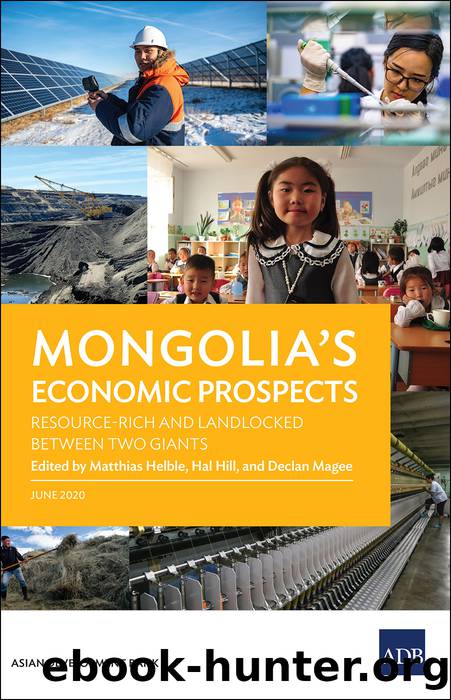
Author:Helble, Matthias;Hill, Hal;Magee, Declan;
Language: eng
Format: epub
Publisher: Asian Development Bank Institute
Published: 2020-06-01T00:00:00+00:00
Coordination failures, public goods, property rights, and the role of government
As is widely acknowledged, one of Mongoliaâs advantages is its natural and agricultural resources from which companies are able to produce high-quality products. Many of the countryâs export products play on the theme of being exclusive, natural, and organic. These include organic cashmere and wool; herbal and natural skincare products; and organic food and beverages, such as raw honey, berry juices, and preserves. Promoting this theme globally can help Mongolian companies export. Because of the âpublic goodâ nature of this type of promotion, it should be undertaken by the government or nongovernment public entities, such as chambers of commerce and industry associations. The scattered efforts by individual companies, especially small firms, to advertise themselves as exclusive are both unlikely be effective and constitute a coordination failure. An âumbrellaâ type of promotion with government support will help smaller businesses, which are often excluded from fairs and other promotional events on cost grounds.
Similarly, individual exporters who use foreign laboratories to test their products incur onerous costs. Larger companies, such as the beverage company, can afford the costs, but the high costs of testing and meeting international standards still make their products less competitive. Smaller companies generally cannot afford such costs and so miss out on global market opportunities. Therefore, Mongolia needs to build modern, internationally recognized testing and standards facilities. Some laboratories in the region have questionable reputations and there is a market for reliable testing services to be provided not only for Mongolian producers but also for other producers in Central Asia. This could be an opportunity for the government to modernize its aging testing and certification facilities and become a regional presence in such facilities.
Another coordination failure is related to building and maintaining distribution channels in export markets. Many businesses in Mongolia, especially SMEs, find it difficult to enter international markets and build successful distribution channels. Some give up a substantial portion of their profits to do this, such the dairy and sea buckthorn companies. Others pay large fixed costs to sell their products abroad, such as the beverage company. The company studies indicated that distribution channels could be built jointly for businesses with similar products. For example, with cost-sharing arrangements, smaller businesses can use distribution channels that have been built by larger businesses but are underutilized. The dairy producer approached other food producers to jointly utilize their distribution network in the PRCâs Inner Mongolia Autonomous Region and Kazakhstan, but found their outreach to be limited. Like laboratory testing and certification, this coordination failure should be tackled by the government or nongovernment public entities; for example industry associations.
The general manager of the natural cosmetics company noted that Mongoliaâs lack of adequate intellectual property protection makes innovation and research costly and risky. The company developed and patented several new products that were later used by former employees and subcontractors, leading to losses in the domestic market, although it did not affect exports. The pharmaceutical company, which has a large research and
Download
This site does not store any files on its server. We only index and link to content provided by other sites. Please contact the content providers to delete copyright contents if any and email us, we'll remove relevant links or contents immediately.
| Anthropology | Archaeology |
| Philosophy | Politics & Government |
| Social Sciences | Sociology |
| Women's Studies |
The Secret History by Donna Tartt(19092)
The Social Justice Warrior Handbook by Lisa De Pasquale(12190)
Thirteen Reasons Why by Jay Asher(8912)
This Is How You Lose Her by Junot Diaz(6887)
Weapons of Math Destruction by Cathy O'Neil(6281)
Zero to One by Peter Thiel(5802)
Beartown by Fredrik Backman(5755)
The Myth of the Strong Leader by Archie Brown(5508)
The Fire Next Time by James Baldwin(5447)
How Democracies Die by Steven Levitsky & Daniel Ziblatt(5219)
Promise Me, Dad by Joe Biden(5154)
Stone's Rules by Roger Stone(5088)
A Higher Loyalty: Truth, Lies, and Leadership by James Comey(4964)
100 Deadly Skills by Clint Emerson(4926)
Rise and Kill First by Ronen Bergman(4790)
Secrecy World by Jake Bernstein(4753)
The David Icke Guide to the Global Conspiracy (and how to end it) by David Icke(4720)
The Farm by Tom Rob Smith(4514)
The Doomsday Machine by Daniel Ellsberg(4490)
