Military Deception and Strategic Surprise! by John Gooch
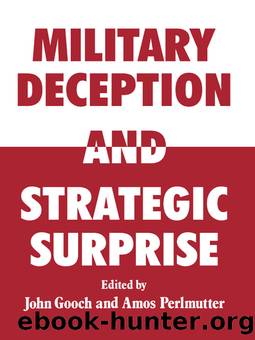
Author:John Gooch [Gooch, John]
Language: eng
Format: epub
ISBN: 9780415449335
Barnesnoble:
Publisher: Taylor & Francis
Published: 2007-06-01T00:00:00+00:00
Conventional Deterrence: Explanations of the Planned Use of Force
In the three years that followed the termination of the War of Attrition in August 1970, Egyptâs leaders seriously considered a surprise military attack against Israel at least four times. After President Sadat proclaimed a âyear of decisionâ in July 1971, he planned an air strike against Israelâs military installations in Sinai preparatory to a landing of paratroopers, for the month of December. The President subsequently explained that he postponed the use of force because of inadequate military shipments from the USSR and the transfer of military equipment to India after the outbreak of the Indo-Pakistani War on 3 December.8 Again the following year, Sadat ordered the Egyptian General Staff to prepare an attack across the Canal, to follow shortly after the American presidential elections, but cancelled the attack in mid-November after dismissing his senior military commanders for refusing to follow his orders.9 In early 1973, Egyptian officers planned a surprise military attack for limited military objectives, in coordination with Syria, for the month of May. And again, the attack was postponed, this time because of the impending Soviet-American summit, inadequate arms deliveries from the Soviet Union, and Israelâs military preparations.10 In the summer of 1973, Egypt and Syria jointly planned a surprise attack across the ceasefire line and on 6 October, the two launched a coordinated military attack, surprising Israelâs leaders and catching their armed forces unprepared.
Four times, then, Egypt planned military action and all four times deception was an integral part of the strategic plan. Only once, however, did Egyptian armed forces actually attack and when they did, deception succeeded. Why did Egypt cancel its planned military action three times? How did the calculus of Egyptian leaders differ the fourth time? What factors were critical in the decision to use force? Using as evidence one or more components of a challengerâs calculus, at least five major approaches to conventional deterrence attempt to explain a challengerâs decision to use military force.
The first of these explanations focuses on a challengerâs assessment of the balance of interests and gives considerable weight to leadersâ estimates of the importance of their own interests in comparison to those of a defender. If leaders consider their opponentâs interests to be greater than their own, they will consider the defenderâs resolve to be high and, very likely, will forego military action.11 Other variants of the interest explanation attach less importance to a comparative assessment and give greater weight to a challengerâs evaluation either of its own interests or those of its adversary. Some argue that a challenger will not use force if it considers a defenderâs interests to be large and obvious while others insist that even a credible commitment by a defender, based on visible interests, is insufficient to deter military action.12
When we look at the calculations of Egyptâs leaders from 1971 to 1973, we find little support for any variant of an interest explanation. In all four cases, Egypt considered its interests to be of overwhelming
Download
This site does not store any files on its server. We only index and link to content provided by other sites. Please contact the content providers to delete copyright contents if any and email us, we'll remove relevant links or contents immediately.
The Radium Girls by Kate Moore(12206)
100 Deadly Skills by Clint Emerson(5034)
Rise and Kill First by Ronen Bergman(4911)
The Templars by Dan Jones(4810)
The Doomsday Machine by Daniel Ellsberg(4633)
The Rape of Nanking by Iris Chang(4338)
Killing England by Bill O'Reilly(4117)
Stalin by Stephen Kotkin(4079)
Hitler in Los Angeles by Steven J. Ross(4018)
12 Strong by Doug Stanton(3635)
Hitler's Monsters by Eric Kurlander(3479)
The Code Book by Simon Singh(3329)
Blood and Sand by Alex Von Tunzelmann(3316)
Darkest Hour by Anthony McCarten(3237)
The Art of War Visualized by Jessica Hagy(3107)
Hitler's Flying Saucers: A Guide to German Flying Discs of the Second World War by Stevens Henry(2816)
Babylon's Ark by Lawrence Anthony(2801)
Tobruk by Peter Fitzsimons(2625)
The Second World Wars by Victor Davis Hanson(2592)
