Migrant Modernism by Brown J. Dillon;
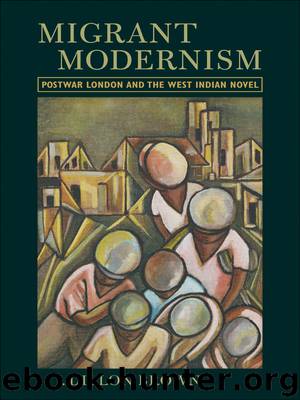
Author:Brown, J. Dillon;
Language: eng
Format: epub
Publisher: University of Virginia Press
Communicating in Tongues:
The Lonely Londoners
Selvon's third novel, The Lonely Londoners, can be seen to take up the problem of simultaneously articulating West Indian difference from and similarity to the British people with yet another experimental innovation. This novel, published in 1956, is almost certainly Selvon's most popular, best-known work. In critical discussions of West Indian and postcolonial literature, The Lonely Londoners is consistently invoked as a seminal work, with primary attention falling on its experimental use of a modified vernacular narration.27 The novel's treatment of West Indian immigrant life and its employment of demotic English are so well known, in fact, that during his lifetime Selvon was “concerned that the preoccupation of many readers and critics with these two features of his writing led them to neglect others of equal importance” (Ramraj, “Samuel Dickson Selvon,” 7). In spite of this possibly overabundant critical attention, the narration of The Lonely Londoners clearly merits recognition as a watershed moment in West Indian literature that provides symbolic legitimacy to a pointedly Caribbean way of thinking and speaking. As Birbalsingh observes, one of Selvon's main legacies is that “attitudes and speech habits which our colonial environment led us to believe were not respectable—he made respectable” (Clarke et al., “Sam Selvon,” 63). Judging by their British reception, Selvon's earlier two novels do not necessarily manage to subvert “the conventional associations of dialect with comic characters or with characters on the periphery” (Ramchand, West Indian Novel, 96). However, in his third novel, Selvon's use of an unidentified third-person narrator speaking in a modified West Indian vernacular assertively makes claims for such a language to be recognized as legitimately literary.28 Selvon himself seems to have embraced the notion of his linguistic creole as a means, once again, of articulating a distinctly West Indian consciousness within a mutually understood (among English-speaking audiences) idiom. In one interview, Selvon emphasizes how he strives “to keep the essence, the music” of the way Caribbean people actually speak, while at the same time trying “to avoid some words or phrases which…would be very difficult for an audience outside of the Caribbean to follow” (“Interview with Sam Selvon,” by Dasenbrock and Jussawalla, 115). In conversation with Fabre, Selvon reiterates his desire to somehow portray West Indianness in a language comprehensibly British, claiming that he “wrote a modified dialect which could be understood by European readers, yet retain[ing] the flavour and essence of Trinidadian speech” (“Samuel Selvon,” 66). Thus, The Lonely Londoners appears to share a similar goal to its predecessors, enacting on both a linguistic and a thematic register a sense of (potential) unity-within-difference.
The novel's language does indeed seem to act as “a deliberate subversion of the colonizer's language” (Joseph, Caliban in Exile, 85), a display of linguistic dissonance indicating opposition to the standards of conventional English (and thus, metonymically, of conventional British society). Numerous incidents in the novel underscore this dissonance as a necessary gesture motivated by the ignorance and racism of the British populace. Early in the novel, the narrator describes
Download
This site does not store any files on its server. We only index and link to content provided by other sites. Please contact the content providers to delete copyright contents if any and email us, we'll remove relevant links or contents immediately.
4 3 2 1: A Novel by Paul Auster(12354)
The handmaid's tale by Margaret Atwood(7730)
Giovanni's Room by James Baldwin(7302)
Asking the Right Questions: A Guide to Critical Thinking by M. Neil Browne & Stuart M. Keeley(5741)
Big Magic: Creative Living Beyond Fear by Elizabeth Gilbert(5726)
Ego Is the Enemy by Ryan Holiday(5392)
The Body: A Guide for Occupants by Bill Bryson(5066)
On Writing A Memoir of the Craft by Stephen King(4920)
Ken Follett - World without end by Ken Follett(4706)
Adulting by Kelly Williams Brown(4552)
Bluets by Maggie Nelson(4534)
Eat That Frog! by Brian Tracy(4500)
Guilty Pleasures by Laurell K Hamilton(4425)
The Poetry of Pablo Neruda by Pablo Neruda(4080)
Alive: The Story of the Andes Survivors by Piers Paul Read(4010)
White Noise - A Novel by Don DeLillo(3990)
Fingerprints of the Gods by Graham Hancock(3979)
The Book of Joy by Dalai Lama(3961)
The Bookshop by Penelope Fitzgerald(3828)
