Memoirs of a Leavisite by Ellis David;
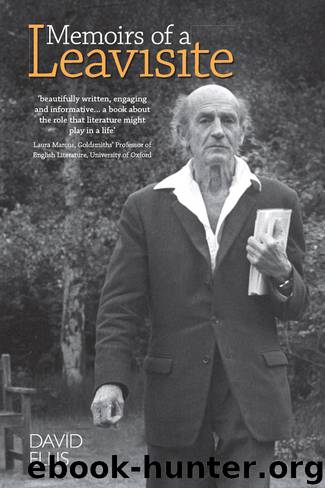
Author:Ellis, David;
Language: eng
Format: epub
Publisher: Liverpool University Press
TWELVE
RESEARCH
The topic I had chosen when I made my application for a State studentship was the reception of French literature in England during the mid-nineteenth century. I think it had occurred to me when reading Matthew Arnold and wondering what the state of play had been before he came on the scene; but I suspect it was also designed to keep up my connection with France (and perhaps help me get back there). The first problem was to find a supervisor, someone who, without necessarily being a nineteenth-century specialist, would not be a liability in the poisonous atmosphere of the Cambridge English Faculty. The year before, Ian Jack had written to the TLS and criticised the inadequate scholarship of Leavisian graduate students. Leavis had responded by withdrawing from graduate supervision entirely on the grounds that it had become dangerous to be known as a pupil of his. The ill-feeling was such that I was advised to find a supervisor who was more or less acceptable to all camps and a natural choice was therefore Leo Salingar, even though his speciality was Elizabethan drama. Salingar had moved from extra-mural work to a fellowship at Trinity and would later publish a book on Renaissance comedy, scholarly enough to have qualified for a doctorat d’Etat. But in his earlier days he had reviewed a book for Scrutiny and was known to be broadly sympathetic to Leavisian views.
The controversy which had elicited Ian Jack’s letter to the TLS had also brought from Leavis a substantial piece on further degrees in English in which he had described the ideal research student as ‘capable of proposing for himself a sustained piece of work worth doing’ so that ‘a standing relation with a congenial senior to whom he could go now and then for criticism and advice’ was all the help he would need. Salingar was a cultivated man who knew French well, and he was certainly congenial. I experienced nothing but kindness and encouragement from him, although I felt I could have done with more criticism. I knew what I was doing – reading all the French novels, plays and poems which had made any kind of impression in Britain and then tracking quite how they were received, in the occasional book but chiefly in the major British periodicals – yet I easily lost sight of why I was doing it. The first thing I discovered was what to others must have been already familiar and obvious: how extraordinarily politicised most of these periodicals were. This was particularly evident in their treatment of French literature: twenty or even thirty years after the Napoleonic wars were over, the greater sexual explicitness of writers such as Balzac or George Sand was still being related back by their British critics to events in France during the early 1790s, and condemned or praised accordingly. For a majority of reviewers, the principal point to be made about writing over the Channel was that too much political freedom meant a lowering of standards in private life which French novels only too graphically illustrated.
Download
This site does not store any files on its server. We only index and link to content provided by other sites. Please contact the content providers to delete copyright contents if any and email us, we'll remove relevant links or contents immediately.
| African | Asian |
| Australian & Oceanian | Canadian |
| Caribbean & Latin American | European |
| Jewish | Middle Eastern |
| Russian | United States |
4 3 2 1: A Novel by Paul Auster(12405)
The handmaid's tale by Margaret Atwood(7773)
Giovanni's Room by James Baldwin(7353)
Big Magic: Creative Living Beyond Fear by Elizabeth Gilbert(5780)
Asking the Right Questions: A Guide to Critical Thinking by M. Neil Browne & Stuart M. Keeley(5779)
Ego Is the Enemy by Ryan Holiday(5455)
The Body: A Guide for Occupants by Bill Bryson(5103)
On Writing A Memoir of the Craft by Stephen King(4948)
Ken Follett - World without end by Ken Follett(4740)
Adulting by Kelly Williams Brown(4582)
Bluets by Maggie Nelson(4563)
Eat That Frog! by Brian Tracy(4546)
Guilty Pleasures by Laurell K Hamilton(4454)
The Poetry of Pablo Neruda by Pablo Neruda(4113)
Alive: The Story of the Andes Survivors by Piers Paul Read(4037)
White Noise - A Novel by Don DeLillo(4018)
Fingerprints of the Gods by Graham Hancock(4009)
The Book of Joy by Dalai Lama(3996)
The Bookshop by Penelope Fitzgerald(3857)
