McCarthyism by Michaels Jonathan;
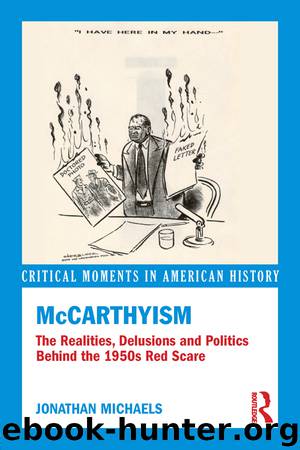
Author:Michaels, Jonathan;
Language: eng
Format: epub
Publisher: Taylor and Francis
Yalta
As the Second World War was drawing to its end, knowing that they were winning the war in Europe, President Roosevelt had met with British Prime Minister Winston Churchill and Soviet Premier Joseph Stalin at Yalta in the Crimean Peninsula to discuss how Europe would be reorganized in the wake of the defeat of the Axis powers. After the war’s end, when eastern Europe and China fell to Communists, a chief theme of attacks on both the Roosevelt and Truman administrations by conservatives like McCarthy was that at Yalta they had “lost” and “betrayed” both eastern Europe and China. It seems reasonably clear that in order to lose something, you first must have it; if any of the Big Three ended the war in possession of Poland and eastern Europe, it was the Soviet Union whose troops occupied those areas. To prise something free from someone who has it, one must have some leverage, something either to force the other person to give it up or something they want that one can use for bargaining purposes. In fact, the Soviet Union held most of the cards here. Roosevelt very much wanted something from the Soviet Union—its entry into the war against Japan would save American lives. He also hoped to establish a postwar world order through a new international institution—what would become the United Nations—that would avert catastrophic wars like the two World Wars with their 30 million deaths. For such an institution to have any hope of success and to be in any way meaningful, Soviet support and participation was critical. The United States had little to bargain with: the Russians had their troops in place and, the American sole possession of the still secret atomic bomb was not a useful bargaining tool since (1) it was a secret, and (2) no one yet knew whether it would work. The Joint Chiefs of Staff were urging the president to reach an agreement with Stalin, for they believed that should an invasion of Japan be necessary, without Russian aid the United States might face a million casualties or more. As James F. Byrnes, an important member of the US delegation, put it, “[i]t was not a question of what we would let the Russians do, but what we could get the Russians to do.”20
Along with Stalin’s commitments to enter the war against Japan and join the United Nations, Roosevelt and Churchill received his promise that, while future governments of European states bordering the Soviet Union would be “friendly” to the USSR, he would allow free elections in all the liberated territories. This was a promise Stalin would break.
One controversial result of the Yalta meeting was a secret protocol that gave way to significant Russian demands in Asia: in return for Stalin’s agreeing to break his nonaggression pact with Japan and to enter the Pacific war within three months of Germany’s surrender, along with a promise to enter into a friendship treaty with Chiang Kai-shek’s government, the Russians were to receive
Download
This site does not store any files on its server. We only index and link to content provided by other sites. Please contact the content providers to delete copyright contents if any and email us, we'll remove relevant links or contents immediately.
| Anarchism | Communism & Socialism |
| Conservatism & Liberalism | Democracy |
| Fascism | Libertarianism |
| Nationalism | Radicalism |
| Utopian |
The Secret History by Donna Tartt(19085)
The Social Justice Warrior Handbook by Lisa De Pasquale(12190)
Thirteen Reasons Why by Jay Asher(8907)
This Is How You Lose Her by Junot Diaz(6885)
Weapons of Math Destruction by Cathy O'Neil(6279)
Zero to One by Peter Thiel(5801)
Beartown by Fredrik Backman(5751)
The Myth of the Strong Leader by Archie Brown(5507)
The Fire Next Time by James Baldwin(5442)
How Democracies Die by Steven Levitsky & Daniel Ziblatt(5218)
Promise Me, Dad by Joe Biden(5153)
Stone's Rules by Roger Stone(5087)
A Higher Loyalty: Truth, Lies, and Leadership by James Comey(4960)
100 Deadly Skills by Clint Emerson(4924)
Rise and Kill First by Ronen Bergman(4788)
Secrecy World by Jake Bernstein(4752)
The David Icke Guide to the Global Conspiracy (and how to end it) by David Icke(4717)
The Farm by Tom Rob Smith(4507)
The Doomsday Machine by Daniel Ellsberg(4490)
