Maximino Avila Camacho and the One-Party State by Quintana Alejandro;
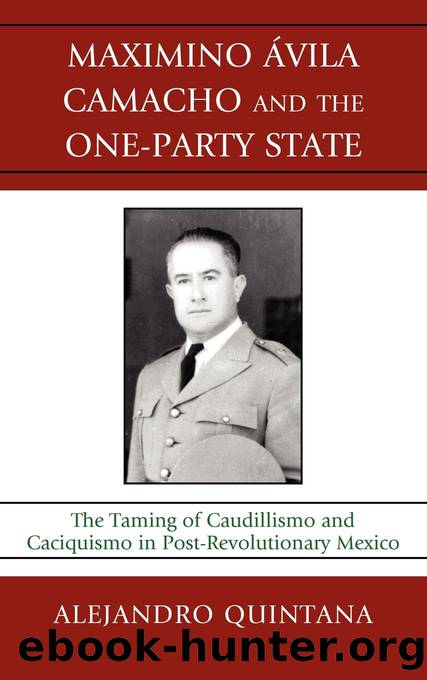
Author:Quintana, Alejandro;
Language: eng
Format: epub
Publisher: Lexington Books
Published: 2010-08-15T00:00:00+00:00
CHAPTER 4
A BASKET WITH SOME ROTTEN APPLES (1937-1941)
On February 1, 1937, General Maximino Ãvila Camacho became Governor of the state of Puebla. When he took office the state was in disarray. He inherited a bankrupt government from his predecessor General José Mijares Palencia. Apart from an economic deficit of 250,000 pesos1 ($1.5 million2) cronyism and corruption had not abated. This led Mijares Palencia to destroy his administrationâs documents before he left office.3 In addition, the state had been roiled by fierce labor clashes particularly in the industrialized textile regions surrounding the city of Puebla. In an effort ostensibly to distance himself from the incompetence and corruption of previous administrations, Maximino declared that his administration would be effective, disciplined, and financially solid.4 At the end of his tenure Maximino characterized his tenure as a role model for peace and development. He left a surplus in the treasury and claimed that the government was no longer corrupt and was staffed with hard-working bureaucrats.5
To be sure Maximino had more to show as an effective Governor than his predecessor, but his success was enhanced by his manipulation of public opinion. Among his accomplishments between 1937 and 1941, he founded the University of Puebla, rescued the fire-damaged Teatro Principal (built in 1761)âone of the oldest theaters on the continentâand renovated the long-abandoned âPalafoxianaâ library (established in 1646), donated by the bishop of Puebla and viceroy of New Spain Juan de Palafox y Mendoza (1600-1659).6 Maximino also claimed to have cleaned up the state finances. In 1938 he reported a surplus of 4.5 million pesos ($28.5 million) and in 1941 a surplus of 7 million pesos ($44.5 million). Maximino also asserted that he had invested 2.5 million pesos ($16 million) in the creation of 197 schools and 500,000 pesos ($3 million), which combined with federal monies paid for the construction of eleven paved roads across the state. In addition, as Governor Maximino dedicated 200,000 pesos ($1.3 million) to water works, especially in the city of Tehuacán, and 272,000 pesos ($1.5 million) for paving streets, primarily in the city of Puebla.7
However, corruption and cronyism flourished. During his tenure, Maximinoâs personal wealth increased substantially and he allegedly had millions of pesos in his bank account.8 If Maximinoâs government was as clean as he claimed, one cannot help but wonder how it was possible for him to accumulate millions of pesos on a yearly salary of 16,425 pesos ($104,000)? Clear-cut proof of corruption, however, has been difficult to establish for two main reasons: first, the only data made available to the public were provided by the state government and, second, due to the tradition of destroying state documents at the end of each administration, it became virtually impossible to verify Maximinoâs claims or his opponentsâ counterclaims indicating that his economic achievements benefited mostly his cronies.
Maximinoâs government does not appear to have deviated substantially from traditional patterns of authoritarianism, corruption, and cronyism found in previous administrations. What is striking is how much this expected practice became a central element of his policies.
Download
This site does not store any files on its server. We only index and link to content provided by other sites. Please contact the content providers to delete copyright contents if any and email us, we'll remove relevant links or contents immediately.
| Anthropology | Archaeology |
| Philosophy | Politics & Government |
| Social Sciences | Sociology |
| Women's Studies |
The Secret History by Donna Tartt(19102)
The Social Justice Warrior Handbook by Lisa De Pasquale(12197)
Thirteen Reasons Why by Jay Asher(8918)
This Is How You Lose Her by Junot Diaz(6894)
Weapons of Math Destruction by Cathy O'Neil(6284)
Zero to One by Peter Thiel(5807)
Beartown by Fredrik Backman(5766)
The Myth of the Strong Leader by Archie Brown(5512)
The Fire Next Time by James Baldwin(5454)
How Democracies Die by Steven Levitsky & Daniel Ziblatt(5224)
Promise Me, Dad by Joe Biden(5157)
Stone's Rules by Roger Stone(5090)
A Higher Loyalty: Truth, Lies, and Leadership by James Comey(4966)
100 Deadly Skills by Clint Emerson(4931)
Rise and Kill First by Ronen Bergman(4797)
Secrecy World by Jake Bernstein(4756)
The David Icke Guide to the Global Conspiracy (and how to end it) by David Icke(4723)
The Farm by Tom Rob Smith(4517)
The Doomsday Machine by Daniel Ellsberg(4493)
