Luxury by Calefato Patrizia; Adams Lisa;
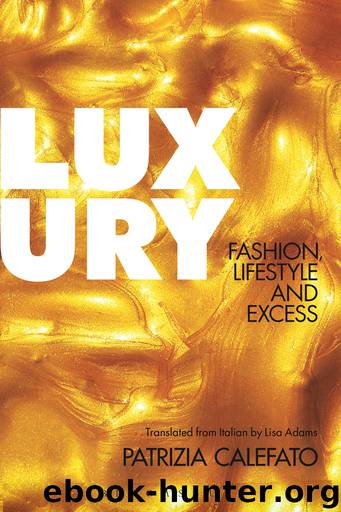
Author:Calefato, Patrizia; Adams, Lisa;
Language: eng
Format: epub
Publisher: Bloomsbury Publishing
Published: 2014-01-12T16:00:00+00:00
THE BODY
Luxury turns the body’s boundaries into a mere abstraction. Luxury is the exorbitant and extraordinary body. High fashion, deluxe makeup, well-being, ease, and space are the poetics of the body that can indulge in the luxury of disregarding its limits. They defy death; indeed, they mock it. They signify eternity achieved despite the limits known by the body. Our body is our greatest otherness; just a slip, a faint, or a fluttering heart are enough to make it fail us, enough to diminish or even nullify our experience of the body as our object—as our territory, where our certainties regarding time are played out. The body is unpredictable. Hence the possibility of well-being in and with one’s body is perceived as one of the greatest contemporary luxuries.
Is luxury an aesthetic ideal? Not in the current sense of body stereotypes, that type of beauty by the book, recognized as perfect only in relation to set standards, which are the ideals of the body as commodity, the body as merchandise, or else the body as an object of inquiry or the seat of experimentation in life technologies. Luxury is not an aesthetic ideal of the body, if by body aesthetics we mean the new anthropometrics, the measurements and limits of the body itself: CAT scans, blood tests, eugenics tables, percentiles, sizes, diets, the visible human project.21 Luxury consists in being able to indulge in the luxury of not giving a damn.22 Luxury makes the body opaque, heavy, and prevents its transformation into something transparent and completely visible in its most secret inner recesses.
Is luxury an ethical ideal? Well-being as body luxury is the true dimension of the body’s humanity; based on its essential principle we should live immoderately, not just survive. Here luxury reveals, in a conflictual way, its opposite: the often impossible survival, where the affluent society turns out to be the sick society in which no one lives well. The emblem of body luxury is David Lachapelle’s photography, a style that magnifies the body, making it extreme, over the top, and unreal, both tacky and glamorous at the same time. His images are like perennial plastic surgery, impossible and unattainable, somewhere between Michael Jackson’s mutant kitsch and the diamonds on a statuesque Miss World.
The exhibition of luxurious female bodies for the Miss World finals in Nigeria in November 2002 resulted in interreligious riots that left over 200 dead. A tragedy of terror and death was unleashed on this occasion in which the contestants expressed the globalized magnificence of a body industry that knows how to multiply its aesthetic canons: every color, every nuance, and every culture, the more “exotic” the better. The event seeks the maximum in beauty and symbols of luxury, from jewelry to deluxe makeup, and industries specializing in these sponsored the pageant. And that very “maximum,” that absolute beauty, was the starting point for the Manichean logic of terror: on one side civilization, on the other barbarism. Yet civilization and barbarism, right and wrong, are interchangeable:
Download
This site does not store any files on its server. We only index and link to content provided by other sites. Please contact the content providers to delete copyright contents if any and email us, we'll remove relevant links or contents immediately.
| Anthropology | Archaeology |
| Philosophy | Politics & Government |
| Social Sciences | Sociology |
| Women's Studies |
Nudge - Improving Decisions about Health, Wealth, and Happiness by Thaler Sunstein(7712)
The Fire Next Time by James Baldwin(5454)
iGen by Jean M. Twenge(5419)
Adulting by Kelly Williams Brown(4582)
The Sports Rules Book by Human Kinetics(4398)
The Hacking of the American Mind by Robert H. Lustig(4387)
The Ethical Slut by Janet W. Hardy(4263)
Captivate by Vanessa Van Edwards(3845)
Mummy Knew by Lisa James(3695)
In a Sunburned Country by Bill Bryson(3548)
The Worm at the Core by Sheldon Solomon(3493)
Ants Among Elephants by Sujatha Gidla(3472)
The 48 laws of power by Robert Greene & Joost Elffers(3305)
Suicide: A Study in Sociology by Emile Durkheim(3025)
The Slow Fix: Solve Problems, Work Smarter, and Live Better In a World Addicted to Speed by Carl Honore(3015)
The Tipping Point by Malcolm Gladwell(2931)
Humans of New York by Brandon Stanton(2876)
Get What's Yours for Medicare: Maximize Your Coverage, Minimize Your Costs by Philip Moeller(2767)
Handbook of Forensic Sociology and Psychology by Stephen J. Morewitz & Mark L. Goldstein(2709)
