Lovecraft and Influence by Waugh Robert H.;
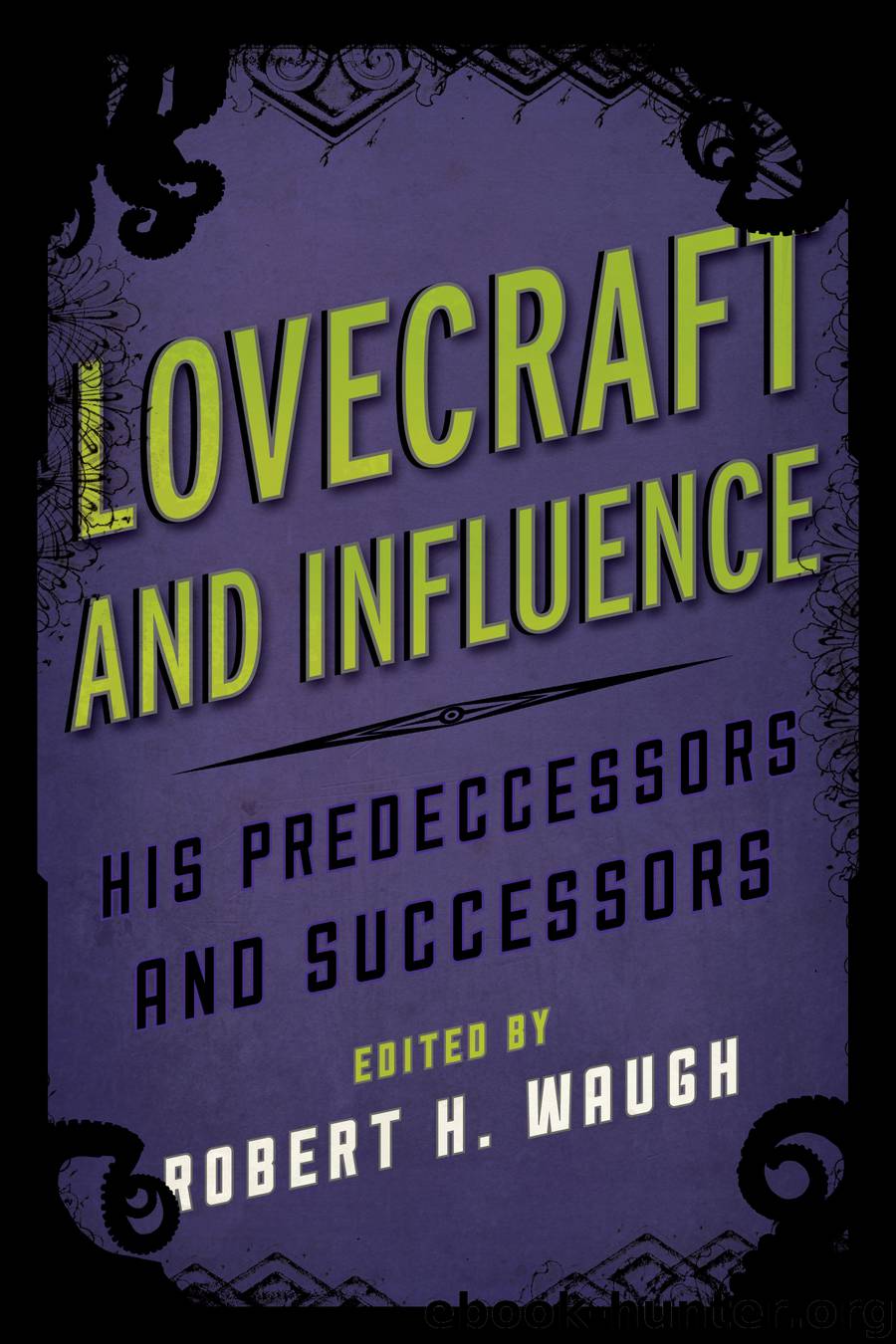
Author:Waugh, Robert H.;
Language: eng
Format: epub
Tags: undefined
Publisher: Scarecrow Press
Published: 2012-03-20T16:00:00+00:00
II
Lovecraft’s Successors
Chapter 9
What Stays in Lovecraft’s Sieve Once Frank Belknap Long Is Strained Through It
Norm Gayford
Sieves are used to remove the larger, used items that have contributed to a broth, and to put pressure on vegetables to extrude a thick delicacy from rougher material. Let’s sieve some of Frank Belknap Long’s material to discover Lovecraftian elements and influence.
By sending a correspondent an epistolary manifesto calling for a new, more complex view of art, one demonstrates hope that the correspondent is receptive. Frank Belknap Long was close to Lovecraft for years. He helped Lovecraft survive New York and endure a rather ill-fitting marriage; they worked in a loose partnership as revisionists, sometimes bouncing clients back and forth. The mutual influences, while not quantifiable, can nonetheless be felt holistically, every bit as much as the shadowed presences in their tales. Sometimes the turn of phrase, the combination of adjective and noun, adverb and verb, brings an echo.
Inflections and innuendoes exert narrative pressures. Long’s Journey into Darkness is one of the most direct and mature fusions of Lovecraft and Long. Journey into Darkness suggests to me that Lovecraft’s influence stayed with Long even as Long continued discoursing, through narrative, about the weird tale’s evolution.
Let’s start with the “blues” trope. Long often dropped “blue” into otherworldly incursions, or iterations of the weird, especially in Journey into Darkness. The first paragraph is full of such references: “blue-and-white counterpane . . . dark blue vase . . . blinds, which were of the same color . . . much lighter blue of the walls,”[1] and this is what Kilmer, the hesitant protagonist, wakes into, fearful at first that he is back in childhood, where his “bedroom . . . had . . . the same pervasive blueness.”[2] Already we have the floor dropped out from beneath us, not unlike the traveler on deck in “Second Night Out.”[3] Kilmer finds no psychological anchors—he wants to be dislodged from the illusion: “the skepticism which might have dispelled it [the illusion] had nothing to fasten on.”[4] Skepticism needs grounding, foundation, as does a weird tale itself. Yet the foundation becomes process rather than object, the process—by the protagonists—of constantly re-seeing, recontextualizing, and qualifying their perceptions. Finally, reality comes home for Kilmer: “Then his vision steadied and objects that had been vague and indefinite stood out with an extraordinary sharpness.”[5] The novel is about seeing clearly what we initially perceive as tenuous, tenebrous reality.
Kilmer calls himself “alienated and . . . preferred to think of himself as emotionally mature enough to be no more than slightly estranged.”[6] First Kilmer is “alienated,” and then, in more modified fashion, “estranged.” While both words denote feeling that one does not belong to a group or community, “alienation” is more connotatively acute. Correspondence mitigates the alienation, especially in a character such as Howland, who lives at a remove from common practice. About isolation and the need for correspondence, Lovecraft writes:
An isolated person requires correspondence as a means of seeing his ideas as others see
Download
This site does not store any files on its server. We only index and link to content provided by other sites. Please contact the content providers to delete copyright contents if any and email us, we'll remove relevant links or contents immediately.
4 3 2 1: A Novel by Paul Auster(12358)
The handmaid's tale by Margaret Atwood(7735)
Giovanni's Room by James Baldwin(7307)
Asking the Right Questions: A Guide to Critical Thinking by M. Neil Browne & Stuart M. Keeley(5745)
Big Magic: Creative Living Beyond Fear by Elizabeth Gilbert(5731)
Ego Is the Enemy by Ryan Holiday(5398)
The Body: A Guide for Occupants by Bill Bryson(5067)
On Writing A Memoir of the Craft by Stephen King(4923)
Ken Follett - World without end by Ken Follett(4711)
Adulting by Kelly Williams Brown(4556)
Bluets by Maggie Nelson(4538)
Eat That Frog! by Brian Tracy(4505)
Guilty Pleasures by Laurell K Hamilton(4430)
The Poetry of Pablo Neruda by Pablo Neruda(4083)
Alive: The Story of the Andes Survivors by Piers Paul Read(4013)
White Noise - A Novel by Don DeLillo(3995)
Fingerprints of the Gods by Graham Hancock(3980)
The Book of Joy by Dalai Lama(3963)
The Bookshop by Penelope Fitzgerald(3829)
