Literary Freedom by McRobie Heather Katherine;
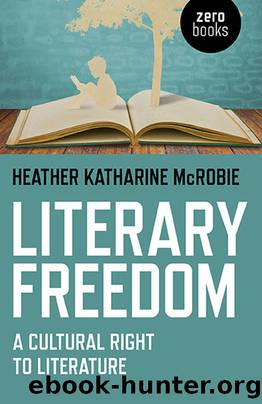
Author:McRobie, Heather Katherine; [McRobie, Heather Katharine]
Language: eng
Format: epub
ISBN: 1566449
Publisher: John Hunt Publishing Limited
Published: 2013-12-13T00:00:00+00:00
3.3 The writer-society relationship
The figure of the writer in exile brings to the fore the symbiotic relationship between the individual writer and society/ societies. The novelist and poet Wole Soyinka, commenting on his own condition of exile, noted that, while many writers insist on âan exile persona that feeds on the community of the alienatedâ â and that celebrates the transgression of boundaries, such as national boundaries â a writerâs exile also brings with it âthe weight of a distant cultural longingâ,52 as the writer as an individual is inevitably from one society, one culture or group, in particular. Theorists who address the concept of âworld literatureâ also note that literature occupies a peculiar position of both belonging to a particular group, and belonging to humanity as a whole.
David Damrosch has shown how literary works âmanifest differently abroad than at homeâ, but still nonetheless belong to a âglobal dialogueâ53, while Pascale Casanova notes that all writers âinheritâ the traditions of the literary culture from which they emerge, and can only choose what to do in the face of this: ânational literary and linguistic patrimony supplies a sort of a priori definition of the writer, one that he will transform (if need be, by rejecting it or, as in the case of [Samuel] Beckett, by conceiving himself in opposition to it) throughout his career.â54 In short, the role of the writer within society echoes and articulates the complexity of the the individual, especially the âtransgressiveâ or âsubversiveâ individual, within the culture that formed them and to which they belong.
Understanding the relationship between the writer and society is a key component of the argument that literary freedom is a cultural right, and clarifies the kinds of positive steps that states should take in order to ensure both access to culture (in this case, literature) and the freedom of the writer. As Chapter 2 made the case for the state funding of the arts and the capabilities approachâs defence of âhigh artâ, the interrelated needs of the writer and society outlined in this Chapter indicate that state policies regarding literary freedom, must ensure that both âsidesâ can fulfil their role in the relationship. Several concrete â although far from comprehensive â suggestions for how to navigate this relationship emerge from the analysis of the writer and society:
Firstly, it entails, most obviously, the negative liberty position that writers must not have their civil and political right to freedom of expression arbitrarily encroached upon by the state, although the gravity of this individual right (which could be seen as an âArticle 19 of the UDHRâ right) is now strengthened by the insight that the society also suffers, as in Czechoslovakia, when the civil and political rights of writers are violated.
Secondly, it entails that state policy on the arts in some sense protects the writer from the society, in the sense of societal pressure â as Orwell noted, self-censorship is the detrimental effect of âsocietyâ on the individual writerâs freedom; and the symbiotic relationship sketched above
Download
This site does not store any files on its server. We only index and link to content provided by other sites. Please contact the content providers to delete copyright contents if any and email us, we'll remove relevant links or contents immediately.
The Secret History by Donna Tartt(19103)
The Social Justice Warrior Handbook by Lisa De Pasquale(12197)
Thirteen Reasons Why by Jay Asher(8919)
This Is How You Lose Her by Junot Diaz(6894)
Weapons of Math Destruction by Cathy O'Neil(6284)
Zero to One by Peter Thiel(5808)
Beartown by Fredrik Backman(5767)
The Myth of the Strong Leader by Archie Brown(5513)
The Fire Next Time by James Baldwin(5454)
How Democracies Die by Steven Levitsky & Daniel Ziblatt(5225)
Promise Me, Dad by Joe Biden(5157)
Stone's Rules by Roger Stone(5091)
A Higher Loyalty: Truth, Lies, and Leadership by James Comey(4966)
100 Deadly Skills by Clint Emerson(4931)
Rise and Kill First by Ronen Bergman(4797)
Secrecy World by Jake Bernstein(4756)
The David Icke Guide to the Global Conspiracy (and how to end it) by David Icke(4723)
The Farm by Tom Rob Smith(4517)
The Doomsday Machine by Daniel Ellsberg(4493)
