Life on Air by Hendy David;
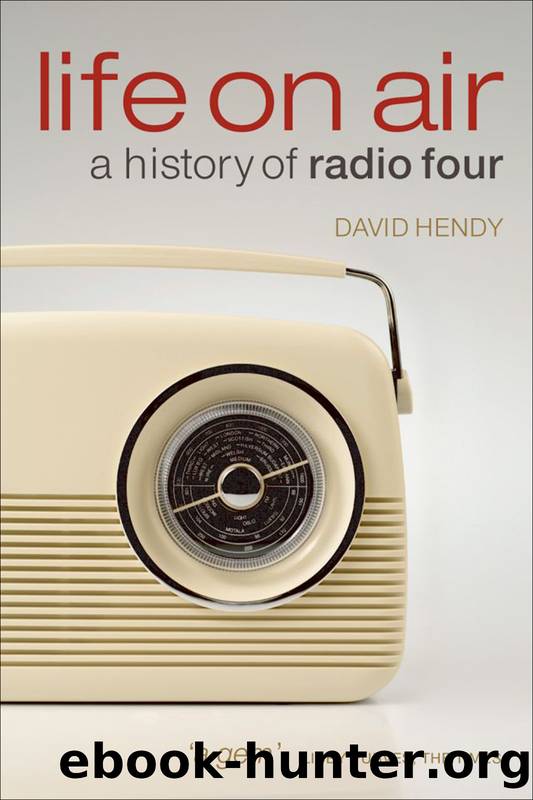
Author:Hendy, David;
Language: eng
Format: epub
Publisher: Oxford University Press USA - OSO
Published: 2007-09-14T16:00:00+00:00
A ‘LOCAL HOME SERVICE’
Events started to move quickly. Within Singer’s small team of planners was Michael Starks, a man just recruited from the commercial broadcasters’ regulator the Independent Broadcasting Authority. Here was someone business-minded and with no vested interest in any part of the Radio empire: someone, in other words, able to challenge programme-makers’ sensitivities and BBC traditions.
Starks first made his presence felt between October 1978 and February 1979, by drawing up several drafts of a scheme, unofficially labelled ‘Radio in the Eighties’, designed to tackle the various pressures on BBC Radio through a programme of expansion. This contemplated a tailor-made ‘sustaining’ service to provide local stations with three hours of American-style “rolling news”’, produced and distributed from London, in order to create a proper ‘fifth’ BBC service. It also asked the government to grant a sixth frequency dedicated to educational programmes, and called for large-scale capital investment, first on transmitters, so that there could be a separate VHF frequency for each of the BBC’s services, and secondly on tackling an accumulation of decrepit studios. The need for capital investment seemed especially urgent, since the number of breakdowns was beginning to overwhelm engineers: 25,000 failures a year in 1978 and rising. More and more plant was now defined as ‘worn out’—so much of it, in fact, that three-quarters of BBC Radio’s capital fund had to be spent on replacement rather than improvement. The real costs of previous economies were starting to show. And a radical solution was now proposed: to cut future losses by moving out of Broadcasting House and into a brand new purpose-built Radio complex across the road in Langham Place.25 It would not be cheap, but it might, so to speak, be worth it.
Starks’s plan was ambitious. But it found no place for the all-news network the journalists had been after. So in order to accommodate the desire for more ‘public affairs’ broadcasting he went on to suggest that Radio Four should be defined as a network of’topical speech’. There would still be drama, comedy, and so on; but the expectation of topicality being the dominant flavour—what the document called the ‘key’ to the network—was made explicit. This was loaded phraseology. Since Radio Four had to be topical, Starks pointed out, it ‘ought ideally to be the most flexible of our services’. For a network with so many fixed-length programmes in its schedule, many of which were distinctly untopical, this did not sound like the status quo. Indeed, when one of the BBC’s General Advisory Council members greeted the plan by saying that ‘topical speech should always have priority over entertainment, because Radio Four was essentially a flexible service of news and current affairs’, the dangers ahead were starting to crystallize.26
The BBC’s Governors and senior managers thought highly of the plan. However: money. The Starks scheme was expensive—relying on something like an 8 per cent growth in total radio spending. This was optimistic, to say the least. Though the BBC had been hoping for an increase in
Download
This site does not store any files on its server. We only index and link to content provided by other sites. Please contact the content providers to delete copyright contents if any and email us, we'll remove relevant links or contents immediately.
| Anthropology | Archaeology |
| Philosophy | Politics & Government |
| Social Sciences | Sociology |
| Women's Studies |
Born to Run: by Christopher McDougall(7127)
The Leavers by Lisa Ko(6948)
iGen by Jean M. Twenge(5415)
Sapiens by Yuval Noah Harari(5370)
Spare by Prince Harry The Duke of Sussex(5197)
The Kite Runner by Khaled Hosseini(5179)
Machine Learning at Scale with H2O by Gregory Keys | David Whiting(4313)
Bullshit Jobs by David Graeber(4190)
Never by Ken Follett(3957)
Goodbye Paradise(3810)
Livewired by David Eagleman(3773)
Fairy Tale by Stephen King(3398)
A Dictionary of Sociology by Unknown(3085)
Harry Potter 4 - Harry Potter and The Goblet of Fire by J.K.Rowling(3073)
The Social Psychology of Inequality by Unknown(3031)
The Club by A.L. Brooks(2925)
Will by Will Smith(2919)
0041152001443424520 .pdf by Unknown(2845)
People of the Earth: An Introduction to World Prehistory by Dr. Brian Fagan & Nadia Durrani(2736)
