Liberty from All Masters by Barry C. Lynn
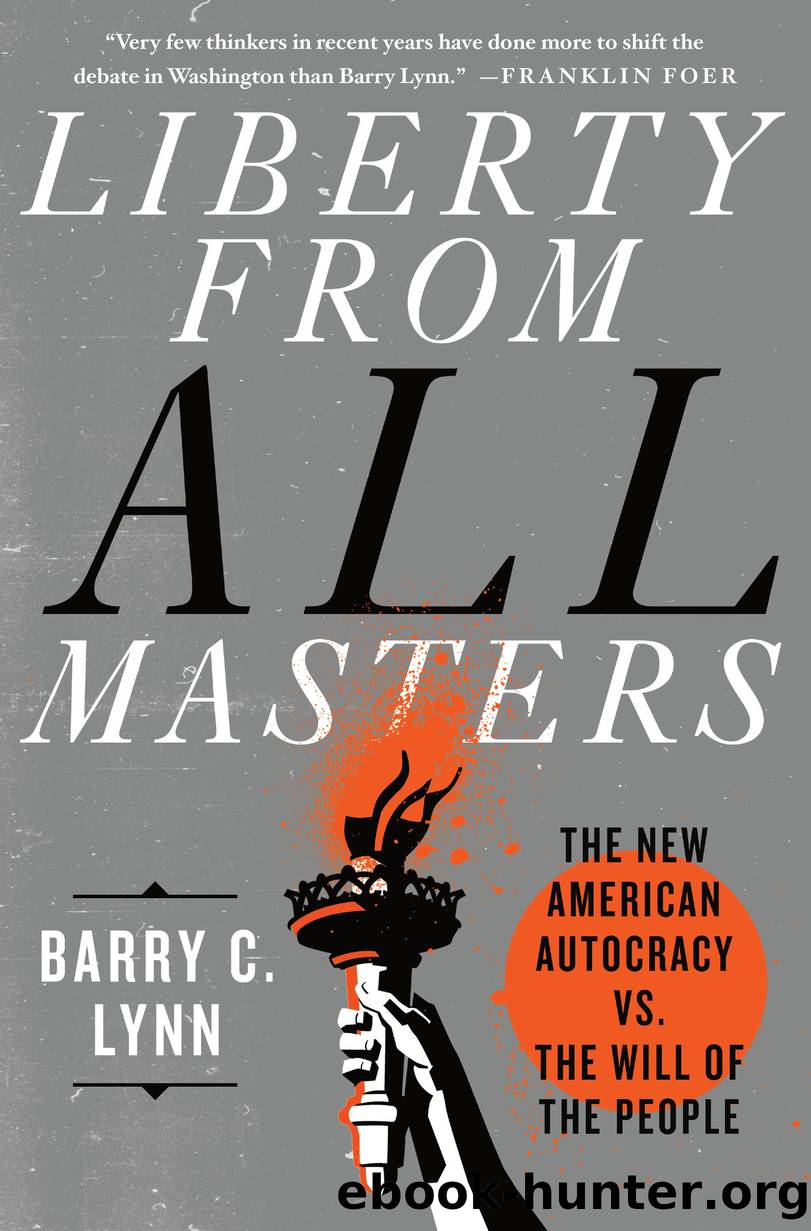
Author:Barry C. Lynn
Language: eng
Format: epub
Publisher: St. Martin's Publishing Group
THE TRUE NEW DEAL
Franklin Roosevelt is often described as a pragmatist, a leader who did not so much wield an ideology as simply exhibit a willingness to test one idea after another until something worked. And certainly, compared to Woodrow Wilsonâwho published five scholarly books, including major studies of constitutional governmentâRoosevelt did not fit the mold of a traditional intellectual.
Unlike Wilson, however, Roosevelt had been extensively schooled in real-world power and policy. This included an intimate knowledge of American finance and American financiers. Much of this was from personal experience. Roosevelt could trace his motherâs family to the Mayflower, and his fatherâs to 1650s New Amsterdam, and the great wealth he inherited came from banking, shipping, sugar growing, Manhattan real estate, and trade with China.7
Rooseveltâs knowledge also cameâafter he opted not to go into any of the family businesses or his own original plan to work in admiralty lawâfrom extensive public service both in the federal government and in New York state politics. He served as assistant secretary of the Navy through the entire Wilson administration, overseeing a vast workforce and complex contracting procedures during the First World War. Then as governor of New York he ran Americaâs largest and most complex state government in the days and months immediately after the devastating crash of 1929.
To the extent Roosevelt had developed a practical vision of political economics by the time he entered the White House, it was the traditional democratic republican belief that banks and corporations exist ultimately to serve the public interest.
Indeed, Roosevelt had already proved highly adept at bending the actions of corporate executives to the will of the people. He did so most dramatically in 1919 when, in order to develop a modern radio system for the U.S. Navy, he forced General Electric, Westinghouse, and AT&T to combine their radio patents with those of the American Marconi Corporation in a new enterprise known as the Radio Corporation of America, or RCA.8 During his time in Washington, Roosevelt was also exposed to many other experiments in the use of the federal government to harness and neutralize the power of business without destroying all the incentives that led private people to invest money in a particular venture. This included the wartime nationalization of Americaâs railways and telephone system and the use of the War Industries Board to force businesses to modernize and expand their factories and sometimes to coordinate their activities with one another.9 Later, in Albany, it included a close education in the ways that utility monopolies price electricity and restrict the development of new generation and distribution systems.10
While in Washington, Roosevelt also came to know many of the main actors in both the New Freedom and the New Nationalism camps.11 In part, this was due to the fact that Wilson himself, during the 1916 election, had welcomed many of the veterans of Theodore Rooseveltâs Bull Moose Progressive campaign of 1912, with its focus on centralization of the political economy, into the Democratic Party. Even though many retained
Download
This site does not store any files on its server. We only index and link to content provided by other sites. Please contact the content providers to delete copyright contents if any and email us, we'll remove relevant links or contents immediately.
| Anthropology | Archaeology |
| Philosophy | Politics & Government |
| Social Sciences | Sociology |
| Women's Studies |
The Secret History by Donna Tartt(19476)
The Social Justice Warrior Handbook by Lisa De Pasquale(12297)
Thirteen Reasons Why by Jay Asher(9128)
This Is How You Lose Her by Junot Diaz(7060)
Weapons of Math Destruction by Cathy O'Neil(6476)
Zero to One by Peter Thiel(5953)
Beartown by Fredrik Backman(5949)
The Myth of the Strong Leader by Archie Brown(5631)
The Fire Next Time by James Baldwin(5592)
How Democracies Die by Steven Levitsky & Daniel Ziblatt(5333)
Promise Me, Dad by Joe Biden(5237)
Stone's Rules by Roger Stone(5196)
A Higher Loyalty: Truth, Lies, and Leadership by James Comey(5091)
100 Deadly Skills by Clint Emerson(5031)
Rise and Kill First by Ronen Bergman(4907)
Secrecy World by Jake Bernstein(4892)
The David Icke Guide to the Global Conspiracy (and how to end it) by David Icke(4854)
The Doomsday Machine by Daniel Ellsberg(4627)
The Farm by Tom Rob Smith(4614)
