Leon Trotsky and the Organizational Principles of the Revolutionary Party by Le Blanc Paul Feeley Dianne Twiss Thomas Breitman George
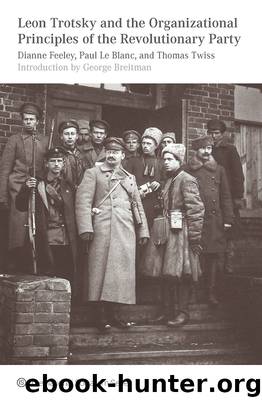
Author:Le Blanc, Paul, Feeley, Dianne, Twiss, Thomas, Breitman, George
Language: eng
Format: epub
Tags: Political Science
ISBN: 978-1-60846-455-5
Publisher: Haymarket Books
Published: 2014-07-23T04:00:00+00:00
4. The crisis of the French section
In 1934, Trotsky observed that “the unusual acuteness of the class struggle” resulted in “the tendency for reformism to be pushed aside by centrism, as well as the tendency toward the radicalization of centrism”—tendencies which he felt were increasing within the ranks of the workers’ movement. The bureaucratic leaderships of the Social Democratic and Communist parties, however, were incapable of providing the necessary revolutionary leadership. While Trotsky believed that the future belonged to the yet-to-be constituted Fourth International, he pointed out: “It may be constituted in the process of the struggle against fascism and the victory gained over it. But it may also be formed considerably later, in a number of years, in the midst of the ruins and the accumulation of debris following upon the victory of fascism and war.” (Writings, 1934-35, pp. 81, 85)
Trotsky saw the People’s Front alliance of the Socialist and Communist parties of France as reflecting in some ways the working-class radicalization (the workers demanded unity to defend their rights). But he also noted that “it cannot be considered excluded that the Social Democratic bureaucracy in France, with the active aid of the Stalinists, will isolate the left wing….” (Writings, 1934-35, p. 83) Trotsky appreciated the contributions of the 100-member French section of the ICL but observed “that our organization is too weak to establish for itself a practical independent role in the struggles that are looming ahead of us.” He urged that the section enter the French Socialist Party and constitute itself as a revolutionary faction for the purpose of escaping isolation, winning new adherents to the Bolshevik-Leninist banner (he hoped for “several thousand workers”), and becoming a significant factor in French politics. Answering objections, he explained: “…the proletarian party must be independent. Quite so. But the League is not yet a party. It is an embryo, and an embryo needs covering and nourishment in order to develop.” (Writings, 1934-35, pp. 36, 38, 43)
At first, there was considerable opposition within the French section to this proposal. In the autumn of 1934, however, it decided to implement this proposal, which came to be known as “the French turn.” By the summer of 1935 it had (within the Socialist Party) 300 members, tens of thousands of readers of its press, and significant influence in the larger organization and—through this—in other sectors of the workers’ movement. Within a short period of time, the leadership of the Socialist Party launched a campaign to curb and, ultimately, to eliminate the revolutionary threat within the party’s ranks.
Trotsky now called for a new turn:
This party opened to us certain possibilities, and it was correct to have formulated and utilized them. But these possibilities are limited. The Mulhouse Congress [of the Socialist Party, at which the Trotskyists won support from a sizeable minority for a revolutionary anti-militarist resolution, and became nationally prominent for their vigorous challenge to the Socialist leadership], together with the repercussions that will follow it, should more or less materially limit these possibilities.
Download
This site does not store any files on its server. We only index and link to content provided by other sites. Please contact the content providers to delete copyright contents if any and email us, we'll remove relevant links or contents immediately.
| Anthropology | Archaeology |
| Philosophy | Politics & Government |
| Social Sciences | Sociology |
| Women's Studies |
The Secret History by Donna Tartt(19382)
The Social Justice Warrior Handbook by Lisa De Pasquale(12265)
Thirteen Reasons Why by Jay Asher(9055)
This Is How You Lose Her by Junot Diaz(7005)
Weapons of Math Destruction by Cathy O'Neil(6413)
Zero to One by Peter Thiel(5899)
Beartown by Fredrik Backman(5879)
The Myth of the Strong Leader by Archie Brown(5589)
The Fire Next Time by James Baldwin(5542)
How Democracies Die by Steven Levitsky & Daniel Ziblatt(5295)
Promise Me, Dad by Joe Biden(5208)
Stone's Rules by Roger Stone(5158)
A Higher Loyalty: Truth, Lies, and Leadership by James Comey(5045)
100 Deadly Skills by Clint Emerson(4994)
Rise and Kill First by Ronen Bergman(4863)
Secrecy World by Jake Bernstein(4825)
The David Icke Guide to the Global Conspiracy (and how to end it) by David Icke(4803)
The Doomsday Machine by Daniel Ellsberg(4583)
The Farm by Tom Rob Smith(4574)
