Kropotkin by Morris Brian;
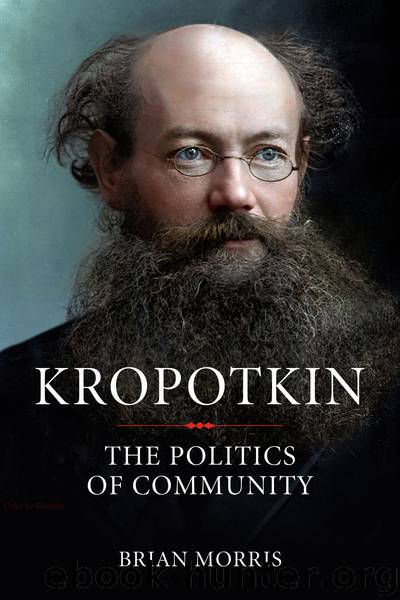
Author:Morris, Brian;
Language: eng
Format: epub
Publisher: PM Press
Published: 2018-04-21T04:00:00+00:00
PART THREE
HISTORICAL STUDIES
9
TRIBAL LIFE AND ANARCHISM
In the metaphysics that Kropotkin embraced, that of evolutionary holism, reality is conceived as rational and orderly, although always undergoing constant change. Like Whitehead, Kropotkin repudiated Hegelian dialectics, but he nevertheless perceived the world as in a state of continuous change and conflict, as well as operating in accordance with certain discernible laws. He shared with Marx a great debt to both the logic and content of the eighteenth-century French Enlightenment (MK, 182), but as we have explored, he rejected entirely its metaphysics of nature. He thus repudiated the anthropocentrism and essentialism of Enlightenment thought—this long before the obscurantist musings of Heidegger and Deleuze on the same subject—as well as its radical dualisms (humanity/nature, mind/body, individual/society) and its mechanistic world picture. But in embracing evolutionary theory, Kropotkin not only rejected the Enlightenment’s philosophy of nature but also it’s social theory. He was, in particular, strongly opposed to the views of such philosophers as Hobbes, Locke, and Rousseau, all “contract theorists” who tended to view humans in a “state of nature”—that is, human society before the emergence of the state—as essentially asocial, atomistic beings. Hobbes especially considered the human person as a self-directing machine, a possessive individual who was aggressive, competitive, acquisitive, antisocial, and power-seeking, ever engaged in a restless desire for power. Life in the “state of nature,” that is, tribal society, was thus uncivilized—lacking culture, art, sociality, and morality. It exhibited a “war of every one against every one.” As Hobbes graphically expressed it, in the oft-quoted phrase, in the state of nature there is continual fear and conflict, and the “life of man” is “solitary, poor, nasty, brutish and short” (1651, 10; McPherson 1962, 19–29).
Although acknowledging the social nature of the individual, Locke and the political economists tended to reaffirm this liberal conception of the individual as a “possessive” individual, the competitive owner of private property, both in terms of real property and in terms of owning “property in the person” (Brown 1973, 3).
Kropotkin rejected entirely the Hobbesian view of social life along with the possessive individualism of liberal social theory. For Kropotkin, as for Aristotle and Marx, humans were intrinsically social animals: indeed, as we have seen, sociality and mutual aid were held by Kropotkin to be intrinsic to animal life itself and thus, as Martin Miller puts it, the primordial existence of humans was lived within a social context, not in isolated hostility. Humans without society had simply never existed; neither had absolute freedom—in the sense of license to do anything.
According to Kropotkin, these were merely myths propagated by the likes of Hobbes to justify the nation-state and its form of governance. Humans had always existed in society, in the sense of a community of people bound together for common purposes—as anthropologists have demonstrated (MK, 184).
As the Hobbesian view of society was still being expressed by scholars like Huxley and Spencer at the end of the nineteenth century, Kropotkin in his writings felt it important to defend the integrity of tribal society.
Download
This site does not store any files on its server. We only index and link to content provided by other sites. Please contact the content providers to delete copyright contents if any and email us, we'll remove relevant links or contents immediately.
| Anthropology | Archaeology |
| Philosophy | Politics & Government |
| Social Sciences | Sociology |
| Women's Studies |
The Secret History by Donna Tartt(19088)
The Social Justice Warrior Handbook by Lisa De Pasquale(12190)
Thirteen Reasons Why by Jay Asher(8909)
This Is How You Lose Her by Junot Diaz(6886)
Weapons of Math Destruction by Cathy O'Neil(6279)
Zero to One by Peter Thiel(5801)
Beartown by Fredrik Backman(5754)
The Myth of the Strong Leader by Archie Brown(5507)
The Fire Next Time by James Baldwin(5444)
How Democracies Die by Steven Levitsky & Daniel Ziblatt(5218)
Promise Me, Dad by Joe Biden(5153)
Stone's Rules by Roger Stone(5087)
A Higher Loyalty: Truth, Lies, and Leadership by James Comey(4962)
100 Deadly Skills by Clint Emerson(4925)
Rise and Kill First by Ronen Bergman(4788)
Secrecy World by Jake Bernstein(4753)
The David Icke Guide to the Global Conspiracy (and how to end it) by David Icke(4717)
The Farm by Tom Rob Smith(4507)
The Doomsday Machine by Daniel Ellsberg(4490)
