Kranti Nation: India and the Fourth Industrial Revolution by Pranjal Sharma
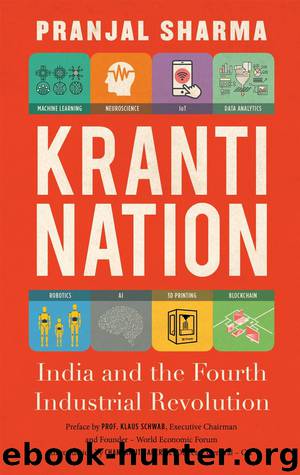
Author:Pranjal Sharma
Language: eng
Format: epub
Tags: Business & Economics, General
Publisher: Pan Macmillan
Published: 2017-11-02T00:00:00+00:00
Apart from healthcare, there are many other sectors in which the AI-first strategy is rolling out. In July 2017, Google acquired Halli Labs, a start-up in Bengaluru which focuses on AI-based solutions.1 The company has also announced that it is mentoring many start-ups in AI in India. These include SigTuple, whose work on AI-based diagnostics is profiled later in the book. ‘The start-ups were shortlisted for their unique value proposition and use of AI and ML to build high-impact solutions for Internet users and the government’s flagship initiative Digital India. We look forward to working with them over the next six months,’ said Google India programme manager, Paul Ravindranath, in a statement.2 Expect Google to acquire more such companies in India.
*
Health technology covers an entire range of products and services employed in the field of health management. To avoid a popular misconception, the healthcare industry referred to in this chapter is a superset of both the medical field and the technological advancements that are used in curative, restorative, palliative, and preventive treatments. A well-developed nation typically has a well-developed healthcare system, with proper delivery and reporting mechanisms in place.
One of the earliest applications of technology in this field was the use of X-rays. Madame Curie’s husband, Pierre Curie, contributed his own genius through the discovery of piezoelectricity (production of electricity through pressure on certain materials), which would eventually help in the generation of ultrasonic-frequency sound waves which are inaudible to the human ear. Ultrasonic imaging would end up being one of the most revolutionary tools available to the diagnostician.
Magnetic Resonance Imaging (MRI), another non-invasive diagnostic tool, was invented in 1971, building on the research and findings in the field of magnetics and resonance since the late 1940s.
Many of the machines we see these days can be considered to be direct descendants of these technologies, employing them in one way or another. As the computing industry grew, becoming more advanced and flexible, companies discovered ways of connecting equipment to terminals, enabling faster diagnoses and recording of a patient’s state of health at different points of time.
In the past two decades, driven principally by the human need to preserve such records, the healthcare industry has expanded to bring in more products and services. If, at one time, the term ‘healthcare’ encompassed only purely medical elements, it now covers ancillary elements such as insurance providers, analytics engines, research departments, device engineers, patients, doctors, wearable technology, at-home/consumer devices, and even sociolegal frameworks.
For instance, electronic health records – which were considered an emerging application as late as in 2009 – are now one of the key drivers for the next generation in healthcare. By standardizing medical histories and reports, it is now possible for hospitals and pharmaceutical companies to keep track of results and monitor them for side-effects. More importantly, though, it has helped save lives because a care provider no longer needs to wait to have a critical patient’s file scanned and sent across.
Wearable technology, such as blood-glucose monitors or pH-monitoring bandages, have reduced the load on clinics without compromising on the patient’s lifestyle.
Download
This site does not store any files on its server. We only index and link to content provided by other sites. Please contact the content providers to delete copyright contents if any and email us, we'll remove relevant links or contents immediately.
The Brazilian Economy since the Great Financial Crisis of 20072008 by Philip Arestis Carolina Troncoso Baltar & Daniela Magalhães Prates(141031)
International Integration of the Brazilian Economy by Elias C. Grivoyannis(111078)
The Art of Coaching by Elena Aguilar(53274)
Flexible Working by Dale Gemma;(23294)
How to Stop Living Paycheck to Paycheck by Avery Breyer(19732)
The Acquirer's Multiple: How the Billionaire Contrarians of Deep Value Beat the Market by Tobias Carlisle(12333)
Thinking, Fast and Slow by Kahneman Daniel(12319)
The Radium Girls by Kate Moore(12036)
The Art of Thinking Clearly by Rolf Dobelli(10495)
Hit Refresh by Satya Nadella(9141)
The Compound Effect by Darren Hardy(8978)
Tools of Titans by Timothy Ferriss(8403)
Atomic Habits: Tiny Changes, Remarkable Results by James Clear(8350)
Turbulence by E. J. Noyes(8057)
A Court of Wings and Ruin by Sarah J. Maas(7858)
Change Your Questions, Change Your Life by Marilee Adams(7788)
Nudge - Improving Decisions about Health, Wealth, and Happiness by Thaler Sunstein(7712)
How to Be a Bawse: A Guide to Conquering Life by Lilly Singh(7494)
Win Bigly by Scott Adams(7204)
