Karl Marx and the Birth of Modern Society by Michael Heinrich;
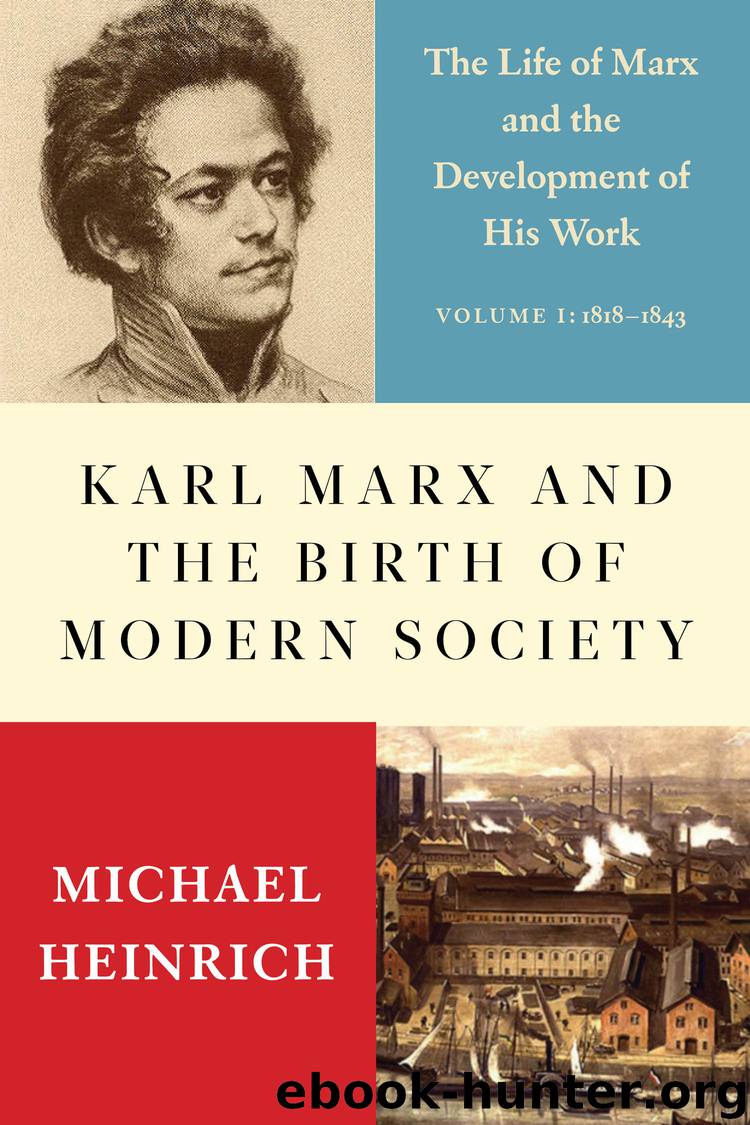
Author:Michael Heinrich;
Language: eng
Format: epub
Publisher: New York University Press
Published: 2019-06-21T16:00:00+00:00
3
THE PHILOSOPHY OF RELIGION, THE BEGINNINGS OF YOUNG HEGELIANISM, AND MARX’S DISSERTATION PROJECTS
1838–1841
From the first two years of Marx’s studies (1835–37), the sources available to us are his father’s letters, Karl’s extensive letter from November 10, 1837, as well as the surviving attempts at poetry. For the period from the end of 1837 until the end of 1840, the availability of sources is considerably worse. From Marx, only a short letter to Adolf Rutenberg has survived; otherwise, there are few letters to Marx. Beyond that, there exist excerpts from the years 1839 and 1840 that were made within the context of Marx’s planned dissertation. Since so little is known about Marx’s life from 1838 to 1840, these years are gladly passed over in biographies and studies of his work. Frequently, the depictions leap from Marx’s letter from November 1837, where he explains his turn to Hegel’s philosophy, to his finished dissertation in 1841.
But the years 1837–41 were important for Marx’s intellectual development. First, his appropriation of Hegel’s philosophy, which had begun in 1837 but was far from concluded, occurred in a specific period of transition. In the second half of the 1830s, Hegel’s reputation had, on the one hand, reached its high point due to the Association of Friends edition of his works and lectures, and, on the other, the Hegelian school began to differentiate itself. This chapter will discuss the extent to which the image of a split between politically conservative “Old Hegelians” and radical “Young Hegelians” is accurate. In any case, Hegelianism was subject to increasingly strong attacks by conservatives, and with the death of the liberal minister of culture, Altenstein, in the year 1840, it also lost its institutional backing. Second, Marx began to occupy himself more intensely in the years after 1837 with a topic that is not examined in many accounts: the philosophy of religion. In the late 1830s, this was a highly political topic in Prussia. The split in the Hegelian school also began with controversies surrounding the philosophy of religion.
The relationship between Marx and Bruno Bauer also has to be considered against this background. In those years, Bauer was connected to Marx not only through an intense personal friendship, but also through considerable proximity in terms of subject matter and politics. Between 1836 and 1839, Bauer consummated a breathtaking development from the “right” to the “left.” We will discuss what Marx’s possible share in this development was, and in turn how Marx was influenced by Bauer.
Toward the end of the 1830s and above all after the royal succession of 1840 and the disappointment that followed when the new king did not bring the liberal reforms that had been hoped for, “Young Hegelian” authors developed increasingly radical positions, “bolder,” wrote Friedrich Engels in 1851, “than hitherto it had been the fate of German ears to hear expounded.” Furthermore, they “attempted to restore to glory the memory of the heroes of the first French Revolution,” which was frowned upon in Germany at the time (MECW 11: 15).
Download
This site does not store any files on its server. We only index and link to content provided by other sites. Please contact the content providers to delete copyright contents if any and email us, we'll remove relevant links or contents immediately.
| Anarchism | Communism & Socialism |
| Conservatism & Liberalism | Democracy |
| Fascism | Libertarianism |
| Nationalism | Radicalism |
| Utopian |
The Secret History by Donna Tartt(19053)
The Social Justice Warrior Handbook by Lisa De Pasquale(12187)
Thirteen Reasons Why by Jay Asher(8893)
This Is How You Lose Her by Junot Diaz(6877)
Weapons of Math Destruction by Cathy O'Neil(6265)
Zero to One by Peter Thiel(5786)
Beartown by Fredrik Backman(5737)
The Myth of the Strong Leader by Archie Brown(5500)
The Fire Next Time by James Baldwin(5431)
How Democracies Die by Steven Levitsky & Daniel Ziblatt(5215)
Promise Me, Dad by Joe Biden(5141)
Stone's Rules by Roger Stone(5081)
A Higher Loyalty: Truth, Lies, and Leadership by James Comey(4954)
100 Deadly Skills by Clint Emerson(4921)
Rise and Kill First by Ronen Bergman(4779)
Secrecy World by Jake Bernstein(4741)
The David Icke Guide to the Global Conspiracy (and how to end it) by David Icke(4708)
The Farm by Tom Rob Smith(4502)
The Doomsday Machine by Daniel Ellsberg(4484)
