It's Even Worse Than It Looks by Thomas E. Mann & Norman J. Ornstein
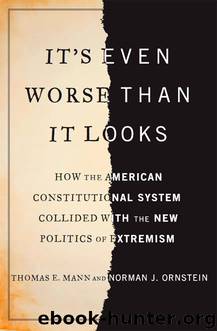
Author:Thomas E. Mann & Norman J. Ornstein [Mann, Thomas E. & Ornstein, Norman J.]
Language: eng
Format: epub
ISBN: 9780465031337
Amazon: 0465031331
Publisher: Basic Books
Published: 2012-05-02T04:00:00+00:00
A Constitutional Amendment to Balance the Budget
Enshrining a requirement for an annual balanced budget in the Constitution is a faulty response to overcoming America’s dysfunctional politics, although it is a centerpiece of congressional Republicans’ plans to deal with deficits and debt and endorsed by all the candidates seeking the GOP presidential nomination. Yes, some version of this amendment is part of forty-nine state constitutions. Yes, more than three-quarters of the public consistently supports its addition to the federal constitution. Yes, federal budget deficits have reached record levels in the past several years, and public debt as a share of the total economy is on a course to threaten the country’s financial integrity. And yes, the regular congressional budget process during this period of time has only nibbled at the edges of the problem in spite of its seriousness.
The 2011 House Republican plan to “Cut, Cap and Balance” the federal budget requires that federal spending be capped over ten years at 19.9 percent of GDP and makes it contingent on passage of a constitutional amendment, which requires spending and revenues to be balanced and a two-thirds majority in both the House and Senate to approve any increase in taxes and in the debt ceiling. Republicans brought the plan up for a vote in the House and intend to do so again. Most Republican presidential candidates have endorsed it.
It is not the only balanced budget amendment out there. The amendment that most House Republicans and every Senate Republican have endorsed is even more draconian. It would cap spending at 18 percent of GDP, but based on the previous year’s GDP, meaning, according to Republican economist Donald Marron, a cap of 16.7 percent of GDP in federal spending.13 This amendment, if added to the Constitution, would require drastic cuts in every area of spending, from health research to food safety to defense and homeland security to Medicare and Social Security, taking America’s social policy back to pre–New Deal territory. The caps could be overcome only via a formal declaration of war or when Congress recognizes a military conflict is underway, and any increased spending over the cap would have to be applied to the military action.
So what’s the problem with a balanced budget amendment? The huge cuts in federal spending and/or increases in taxes would be required immediately following ratification. The supermajority requirement for tax increases makes it highly likely that only spending cuts would be on the table. The public that supports a balanced budget amendment has no idea that these cuts are perforce part of the deal. By way of comparison, the ambitious, conservative budget resolution crafted by Budget Committee Chairman Paul Ryan and approved by House Republicans, which includes deep cuts in discretionary domestic spending and a major restructuring of the Medicare and Medicaid programs, would not reach a balance for decades.
If the amendment were ratified quickly, these deep cuts would be made at a time in which the economy remains at risk of a double-dip recession. Such an austerity
Download
This site does not store any files on its server. We only index and link to content provided by other sites. Please contact the content providers to delete copyright contents if any and email us, we'll remove relevant links or contents immediately.
| Anthropology | Archaeology |
| Philosophy | Politics & Government |
| Social Sciences | Sociology |
| Women's Studies |
The Secret History by Donna Tartt(19486)
The Social Justice Warrior Handbook by Lisa De Pasquale(12302)
Thirteen Reasons Why by Jay Asher(9136)
This Is How You Lose Her by Junot Diaz(7078)
Weapons of Math Destruction by Cathy O'Neil(6489)
Zero to One by Peter Thiel(5957)
Beartown by Fredrik Backman(5954)
The Myth of the Strong Leader by Archie Brown(5633)
The Fire Next Time by James Baldwin(5599)
How Democracies Die by Steven Levitsky & Daniel Ziblatt(5340)
Promise Me, Dad by Joe Biden(5240)
Stone's Rules by Roger Stone(5198)
A Higher Loyalty: Truth, Lies, and Leadership by James Comey(5092)
100 Deadly Skills by Clint Emerson(5036)
Rise and Kill First by Ronen Bergman(4914)
Secrecy World by Jake Bernstein(4900)
The David Icke Guide to the Global Conspiracy (and how to end it) by David Icke(4858)
The Doomsday Machine by Daniel Ellsberg(4635)
The Farm by Tom Rob Smith(4614)
