Islam and Liberal Citizenship by Andrew F. March
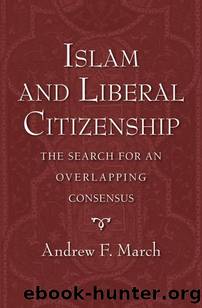
Author:Andrew F. March [March, Andrew F.]
Language: eng
Format: epub
Publisher: Oxford University Press
Published: 2009-03-26T18:30:00+00:00
6
Loyalty to a Non-Muslim State
Fulfill the Covenant of God when you have entered into it and do not break your oaths after you have affirmed them for you have made God your guarantor and God knows all that you do.
âQurâan, SÅ«rat al-Nal (16):191
It is not righteousness to turn your faces towards East or West, but rather righteousness is . . . to fulfill the contracts which you make.
âQurâan, SÅ«rat al-Baqara (2):177
In chapter 3, we came across a tradition of Islamic doctrines that constitute the Islamic foundation for rejecting civic loyalty to a non-Muslim state. Views akin to the following five positions are ubiquitous in Islamic juridical discourses:
1. A Muslim may never combat another Muslim in the service of unbelievers regardless of the cause.
2. A war for the sole purpose of expanding the space ruled by Islam and Islamic law is a just war, a legitimate form of jihÄd.
3. It may be the duty of every individual Muslim, even those residing outside the Islamic polity to contribute to a legitimate jihÄd, if so called by a legitimate Imam.
4. A Muslim may not advance the cause of unbelievers or uphold non-Islamic rulings and truth-claims.
5. A Muslim may not sacrifice his life for other than certain causes, of which defending a non-Muslim society is not one.
Given that, taken individually or together, these principles deny that a Muslim resident of a non-Muslim state may develop even minimal bonds of loyalty to it, especially when that might detract from loyalty to the Muslim community, I have argued that an Islamic doctrine of citizenship would require some formulation of contrary principles.
It is appropriate here to summarize my discussion from chapter 4 of what political liberalism might regard as the proper demands on citizens in terms of patriotism and contributing to a stateâs self-defense. Traditional liberal justifications of conscientious objection to unjust wars, or general exemption from fighting in the case of committed pacifists, do not apply in the case of believing Muslim citizens. In their case, a reluctance to fight may be the consequence of the principle of al-walÄâ waâl-barÄâ: their solidarity with a community of fellow believers across citizenship boundaries or, inversely, even when hostilities do not concern Muslims on either side, their unwillingness to form deep bonds of solidarity with non-Muslims at all. The basic idea of greater solidarity with Muslims does not necessarily result in a doctrine contrary to the demands of citizenship from the perspective of political liberalism because communal solidarity is one of those components of a conception of the good that might be reasonable. Political liberalism does not demand that a deep, robust, emotional commitment to oneâs political community and its system of governance be part of oneâs comprehensive conception of the good. If a conception of the good involves a special concern for a certain community of fellow believers, then political liberalism objects only insofar as this special concern prescribes attitudes or actions that violate the legitimate political rights and needs of the community of citizenship. I thus argued
Download
This site does not store any files on its server. We only index and link to content provided by other sites. Please contact the content providers to delete copyright contents if any and email us, we'll remove relevant links or contents immediately.
| Anthropology | Archaeology |
| Philosophy | Politics & Government |
| Social Sciences | Sociology |
| Women's Studies |
The Secret History by Donna Tartt(19111)
The Social Justice Warrior Handbook by Lisa De Pasquale(12197)
Thirteen Reasons Why by Jay Asher(8921)
This Is How You Lose Her by Junot Diaz(6894)
Weapons of Math Destruction by Cathy O'Neil(6286)
Zero to One by Peter Thiel(5808)
Beartown by Fredrik Backman(5769)
The Myth of the Strong Leader by Archie Brown(5513)
The Fire Next Time by James Baldwin(5456)
How Democracies Die by Steven Levitsky & Daniel Ziblatt(5225)
Promise Me, Dad by Joe Biden(5159)
Stone's Rules by Roger Stone(5091)
A Higher Loyalty: Truth, Lies, and Leadership by James Comey(4967)
100 Deadly Skills by Clint Emerson(4935)
Rise and Kill First by Ronen Bergman(4797)
Secrecy World by Jake Bernstein(4756)
The David Icke Guide to the Global Conspiracy (and how to end it) by David Icke(4724)
The Farm by Tom Rob Smith(4517)
The Doomsday Machine by Daniel Ellsberg(4493)
