Is Russia Fascist? by Marlene Laruelle
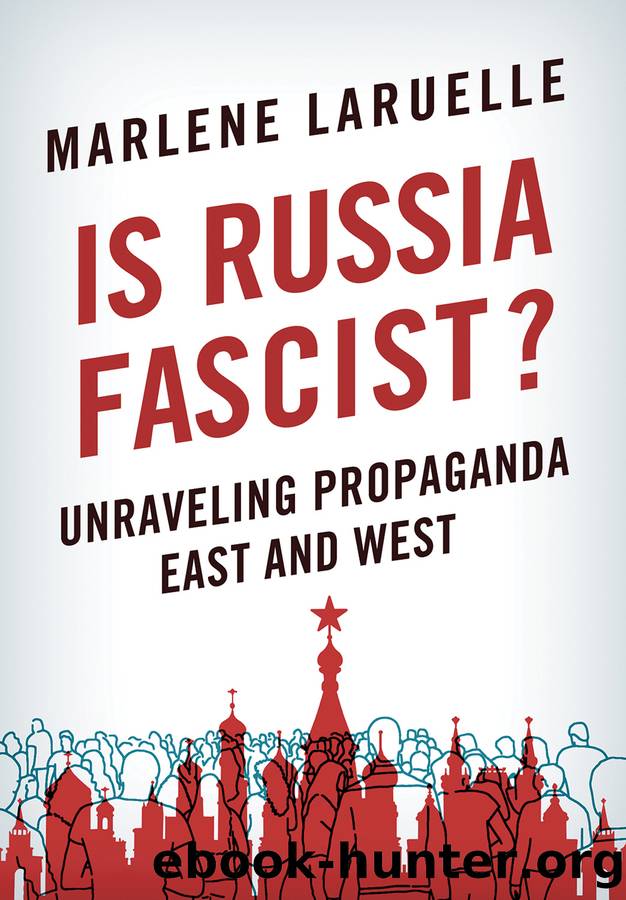
Author:Marlene Laruelle
Language: eng
Format: epub
Publisher: Cornell University Press
Regime Theory and the Neo-Totalitarianism Fallacy
Another aspect of the debate to be debunked is related to the use of the concept of totalitarianism.12 The totalitarianism theory, established by Hannah Arendt in her 1951 bookâeven if the term was largely used before her by scholars describing Italian Fascism and by writers such as George Orwellâstates that totalitarianism is a novel form of government that cannot be considered a higher degree of authoritarianism but is instead one of a kind.13 Yet many scholars of fascism explain that if the concept of totalitarianism works for Nazi Germanyâand for the Stalinist Soviet Unionâand was aspirational for Mussoliniâs Italy, it does not apply to more âmoderateâ fascist regimes such as those that existed in Spain, Portugal, or Latin America, which combined a more traditional authoritarian regime with a military junta in power, nor to the late Soviet Union.14 With the exception of Nazi Germany, the majority of fascist regimes were not totalitarian in practiceâthey did not exercise full control of every aspect of individual life, and instead showed some âloopholesâ in their totalitarian aspirations.
In all cases, Nazi-style totalitarianism, southern European- and Latin American-style military authoritarianism, and Stalinism, these parallels fail to work for Putinâs Russia. Totalitarianism uses a system of terror to subjugate mass populations and seeks to dominate every aspect of life as a prelude to world domination. Todayâs Russia offers no indications that would qualify it as a totalitarian state: no system of terror is in place, no mandatory indoctrination exists to subjugate the masses, and no mobilization mechanisms are present. Definitions of todayâs Russian regime as totalitarian thus do not rely on scholarly analysis but belong to media hype, such as, for instance, Masha Gessenâs The Future Is History: How Totalitarianism Reclaimed Russia,15 or to the politicized labeling of Russia as fascist, such as that advanced by Snyder or Alexander Motyl. This label is based on a fallacious logical triangle: if Nazism and Communism are equally totalitarian and if the Putin regime is neo-Stalinist, then Putinâs Russia equals Nazism through its revamped Stalinism.
The Putin regime focuses on outlawing liberal opposition and invites citizens to be busy with their private lives and individual well-being, permitting as many free spaces as possible for nonpolitical expression in order to avoid resentment, which could become a driver of antiregime mobilization. These features are classic for authoritarian regimes, which limit themselves to gaining and then keeping political power, requiring the observance of certain rules, and allowing limited liberties as long as they do not challenge political domination. One can thus question whether Putin is, as Motyl asserts, âa dictator.â Motyl supports his claims of Russiaâs alleged dictatorship by relying on Freedom House scores, a choice that hardly makes his allegations incontrovertibleâthe advocacy institution divides the world into just three categories (free, partly free, and not free), a classification that is too restrictive to be meaningful.16
The Polity IV project offers a much more granular ranking for capturing the nature of the Russian political regime by âexamining concomitant qualities
Download
This site does not store any files on its server. We only index and link to content provided by other sites. Please contact the content providers to delete copyright contents if any and email us, we'll remove relevant links or contents immediately.
| Arms Control | Diplomacy |
| Security | Trades & Tariffs |
| Treaties | African |
| Asian | Australian & Oceanian |
| Canadian | Caribbean & Latin American |
| European | Middle Eastern |
| Russian & Former Soviet Union |
The Secret History by Donna Tartt(19088)
The Social Justice Warrior Handbook by Lisa De Pasquale(12190)
Thirteen Reasons Why by Jay Asher(8909)
This Is How You Lose Her by Junot Diaz(6886)
Weapons of Math Destruction by Cathy O'Neil(6279)
Zero to One by Peter Thiel(5802)
Beartown by Fredrik Backman(5754)
The Myth of the Strong Leader by Archie Brown(5507)
The Fire Next Time by James Baldwin(5444)
How Democracies Die by Steven Levitsky & Daniel Ziblatt(5218)
Promise Me, Dad by Joe Biden(5153)
Stone's Rules by Roger Stone(5087)
A Higher Loyalty: Truth, Lies, and Leadership by James Comey(4963)
100 Deadly Skills by Clint Emerson(4925)
Rise and Kill First by Ronen Bergman(4788)
Secrecy World by Jake Bernstein(4753)
The David Icke Guide to the Global Conspiracy (and how to end it) by David Icke(4718)
The Farm by Tom Rob Smith(4509)
The Doomsday Machine by Daniel Ellsberg(4490)
