Is Democracy Possible Here?: Principles for a New Political Debate by Ronald Dworkin
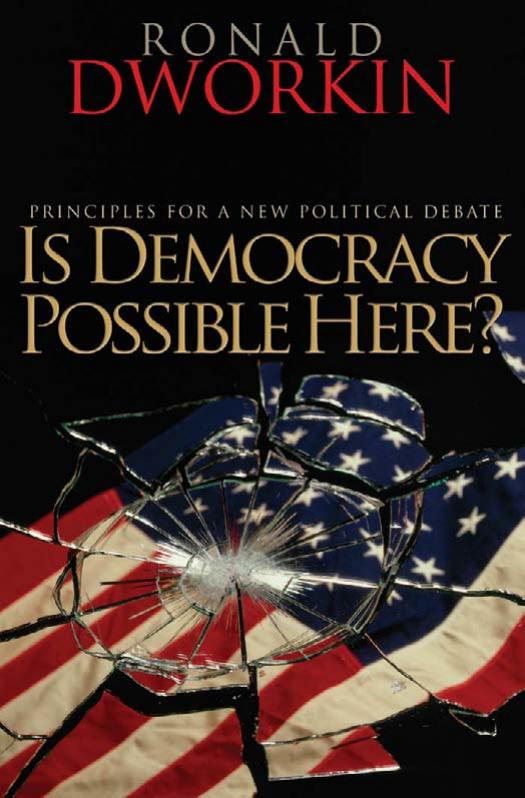
Author:Ronald Dworkin [Dworkin, Ronald]
Language: eng
Format: epub, pdf
Tags: Political Science, Philosophy, Political Ideologies, Democracy, Political
ISBN: 9781400827275
Publisher: Princeton University Press
Published: 2008-07-01T04:04:01+00:00
Allegiance and Ceremony
Now consider another issue of contemporary controversy: the American pledge of allegiance. This is the official pledge of political fidelity that by tradition is recited in schools and on some ceremonial occasions. For some decades the ritual pledge has included, by act of Congress, a reasonably ecumenical religious declaration: the pledge recites that America is “one nation under God.” The pledge is voluntary; the Supreme Court held long ago, even before this reference to God was made part of the pledge, that schoolchildren could not be forced to recite it. People drawn to the tolerant religious model support the religious reference in the official pledge because they believe it both symbolizes and achieves an indispensable fusion of religion and patriotism. They point out that since no one is required to recite the official pledge, no one is forced into an act that contradicts his conscience. They might acknowledge that an American who stands silent while the crowd around him recites the pledge is made to feel an outsider. That is nevertheless his choice, however; if he cannot subscribe to an ecumenical endorsement of monotheism, he is an outsider, and there can be harm in reminding him and everyone else of that fact.
But dignity does not simply command that no one be forced to recite what he does not believe. It assigns us a positive responsibility to choose ethical values for ourselves, and though, as I said, we know we are influenced by a thousand dimensions of culture in making those choices, we must nevertheless refuse to accept subordination to a government that deliberately and coercively manipulates our choices. There can be no distributive justification for creating an official pledge that makes full citizens feel like outsiders. There can be only a personally judgmental justification: deliberately influencing the shared culture to associate religion and patriotism, on the ground that that association is desirable, in a way that makes it more difficult for someone who wishes to embrace patriotism free of religion to do so. It is plainly part of people’s responsibility for their own values to define for themselves the religious or metaphysical assumptions of political allegiance. The coercive impact of an officially endorsed ritual is no more acceptable than the open manipulation of compelled assertion.
That coercive impact is in fact not very strong, however, and so though the official pledge is a violation of liberty, it is not a practically serious one. Just as an atheist can fish in his pocket for a coin that bears a message of trust in God or stand at the opening ceremony of prayer in congressional or court sessions without any sense of self-betrayal, so he can mouth the words of the pledge without loss of integrity. Few children treat the detailed wording of the pledge they recite in school as having the authority even of the solemn vows they make in the playground. But that means only that the intended purpose of making the pledge theological has failed, not that that purpose is in itself legitimate.
Download
Is Democracy Possible Here?: Principles for a New Political Debate by Ronald Dworkin.pdf
This site does not store any files on its server. We only index and link to content provided by other sites. Please contact the content providers to delete copyright contents if any and email us, we'll remove relevant links or contents immediately.
| Anthropology | Archaeology |
| Philosophy | Politics & Government |
| Social Sciences | Sociology |
| Women's Studies |
The Secret History by Donna Tartt(19092)
The Social Justice Warrior Handbook by Lisa De Pasquale(12191)
Thirteen Reasons Why by Jay Asher(8912)
This Is How You Lose Her by Junot Diaz(6889)
Weapons of Math Destruction by Cathy O'Neil(6281)
Zero to One by Peter Thiel(5802)
Beartown by Fredrik Backman(5756)
The Myth of the Strong Leader by Archie Brown(5509)
The Fire Next Time by James Baldwin(5447)
How Democracies Die by Steven Levitsky & Daniel Ziblatt(5219)
Promise Me, Dad by Joe Biden(5154)
Stone's Rules by Roger Stone(5088)
A Higher Loyalty: Truth, Lies, and Leadership by James Comey(4964)
100 Deadly Skills by Clint Emerson(4926)
Rise and Kill First by Ronen Bergman(4790)
Secrecy World by Jake Bernstein(4753)
The David Icke Guide to the Global Conspiracy (and how to end it) by David Icke(4720)
The Farm by Tom Rob Smith(4514)
The Doomsday Machine by Daniel Ellsberg(4490)
