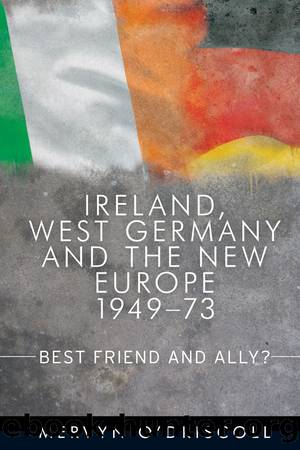
Ireland, West Germany and the New Europe, 1949-73: Best Friend and Ally? by Mervyn O'Driscoll
Author:Mervyn O'Driscoll [O'Driscoll, Mervyn]
Language: eng
Format: epub
Tags: Europe, Comparative Politics, Political Science, History, General
ISBN: 9781526126061
Google: 7HK5DwAAQBAJ
Publisher: Manchester University Press
Published: 2018-01-10T10:21:10+00:00
Adapting to European foreign preferences
A reconfiguration of Irish foreign policy was also palpable in other arenas and it broadly coincided with Lemassâs elevation to the head of government and the appearance of European trade divisions. Until this juncture, Ireland had remained an independent-minded actor in the UN under Aikenâs stewardship (after 1957). It had demonstrated limited common cause with its European neighbours in the UNâs Western European Group. This was signified by its non-membership of NATO and its unreliability on several issues of concern to the Western Europeans.32
The AA, it will be recalled, was disconcerted by Aikenâs proposal in 1957 recommending NATO and Warsaw Pact troop disengagement in the Central European zone to create a neutral zone. Bonn regarded Aikenâs intervention as unsolicited and ill-advised.33 Such unilateralism in an area of direct interest to Germany without advance consultation was unwise. Irish support for Chinese membership of UN was also contra the American line that was mimicked by the Western Europeans in the UN. Adenauerâs Germany was a devotee of US policy preferences on most matters; its security depended on US sponsorship and activism in NATO. Aikenâs maverick behaviour (by Western standards) in the UN in 1957 and 1958 had not been greeted with acclamation in West German circles.
Irish membership of the UN was important in German official minds, particularly in the light of the Germany non-membership of this important organisation. In line with its standard practice since the 1950s, the Irish Republic remained an unflagging adherent to the Hallstein Doctrine.34 It resolutely refused to recognise the GDR as an independent sovereign state designating it âthe Soviet Occupied Zone of Germanyâ in line with NATO practice.35 Bonn and West German public opinion were grateful for Aikenâs plea for German reunification at the opening general debate of the 14th session of UN General Assembly in September 1959:
If a just and lasting peace is to be made in Europe, the problem of German reunification must be settled in accordance with the will of the majority of the German people and the right of nations to unity and independence. There is, as far as we can see, no peaceful and permanent solution for Berlin, except as the capital of a united Germany.36
His modulated intimation suggesting a central European zone of peace inspected by the UN, consisting of âa reunited Germany, together with Poland and other eastern European countries ⦠free from foreign troops, free from weapons of blitzkrieg and mass destructionâ, also gained coverage.37 The German papers were silent about the main part of Aikenâs speech which was devoted to the dangers of nuclear weapons and the necessity for nuclear non-dissemination and a test ban.38
As a result of the publicity surrounding the German reunification component of Aikenâs 1959 speech, a member of the Irish Legation was invited to visit the border between the FRG and the GDR in October 1959.39 Next Frederick Boland, the Irish permanent representative to the UN, stood as a candidate in the elections for the presidency of the General Assembly for the 15th session of the UN (1960â61).
Download
This site does not store any files on its server. We only index and link to content provided by other sites. Please contact the content providers to delete copyright contents if any and email us, we'll remove relevant links or contents immediately.
| Anthropology | Archaeology |
| Philosophy | Politics & Government |
| Social Sciences | Sociology |
| Women's Studies |
The Secret History by Donna Tartt(19053)
The Social Justice Warrior Handbook by Lisa De Pasquale(12187)
Thirteen Reasons Why by Jay Asher(8894)
This Is How You Lose Her by Junot Diaz(6877)
Weapons of Math Destruction by Cathy O'Neil(6267)
Zero to One by Peter Thiel(5789)
Beartown by Fredrik Backman(5737)
The Myth of the Strong Leader by Archie Brown(5500)
The Fire Next Time by James Baldwin(5431)
How Democracies Die by Steven Levitsky & Daniel Ziblatt(5216)
Promise Me, Dad by Joe Biden(5144)
Stone's Rules by Roger Stone(5081)
A Higher Loyalty: Truth, Lies, and Leadership by James Comey(4954)
100 Deadly Skills by Clint Emerson(4921)
Rise and Kill First by Ronen Bergman(4780)
Secrecy World by Jake Bernstein(4741)
The David Icke Guide to the Global Conspiracy (and how to end it) by David Icke(4709)
The Farm by Tom Rob Smith(4502)
The Doomsday Machine by Daniel Ellsberg(4484)
