India in Translation, Translation in India by GJV Prasad;
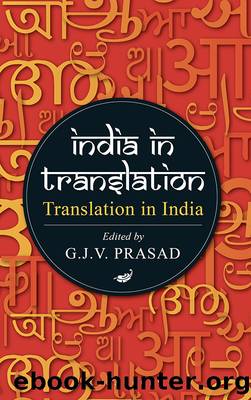
Author:GJV Prasad;
Language: eng
Format: epub
Publisher: Bloomsbury UK
10
Transcending Borders, Bridging Cultures: Reading Faiz Ahmed Faiz1
Fatima Rizvi
People within a cultural tradition engage with their literary texts in a process of âprimary internalisationâ whereby they interiorise literary capital in their collective consciousness. Authors and their texts, inclusive of metaphors, images and symbols, become part and parcel of a literary imagination. âSecondary internalisationâ requires people from different cultural domains to develop a level of familiarity with the linguistic practices, literary forms and styles of other cultural traditions. This makes serious demands upon readers. Only after striking the imagination of the new readers, can the new literary forms be accepted and subsequently internalised (Rahman âInternalizingâ¦â). Translation enables secondary internalisation by widening the scope of literary forms belonging to various literary and linguistic traditions. In the case of British Literature, translation decentralises its centrality by increasing the relevance of literatures belonging to other cultural and linguistic canons. It helps create liberal spaces of readership where acceptance of new texts and significance of different sensibilities becomes possible. It widens possibilities of reviewing and researching not only a text but also the culture of its location. Translational exercises are processes whereby the translator decodes semantic and syntactic codes of the source language along with the intangible and tangible cultural elements and recodes or appropriates them so as to blend with the target language and culture. Cross-cultural translational exercises are about understanding and interpreting cultural significations with a view to surmount both linguistic and cultural gaps. They involve a creative involvement with the source and the target languages. Familiarity with the cultural milieu of the two languages plays a significantly enabling role. This chapter reads poems of Faiz Ahmed Faiz (1911â1984) and their translations, as creative exercises, transcending borders and bridging cultures. It elucidates that translation is not merely âa transaction between two languages ⦠that literary texts [are] constituted not primarily of language but in fact culture, language being in effect a vehicle of cultureâ (Trivedi 2007, 278). It explicates that âthe task of the translator consists in finding the particular intention toward the target language which produces in that language the echo of the originalâ (Benjamin 2002, 258). The aim of translation is not to imitate the sense of the original, but to incorporate the originalâs way of meaning and thus make both the translation and the original recognisable as fragments of a greater language (Benjamin 2002, 260). The study comments on Faizâs assertiveness in having himself translated. It reads humanism in his poetry and goes on to read translatorsâ engagements/conversations with the aesthetic and essence of Faizâs Urdu language poetry and its significationsâboth possibilities owing much to the availability of the translated Faiz.
During the nineteenth century, prose genres were popular, perhaps because they were better suited to express realism that was rapidly making inroads into the socio-cultural fabric of subcontinental India. Apart from this, the popularity of prose emanated from the fact that it was easy to grasp for readers who werenât from literary backgrounds, as also for those looking for the social change it was propagating.
Download
This site does not store any files on its server. We only index and link to content provided by other sites. Please contact the content providers to delete copyright contents if any and email us, we'll remove relevant links or contents immediately.
| Anthropology | Archaeology |
| Philosophy | Politics & Government |
| Social Sciences | Sociology |
| Women's Studies |
Born to Run: by Christopher McDougall(7121)
The Leavers by Lisa Ko(6945)
iGen by Jean M. Twenge(5408)
Sapiens by Yuval Noah Harari(5366)
Spare by Prince Harry The Duke of Sussex(5176)
The Kite Runner by Khaled Hosseini(5170)
Machine Learning at Scale with H2O by Gregory Keys | David Whiting(4293)
Bullshit Jobs by David Graeber(4179)
Never by Ken Follett(3937)
Goodbye Paradise(3799)
Livewired by David Eagleman(3764)
Fairy Tale by Stephen King(3370)
A Dictionary of Sociology by Unknown(3073)
Harry Potter 4 - Harry Potter and The Goblet of Fire by J.K.Rowling(3060)
The Social Psychology of Inequality by Unknown(3018)
The Club by A.L. Brooks(2919)
Will by Will Smith(2910)
0041152001443424520 .pdf by Unknown(2843)
People of the Earth: An Introduction to World Prehistory by Dr. Brian Fagan & Nadia Durrani(2728)
