Imagining the Unimaginable by Glyn Morgan;
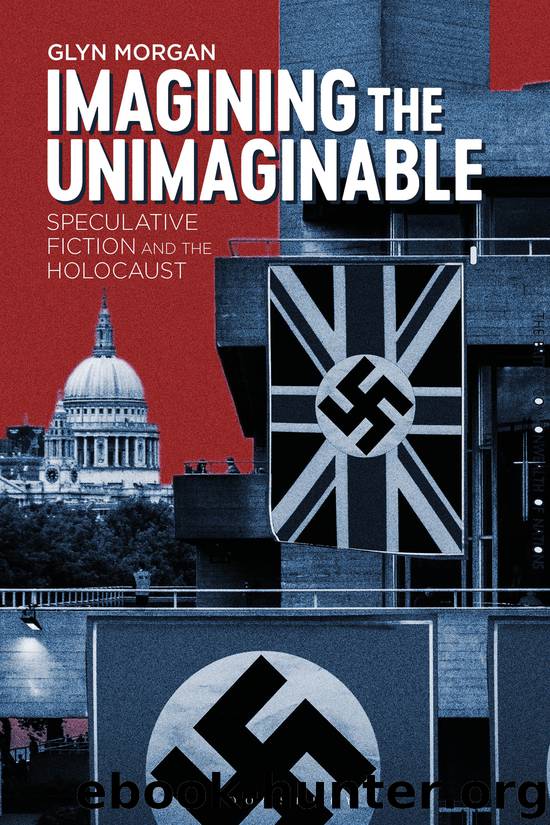
Author:Glyn Morgan;
Language: eng
Format: epub
Publisher: Bloomsbury USA
Epilogue: Further Fabulation
One generation later, it can still be said and must now be affirmed: There is no such thing as a literature of the Holocaust, nor can there be. The very expression is a contradiction in terms. Auschwitz negates any form of literature, as it defies all systems, all doctrines ... A novel about Auschwitz is not a novel, or else it is not about Auschwitz. The very attempt to write such a novel is blasphemy.1
Elie Wiesel was the most vocal defender of the representation of the Holocaust as unrepresentable, yet he is also one of its most prolific writers, producing both fiction and non-fiction about the genocide. However, there is a blurriness to these distinctions; Wiesel’s own Night is normally referred to as a Holocaust memoir yet many critics have identified its fictive qualities. Ruth Franklin points out that it, ‘like the stories of Tadeusz Borowski, the autobiographical work of Primo Levi, and virtually every other important work of literature about the Holocaust – has been understood, at different times, as both a novel and a memoir’.2 There is a slippage of terminology and classification, aided by the insistence of impossibility, the reliance on highfalutin quasi-religious statements – often ironically poetic in their insistence of the futility of poetry – and made more complicated still by infamous examples of forgery.3 A slippage which seems to support the insistence that the Holocaust truly is something different as a source material for humanity’s writing, that the standard tools are no longer adequate, but that does not mean that we are without resources.
The texts I have discussed in this book are testament to the storytelling capacities of speculative fiction and its capacity to be utilized as just such a resource for attempting to explore the Holocaust’s relationship with our culture, especially now more than seventy years since its end. The paradox of the Holocaust is its prolific presence in literature (fiction and non-fiction) placed against the rhetoric of unspeakability which has historically dominated surrounding discourse. Speculative fiction narratives seek to square the circle, unravelling the paradox by dislocating the Other of the Holocaust to the Other of the non-mimetic through estrangement, an Other which thanks to millennia of non-mimetic narratives we are more comfortably able to cognitively conceptualize. Fredric Jameson writes of historical fabulations that ‘agency steps out of the historical record itself into the process of devising it; and new multiple or alternate strings of events rattle the bars of the national traditional and the history manuals’.4 The Holocaust is not outside of history, despite the sentiment expressed by some supporters of exceptionalism that perhaps it should be, and so the Holocaust is not beyond the effect described by Jameson.
Wiesel also wrote that the title of his important essay ‘The Holocaust as Literary Inspiration’ is an impossible contradiction. ‘Wouldn’t that mean, then’, he writes ‘that Treblinka and Belzec, Ponar and Babi Yar all ended in fantasy, in words, in beauty, that it was simply a matter of literature?’5 Wiesel equates
Download
This site does not store any files on its server. We only index and link to content provided by other sites. Please contact the content providers to delete copyright contents if any and email us, we'll remove relevant links or contents immediately.
4 3 2 1: A Novel by Paul Auster(12363)
The handmaid's tale by Margaret Atwood(7749)
Giovanni's Room by James Baldwin(7315)
Asking the Right Questions: A Guide to Critical Thinking by M. Neil Browne & Stuart M. Keeley(5751)
Big Magic: Creative Living Beyond Fear by Elizabeth Gilbert(5744)
Ego Is the Enemy by Ryan Holiday(5409)
The Body: A Guide for Occupants by Bill Bryson(5072)
On Writing A Memoir of the Craft by Stephen King(4924)
Ken Follett - World without end by Ken Follett(4717)
Adulting by Kelly Williams Brown(4561)
Bluets by Maggie Nelson(4542)
Eat That Frog! by Brian Tracy(4512)
Guilty Pleasures by Laurell K Hamilton(4437)
The Poetry of Pablo Neruda by Pablo Neruda(4088)
Alive: The Story of the Andes Survivors by Piers Paul Read(4017)
White Noise - A Novel by Don DeLillo(3999)
Fingerprints of the Gods by Graham Hancock(3983)
The Book of Joy by Dalai Lama(3966)
The Bookshop by Penelope Fitzgerald(3841)
