Humanitarian Negotiations with Armed Groups by Ashley Jonathan Clements;
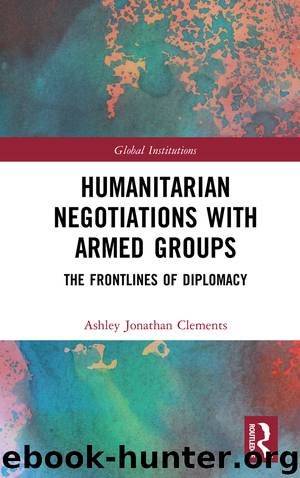
Author:Ashley Jonathan Clements;
Language: eng
Format: epub
Publisher: Taylor & Francis (CAM)
Published: 2020-03-15T00:00:00+00:00
Negotiation process
Myanmar HC Ashok Nigam (2011–2013) and representatives from OCHA first reached out to the KIA soon after the resumption of hostilities in mid-2011. Humanitarian officials invested in relationships with local Kachin-based development and humanitarian workers, using these groups to make initial phone contact with the KIA. The Kachin rebels proved receptive to international offers of assistance but reportedly declined to provide written authorization for humanitarian personnel to access areas under their control. International agencies also required permission from national, local, and military authorities to reach KIA territory. This, too, had to be negotiated as part of the complex, continuous, multi-level humanitarian negotiations in the state.
During the first months of fighting, requests by senior UN officials for blanket permission to access all conflict-affected areas in the state were quickly rejected at the highest levels in Naypyidaw. Early negotiations with Union officials to establish days of tranquility and humanitarian corridors also failed.36 In parallel, international humanitarians began to engage with the Kachin State Government (KSG) to negotiate access to KIA-held areas. But state authorities refused to permit international agencies to cross frontlines, deferring to their national counterparts who in turn often delayed negotiations by claiming to consult the KSG or the Tatmadaw prior to making a decision. National and state authorities rarely refused access requests outright, but instead delayed decisions, ignored demands, or objected to the timing of travel requests (usually citing security concerns). Approaches were also made to negotiate directly with the Northern Command (the section of the Tatmadaw responsible for military operations in Kachin State). But they too insisted on receiving permission from Naypyidaw prior to negotiating access with international agencies.
Negotiations with national authorities over access to rebel-held areas of the state were undermined by the opaque decision-making structures within the former military regime. The outbreak of fighting in mid-2011 coincided with the transition to a nominally civilian government under the leadership of President Thein Sein. Decision-making and political agendas within the new administration proved somewhat unknown and untested for international negotiators, leading to months of delays and uncertainty. Humanitarians were thus caught between state and national authorities, and between political and military actors, in a complex series of negotiations – the success of which was a prerequisite for negotiating with the KIA.
Five key interests likely influenced the attitude of political and military authorities towards humanitarian access. First, national authorities were determined to limit the presence of international personnel within the state who could bear witness to the conduct of Tatmadaw forces and would thereby increase political pressure on the regime. Second, Naypyidaw was likely fearful that a substantial international presence in KIA-held areas would legitimize the armed group and bolster their support. Third, both political and military authorities expressed concern that substantial flows of relief into KIA-controlled areas were being diverted for use by the Kachin rebels or were allowing the armed group to redirect resources away from relief activities to support combat – a concern that was not entirely unfounded. Fourth, Naypyidaw and the Tatmadaw appear to
Download
This site does not store any files on its server. We only index and link to content provided by other sites. Please contact the content providers to delete copyright contents if any and email us, we'll remove relevant links or contents immediately.
| Anthropology | Archaeology |
| Philosophy | Politics & Government |
| Social Sciences | Sociology |
| Women's Studies |
The Secret History by Donna Tartt(19470)
The Social Justice Warrior Handbook by Lisa De Pasquale(12293)
Thirteen Reasons Why by Jay Asher(9120)
This Is How You Lose Her by Junot Diaz(7057)
Weapons of Math Destruction by Cathy O'Neil(6468)
Zero to One by Peter Thiel(5952)
Beartown by Fredrik Backman(5939)
The Myth of the Strong Leader by Archie Brown(5625)
The Fire Next Time by James Baldwin(5586)
How Democracies Die by Steven Levitsky & Daniel Ziblatt(5322)
Promise Me, Dad by Joe Biden(5229)
Stone's Rules by Roger Stone(5190)
A Higher Loyalty: Truth, Lies, and Leadership by James Comey(5089)
100 Deadly Skills by Clint Emerson(5023)
Rise and Kill First by Ronen Bergman(4891)
Secrecy World by Jake Bernstein(4885)
The David Icke Guide to the Global Conspiracy (and how to end it) by David Icke(4850)
The Doomsday Machine by Daniel Ellsberg(4622)
The Farm by Tom Rob Smith(4611)
