Hubris by Meghnad Desai
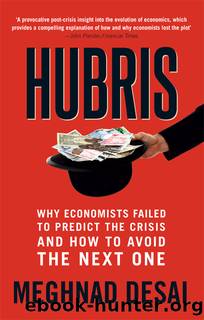
Author:Meghnad Desai
Language: eng
Format: epub
ISBN: 9780300213546
Publisher: Yale University Press
Keynesian Economics in Action
Keynesâs theory lent itself easily to a mathematical formulation. During World War II, scientific research had been harnessed to the war effort. The idea that government policy could be improved by using modern tools of mathematics and statistics was central to both the war effort and postwar policy-making. If so, the parameters of the relationships derived in Keynesâs theory, such as the marginal propensity to consume or the accelerator, could be estimated from historical data and used to guide future policy. Econometrics itself was a developing subject in those days and computing power was slowly increasing. Keynesian economists could promise statistical sophistication to policy-makers. (Keynes himself was skeptical about the use of these statistical tools, but his objections were ignored.)
The American Keynesians faced an immediate setback. As World War II drew to a close, they made dire predictions on the state of the economy. Based on the intuitive assumptions that government spending would be drastically reduced and that swathes of soldiers returning from the war would face unemployment, they forecast that a negative multiplier would come into play, which would result in a sizable reduction in output. But, as it turned out, there was a boom. People had been exhorted to save during the war, and indeed there had been very little to spend money on. Once the war ended, men and women got married and formed households. They had money to buy houses and refrigerators and radios and cars. The money balances available to spend lifted the economy and this continued until 1949. In a sense, this vindicated Pigouâs insight about money balances playing a crucial role in moving the economy up. Keynesians had to do better in predicting the workings of the economy.
But the econometricians were not dejected by this initial setback. The Cowles Foundation was the incubator for new developments in econometrics and there the first models of the US economy were estimated by Lawrence Klein (who won the Nobel Prize in 1980). They were based on annual data for income, consumption, investment, and employment. From small beginnings â the first model had only six equations â econometric models grew in size. By 1955, Klein, along with his associate Arthur Goldberger, had built a 20-equation model. These models were dominated by quantitative relationships among income and expenditure. Prices and interest rates played a minor part or no part at all in explaining the workings of the economy. The Keynesian orthodoxy about the irrelevance of money was maintained by these models. Their use for informing policy debates continued and by the early 1960s the American Social Science Research Council had invested financial and personnel resources to enable a larger model to be devised in which many US universities cooperated. The Brookings-SSRC Econometric Model of the US Economy had scores of equations.
One issue was to ask whether Keynesian models could mimic the cyclical behavior of the US economy. The data underlying the models spanned much of the early twentieth century and so it was reasonable to ask whether the models could reproduce the cycles.
Download
This site does not store any files on its server. We only index and link to content provided by other sites. Please contact the content providers to delete copyright contents if any and email us, we'll remove relevant links or contents immediately.
The Brazilian Economy since the Great Financial Crisis of 20072008 by Philip Arestis Carolina Troncoso Baltar & Daniela Magalhães Prates(365264)
International Integration of the Brazilian Economy by Elias C. Grivoyannis(111612)
The Art of Coaching by Elena Aguilar(53668)
Flexible Working by Dale Gemma;(23362)
How to Stop Living Paycheck to Paycheck by Avery Breyer(19837)
Thinking, Fast and Slow by Kahneman Daniel(12537)
The Acquirer's Multiple: How the Billionaire Contrarians of Deep Value Beat the Market by Tobias Carlisle(12433)
The Radium Girls by Kate Moore(12189)
The Art of Thinking Clearly by Rolf Dobelli(10721)
Hit Refresh by Satya Nadella(9263)
The Compound Effect by Darren Hardy(9169)
Tools of Titans by Timothy Ferriss(8600)
Atomic Habits: Tiny Changes, Remarkable Results by James Clear(8524)
Turbulence by E. J. Noyes(8219)
A Court of Wings and Ruin by Sarah J. Maas(8120)
Change Your Questions, Change Your Life by Marilee Adams(7938)
Nudge - Improving Decisions about Health, Wealth, and Happiness by Thaler Sunstein(7862)
How to Be a Bawse: A Guide to Conquering Life by Lilly Singh(7617)
Win Bigly by Scott Adams(7350)
