Hubert Humphrey by Arnold A. Offner
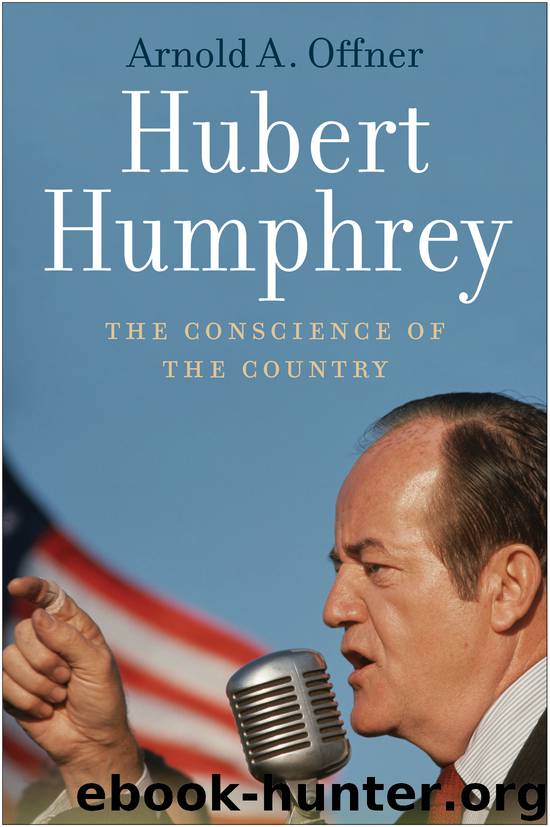
Author:Arnold A. Offner
Language: eng
Format: epub
ISBN: 9780300222395
Publisher: Yale University Press
15
NORTHWEST’S PASSAGE
Humphrey’s new year began unhappily. Johnson ordered his staff not to consult the vice president about his January 10, 1967, State of the Union address or show him an advance copy until the press had been briefed. Every reporter in Washington knew the contents of the speech before Humphrey did. Even worse, when Humphrey and his former aide Thomas Hughes jogged out of earshot of the ever-trailing Secret Service agents, he told Hughes that the president had put wiretaps not only in his offices but also in his new condominium in Washington. And Jack Valenti and his aides were reporting not only on him but on his staff, who Johnson complained were “wild men.”1
When the Humphreys invited the Johnsons to their new home for dinner, the president pulled his host aside to tell him that by all reports he was “our greatest national resource” when it came to explaining US policy in Southeast Asia to the public and insisted that Humphrey recite one of his Vietnam speeches verbatim—to his audience of one. Humphrey balked at first, but then gave in to Johnson’s persistence, even as the president moved from the sofa to the bathroom, calling over his shoulder, “Keep talkin’, Hubert, I’m listenin’”—until the summons to dinner ended this absurd humiliation.2
The shortest answer to the question why Humphrey continued to endure Johnson’s perverse behavior is most likely found in Humphrey’s remark to reporters in early 1967: “I’m Vice President because he made me Vice President”—the office the Minnesotan viewed as providing his best route to the White House, given that he came from a small state and lacked wealth. Humphrey also felt indebted to Johnson for easing his initial pariahlike isolation imposed by the Senate’s Old Guard southerners, putting him on the prestigious Foreign Relations Committee in 1953, and helping him become majority whip in 1961. As vice president, he could not contest the president’s power, and he personally could not stand up to Johnson, who he had said in 1966 seemed to regard him “almost as a son.” Or perhaps better said, Humphrey viewed Johnson as a father figure too powerful for him to fight.3
Humphrey was prepared to live with the consequences of his choices. As Max Kampelman, his former legislative aide and now a successful Washington lawyer, said in January 1967, Humphrey was “a fatalist who tries to maximize his opportunities,” and he believed that “if you do everything you’re capable of, virtue will triumph. He gives the President eighteen hours a day, he doesn’t play golf, he’s working all the time and when he’s not working he’s thinking. So while he would be disappointed if history decided he’s not to be President, he wouldn’t be a beaten, depressed man. He’s service oriented and he would want to serve in some other way.”4
Humphrey delighted in being the administration’s chief public spokesman. In February, he toured the western states, with a stop in Minnesota, to remind his DFL compatriots that, contrary to rumors, Johnson intended to head the party’s ticket in 1968.
Download
This site does not store any files on its server. We only index and link to content provided by other sites. Please contact the content providers to delete copyright contents if any and email us, we'll remove relevant links or contents immediately.
| Anthropology | Archaeology |
| Philosophy | Politics & Government |
| Social Sciences | Sociology |
| Women's Studies |
The Secret History by Donna Tartt(19103)
The Social Justice Warrior Handbook by Lisa De Pasquale(12197)
Thirteen Reasons Why by Jay Asher(8919)
This Is How You Lose Her by Junot Diaz(6894)
Weapons of Math Destruction by Cathy O'Neil(6285)
Zero to One by Peter Thiel(5808)
Beartown by Fredrik Backman(5768)
The Myth of the Strong Leader by Archie Brown(5513)
The Fire Next Time by James Baldwin(5454)
How Democracies Die by Steven Levitsky & Daniel Ziblatt(5225)
Promise Me, Dad by Joe Biden(5157)
Stone's Rules by Roger Stone(5091)
A Higher Loyalty: Truth, Lies, and Leadership by James Comey(4967)
100 Deadly Skills by Clint Emerson(4932)
Rise and Kill First by Ronen Bergman(4797)
Secrecy World by Jake Bernstein(4756)
The David Icke Guide to the Global Conspiracy (and how to end it) by David Icke(4724)
The Farm by Tom Rob Smith(4517)
The Doomsday Machine by Daniel Ellsberg(4493)
