History and Utopia by E. M. Cioran
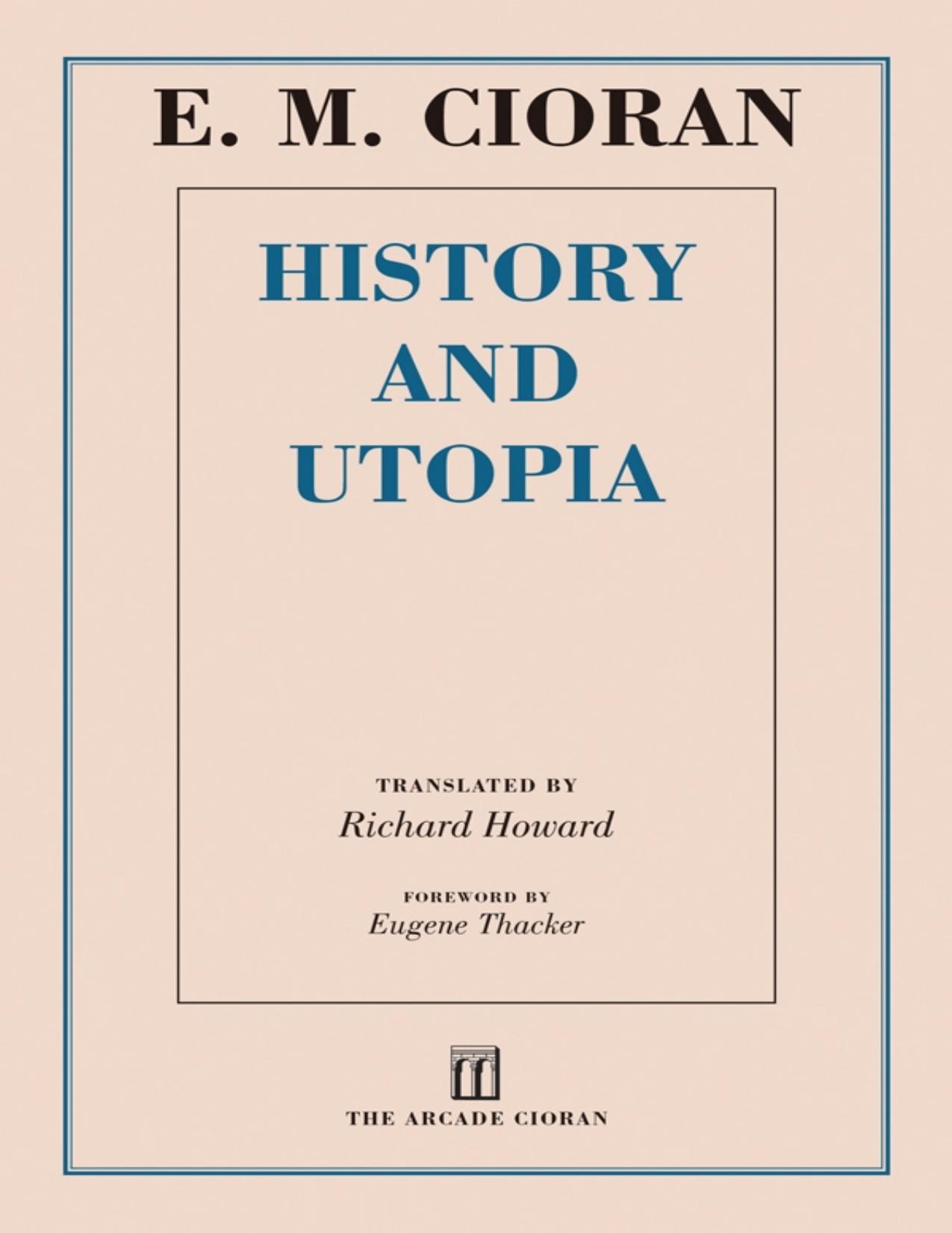
Author:E. M. Cioran
Language: eng
Format: epub, azw3, pdf
ISBN: 9781628724660
Publisher: Arcade
Published: 2015-01-05T05:00:00+00:00
An abiding, vigilant rancor can constitute, all by itself, the armature of an individual: weakness of character proceeds in most cases from a poor memory. Not to forget an insult is one of the secrets of success, an art invariably possessed by men with strong convictions, for every conviction consists chiefly of hate, and only secondly of love. Perplexities, on the other hand, are the lot of the man who, equally inept at hating or loving, has nothing to choose, not even his lacerations. If he would assert himself, shake off his apathy, play a part, let him invent enemies and cling to them, let him waken his dormant cruelty or the memory of outrages imprudently despised! To take the smallest step forward, even just to exist, requires a minimum of villainy. Let no one abandon his holdings in indignity if he wants to “persevere in being.” Rancor preserves; if, moreover, we can sustain it, nurture it, we avoid softness and insipidity. We should even encourage it toward things: what better tactic for arming ourselves against them, for lowering ourselves advantageously to reality? A pure sentiment, lacking any vital charge, is a contradiction in terms, an impossibility, a fiction. Indeed there is no such thing, even if we sought it in religion, a realm where it is supposed to flourish. We do not undertake to exist, still less to pray, without sacrificing to the devil. In most cases we attach ourselves to God in order to take revenge on life, to punish it, to signify we can do without it, that we have found something better; and we also attach ourselves to God in horror of men, in reprisal against them, to make them understand that, having entrée elsewhere, we do not find their society indispensable, and that if we grovel before Him, it is in order not to have to grovel before them. Without this shabby, murky, secret element, our fervor would lack energy—perhaps it could not even exist.
The unreality of pure sentiments—we might suppose that it was the sick who could best reveal such a thing to us, that this was their mission and the meaning of their ordeals. Nothing more natural, since it is in the sick that the flaws of our race are concentrated and exacerbated. Having ranged through the various species, having striven with more or less success to imprint its sign upon them, Disease, weary of its progress, doubtless longed for rest and sought someone over whom to declare its supremacy in peace, someone who would prove quite amenable to its whims and its despotism, someone on whom it could really count. Experimenting left and right, Disease suffered many a failure, until at last it found man—unless it created him. Thus we are all sick men, some potentially so—the mass of the healthy, the type of placid, harmless humanity—the others actual, the diseased strictly speaking, a cynical and impassioned minority. Two categories close in appearance, irreconcilable in fact: a considerable gap separates possible pain from the real thing.
Download
History and Utopia by E. M. Cioran.azw3
History and Utopia by E. M. Cioran.pdf
This site does not store any files on its server. We only index and link to content provided by other sites. Please contact the content providers to delete copyright contents if any and email us, we'll remove relevant links or contents immediately.
| Anthropology | Archaeology |
| Philosophy | Politics & Government |
| Social Sciences | Sociology |
| Women's Studies |
The Secret History by Donna Tartt(19088)
The Social Justice Warrior Handbook by Lisa De Pasquale(12190)
Thirteen Reasons Why by Jay Asher(8910)
This Is How You Lose Her by Junot Diaz(6887)
Weapons of Math Destruction by Cathy O'Neil(6280)
Zero to One by Peter Thiel(5802)
Beartown by Fredrik Backman(5754)
The Myth of the Strong Leader by Archie Brown(5507)
The Fire Next Time by James Baldwin(5446)
How Democracies Die by Steven Levitsky & Daniel Ziblatt(5219)
Promise Me, Dad by Joe Biden(5153)
Stone's Rules by Roger Stone(5088)
A Higher Loyalty: Truth, Lies, and Leadership by James Comey(4964)
100 Deadly Skills by Clint Emerson(4925)
Rise and Kill First by Ronen Bergman(4789)
Secrecy World by Jake Bernstein(4753)
The David Icke Guide to the Global Conspiracy (and how to end it) by David Icke(4720)
The Farm by Tom Rob Smith(4512)
The Doomsday Machine by Daniel Ellsberg(4490)
