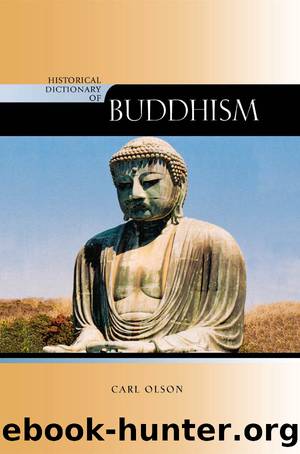
Historical Dictionary of Buddhism by Carl Olson
Author:Carl Olson
Language: eng
Format: epub
Publisher: Scarecrow Press
Published: 2009-01-15T00:00:00+00:00
â M â
MACHIG LAPGI DRÃNMA (1055â1145). A Tibetan female saint and practitioner of tantra. She was an expert in the chöd method in which a person visualizes a demon dismembering oneâs body with the purpose of becoming detached from oneâs body. It was believed that Machig was originally a male, who fled from India to Tibet to avoid hostile Brahmins. He transformed himself into a female by projecting his consciousness into the body of a living female.
MÄDHYAMIKA. An influential MahÄyÄna school of thought founded by Nãgãrjuna (second century CE) and based on his text Fundamentals of the Middle Way (MÅ«lamadhyamaka-kãrikã). Nãgãrjuna envisioned his philosophy as a middle path between two extremes: externalism (is) and nihilism (is not). This position entails that nothing in the world exists absolutely and nothing perishes completely because the middle is transcendental and thus beyond language and concepts, which implies that no philosophical position is ultimate. The path envisioned by Nãgãrjuna does not lead to a definite goal, but it does lead to the end of all theorizing, which he grasps as the perfection of wisdom (prajñãpÄparamitÄ).
By means of his negative dialectic, Nãgãrjuna attacks the existence of all dharmas (things), concepts, or theories devised by Abhidharma scholars because they lack any self-nature (svabhÄva), which means that it is impossible to predicate existence or non-existence to them. Because everything is subject to causation and lacks self-nature, everything is empty (ÅÅ«nyatÄ). The school was promoted by Äryadeva, a disciple of its founder, before it split later into two branches: SvÄtantrika led by BhÄvaviveka (ca. 490â570) and PrÄsaá¹ gika promoted by CandrakÄ«rti (ca. 650). The two branches disagreed respectively about the use of a positive or a negative dialectic. The school had a widespread influence in Tibet, in China in the form of the San-lun school, and in Japan with its Sanron school.
MAGADHA. During the lifetime of SiddhÄrtha (Buddha), it was a major kingdom south of the Ganges River ruled by King BimbisÄra before dying from maltreatment by his son and successor, AjÄtaÅatru. Father and son were both followers of Buddhism and gave support to the new religion. After the death of the Buddha, the first Buddhist council was held at the capital of RÄjagá¹ha and later the third council was held at its new capital of PÄá¹aliputra during the reign of King AÅoka.
MAHÄBODHI SOCIETY. The Buddhist society founded by AnagÄrika Dharmapala (1864â1933) in 1891 with the purpose of revitalizing the religion. He was motivated initially to restore BodhgayÄ, which was the site of the Buddhaâs enlightenment, to Buddhist control. The society spread internationally with its first office in England opening in 1925. Before this event, the society gained wider public attention when its founder attended the World Parliament of Religions in Chicago in 1891. Branches of the society around the world today reach people through their publications.
MAHÄMAUDGALYÄYANA. Sanskrit name for the Pãli monk MahÄmoggallÄna, who was a senior disciple and life-long friend of the Buddha. After achieving enlightenment rather swiftly, he became famous for his miraculous powers by changing his own form and conjuring various living shapes.
Download
This site does not store any files on its server. We only index and link to content provided by other sites. Please contact the content providers to delete copyright contents if any and email us, we'll remove relevant links or contents immediately.
Professional Troublemaker by Luvvie Ajayi Jones(29648)
Empire of the Sikhs by Patwant Singh(23069)
Twilight of the Idols With the Antichrist and Ecce Homo by Friedrich Nietzsche(18618)
Plagued by Fire by Paul Hendrickson(17401)
The Sun and Her Flowers by Rupi Kaur(14508)
Norse Mythology by Gaiman Neil(13335)
A Journey Through Charms and Defence Against the Dark Arts (Harry Potter: A Journey Throughâ¦) by Pottermore Publishing(9267)
Fangirl by Rainbow Rowell(9227)
Adultolescence by Gabbie Hanna(8910)
Wonder by R.J. Palacio(8569)
Tools of Titans by Timothy Ferriss(8362)
Becoming Supernatural by Dr. Joe Dispenza(8196)
How to Bang a Billionaire by Alexis Hall(8144)
Wonder by R. J. Palacio(8097)
Crystal Healing for Women by Mariah K. Lyons(7922)
The Road Less Traveled by M. Scott Peck(7591)
The Lost Art of Listening by Michael P. Nichols(7487)
The Witchcraft of Salem Village by Shirley Jackson(7250)
The Institute by Stephen King(7022)
