Hermeneutics in the Genre of Mukhta?ar by Kassim Husain;
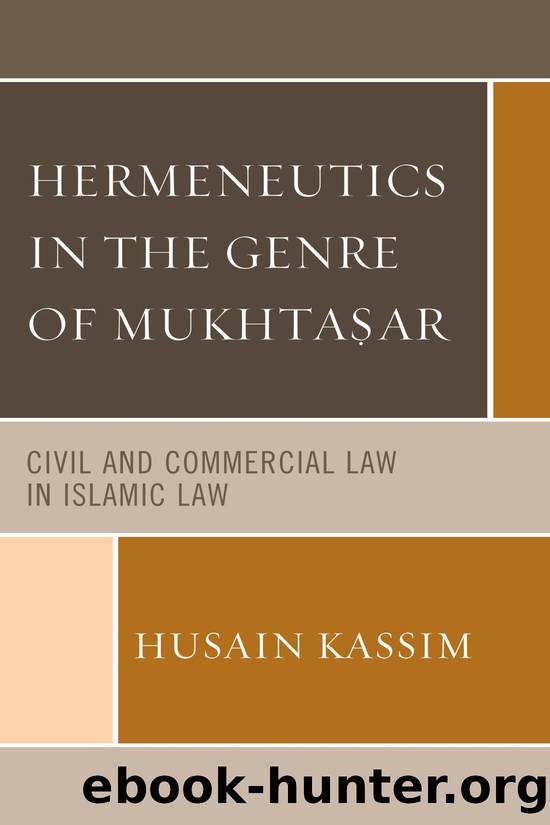
Author:Kassim, Husain;
Language: eng
Format: epub
Publisher: Lexington Books/Fortress Academic
Chapter 6
MÄlikÄ« School of Law
Hermeneutics as Reflected in al-KhalÄ«lâs Mukhtaá¹£ar
A Brief Biographical Account of MÄlik bin Anas
The exact date of birth of Abá¿¡ Ê»Abd Allah MÄlik bin Anas ibn MÄlik is not known. He died at the age of eighty-five in the year 179/795. He belonged to the Humayar who was included in the Baná¿¡ ibn Murra. Legend is that he spent three years in his motherâs womb. The Prophet himself is said to have foretold his coming as well as that of Abá¿¡ á¿anÄ«fa, and al-ShÄfiʻī. It is said that he wanted to become a singer but changed his career for the study of the fiqh on his motherâs advice because of his physical appearance.
MÄlik ibn Anas studied fiqh with RabiÊ»al-Farrá¿¡q, who cultivated raây in Medina. He transmitted prophetic ḤadÄ«th reports from al-ZuhrÄ«, NÄfÄ«, Mawla ibn Ê»Omar, and many others.
MÄlikâs MuwaÈÈaâ
The MuwaÈÈaâ of MÄlik is considered one of the oldest surviving books of the Islamic legal system. MÄlik is the first jurist to use the name MuwaÈÈaâ. Before whom those who authored books on law in his age used to call them the Comprehensive (al-JÄmiÊ») or the Compilation (Muá¹£annaf). âThe word muwaÈÈaâ means that which is made easy and is pruned and trimmed of superfluous matters.â1
MÄlik compiled the MuwaÈÈaâ intending to include exclusively the strong prophetic ḤadÄ«th reports of the people of á¿ijÄz combined with the sayings of Companions, and Followers. According to some, MÄlikâs MuwaÈÈaâ is the first recorded collection of prophetic ḤadÄ«th reports. In that respect, it came to be seen as the transition from the simple fiqh to the pure science of prophetic ḤadÄ«th reports.2
âThe transformation of MÄlik into the mediator (through the isnÄds) of ideally prophetic authority and into an exegete (through the appended juristic dicta (qÄla MÄlik) are one of the key elements in the creation of hermeneutics,â3 though his dicta are entirely confined to the prophetic ḤadÄ«th reports. As a result, hermeneutical interpretations in it are limited to that extent. It was later that MÄlikÄ« jurists in the next succeeding generations, who developed it further with the acceptance of al-ShÄfiʻīâs concept of hermeneutics.
The MuwaÈÈaâ is composed of numerous discrete items, exhibiting two basic forms. First, there are prophetic ḤadÄ«th reports, characterized by a formal chain of narrations (isnad, pl. of á¹£anad), introduced by ḥaddatha-nÄ« Ê»an MÄlik. This change of narrations may end at the Prophet, or at the Companion, or at the Follower, or an ancient Jurist. Secondly, there are juristic dicta characterized by the introductory formula qÄla MÄlik.4
Different Recensions of the Muwaá¹á¹aâ5
There are about fifteen different recensions of MÄlikâs Muwaá¹á¹aâ. Some of these include version of YaḥyÄ ibn YaḥyÄ (234/849), version of Abá¿¡ Muḥammad Ê»Abdalla ibn Salama al-FikhrÄ« al-Miá¹£rÄ« ibn Wahb (197/813), version of Abá¿¡ Ê»Abd Allah Ê»Abd al-RaḥmÄn ibn al-QÄsim (191/807), version of Abá¿¡ YaḥyÄ Maʻīn Ê»IsÄ ibn DÄ«nÄr al-MadanÄ« (198/814), version of Abá¿¡ Muṣʻab al-ZuhrÄ« (242/857), and version of Muḥammad ibn al Ḥasan al-ShaybÄnÄ«, the disciple of Abá¿¡ ḤanÄ«fa.
A Brief Account of Biography of KhalÄ«l bin IsḥÄq
IsḥÄq bin Má¿¡sa ShuÊ»ayb KhalÄ«l known also as al-JundÄ« died in the year 776/1374.
Download
This site does not store any files on its server. We only index and link to content provided by other sites. Please contact the content providers to delete copyright contents if any and email us, we'll remove relevant links or contents immediately.
| Anthropology | Archaeology |
| Philosophy | Politics & Government |
| Social Sciences | Sociology |
| Women's Studies |
The Secret History by Donna Tartt(19052)
The Social Justice Warrior Handbook by Lisa De Pasquale(12187)
Thirteen Reasons Why by Jay Asher(8893)
This Is How You Lose Her by Junot Diaz(6877)
Weapons of Math Destruction by Cathy O'Neil(6264)
Zero to One by Peter Thiel(5786)
Beartown by Fredrik Backman(5737)
The Myth of the Strong Leader by Archie Brown(5499)
The Fire Next Time by James Baldwin(5431)
How Democracies Die by Steven Levitsky & Daniel Ziblatt(5215)
Promise Me, Dad by Joe Biden(5141)
Stone's Rules by Roger Stone(5081)
A Higher Loyalty: Truth, Lies, and Leadership by James Comey(4954)
100 Deadly Skills by Clint Emerson(4921)
Rise and Kill First by Ronen Bergman(4779)
Secrecy World by Jake Bernstein(4741)
The David Icke Guide to the Global Conspiracy (and how to end it) by David Icke(4706)
The Farm by Tom Rob Smith(4502)
The Doomsday Machine by Daniel Ellsberg(4484)
