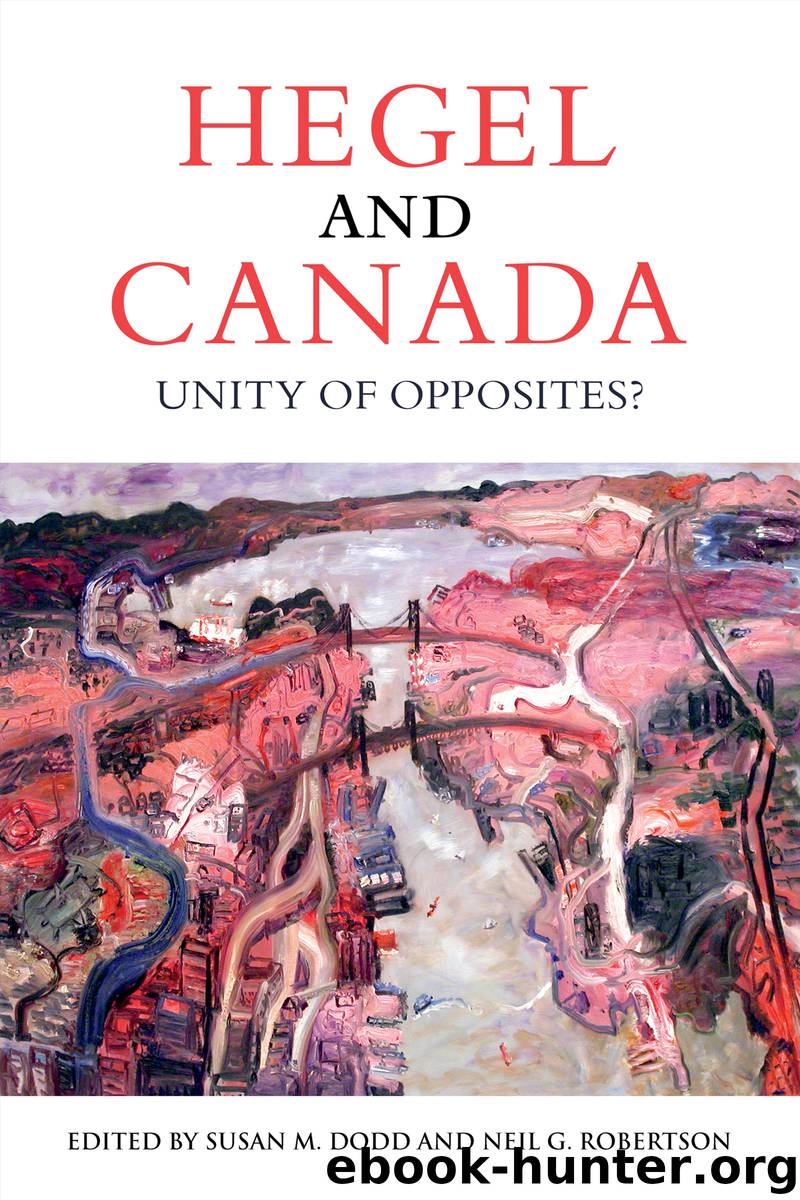
Hegel and Canada by Dodd Susan;Robertson Neil G.;
Author:Dodd, Susan;Robertson, Neil G.;
Language: eng
Format: epub
Publisher: University of Toronto Press
10 Idealism and Empire: John Watson, Michael Ignatieff, and the Moral Warrant for “Liberal Imperialism”
* * *
ROBERT C. SIBLEY
Towards the end of the nineteenth-century, Prussian leader Otto von Bismarck remarked that the most important thing to know about the twentieth century was that Americans spoke English. His point was obvious: an alliance between the British Empire and the United States, the world’s largest English-speaking polities, would create the most powerful political entity on the planet. Others made similar observations at the time – Rudyard Kipling, Winston Churchill, and Theodore Roosevelt, to mention a few.
Perhaps surprisingly, late nineteenth-century Canadians thought in these terms, too. Men such as George Monro Grant, George Robert Parkin, and, later, Stephen Leacock, Andrew Macphail, and James Cappon; they all spoke in one fashion or another of a grand alliance of the English-speaking people. For example, Parkin, the headmaster of Upper Canada College and an evangelist of empire, envisioned a new world order in which Britons (which, of course, included Canadians) and Americans worked together to become “the greatest secular instrument for good in the world.”1 At the time, the promotion of such a view of empire ensured that “the imperial idea became at once a popular enthusiasm and a reasoned political and ethical philosophy.”2
The postcolonial era has largely discredited this notion of empire.3 Even so, we should remember that these turn-of-the-twentieth-century Canadians had high hopes for Canada’s future greatness, and their imperial dreams reflected the belief that Canada detached from the British Empire would become a “Little Canada,” a political entity unable to satisfy the highest ideals and aspirations of its citizens. Only as an equal partner in the Empire, sharing in the benefits and responsibilities of imperial citizenship, would Canadians overcome their colonial mentality and achieve their potential greatness.4 Leacock voiced this idealist view of empire on the eve of the 1907 Imperial Conference when he urged delegates to “find for us something other than mere colonial stagnation, something other than independence, nobler than annexation, greater in purpose than a Little Canada … We must become something greater or something infinitely less.”5 For the imperialists like Leacock, the issue of Canada being part of an empire or succumbing to a lesser political destiny was “the greatest political question of the hour.”6
The Canadian imperialists were sustained in their enthusiasm for empire by the then dominant philosophy of Idealism.7 The philosopher most responsible for this was John Watson,8 who taught at Queen’s University for some fifty years and was a leading exponent of Idealism in the Anglo-Saxon world.9 Watson’s thought, as Brian McKillop observes, gave “the argument for an increased imperial connection much philosophical substance.”10
Does a long-dead Idealist philosopher have anything to say to us when the geopolitical questions of the hour are Islamist terrorism and, as it sometimes seems, the breakdown of an international order amenable to the interests and inclinations of the liberal democratic West? Perhaps this: While the concept of empire was much maligned during the decades of decolonization in the mid-twentieth century, it has returned in the early twenty-first century as a subject of serious political discourse.
Download
This site does not store any files on its server. We only index and link to content provided by other sites. Please contact the content providers to delete copyright contents if any and email us, we'll remove relevant links or contents immediately.
| Arms Control | Diplomacy |
| Security | Trades & Tariffs |
| Treaties | African |
| Asian | Australian & Oceanian |
| Canadian | Caribbean & Latin American |
| European | Middle Eastern |
| Russian & Former Soviet Union |
The Secret History by Donna Tartt(19032)
The Social Justice Warrior Handbook by Lisa De Pasquale(12183)
Thirteen Reasons Why by Jay Asher(8885)
This Is How You Lose Her by Junot Diaz(6873)
Weapons of Math Destruction by Cathy O'Neil(6261)
Zero to One by Peter Thiel(5782)
Beartown by Fredrik Backman(5734)
The Myth of the Strong Leader by Archie Brown(5494)
The Fire Next Time by James Baldwin(5425)
How Democracies Die by Steven Levitsky & Daniel Ziblatt(5211)
Promise Me, Dad by Joe Biden(5141)
Stone's Rules by Roger Stone(5080)
A Higher Loyalty: Truth, Lies, and Leadership by James Comey(4946)
100 Deadly Skills by Clint Emerson(4913)
Rise and Kill First by Ronen Bergman(4776)
Secrecy World by Jake Bernstein(4738)
The David Icke Guide to the Global Conspiracy (and how to end it) by David Icke(4697)
The Farm by Tom Rob Smith(4501)
The Doomsday Machine by Daniel Ellsberg(4482)
