Haunted by Hitler by Vials Christopher;
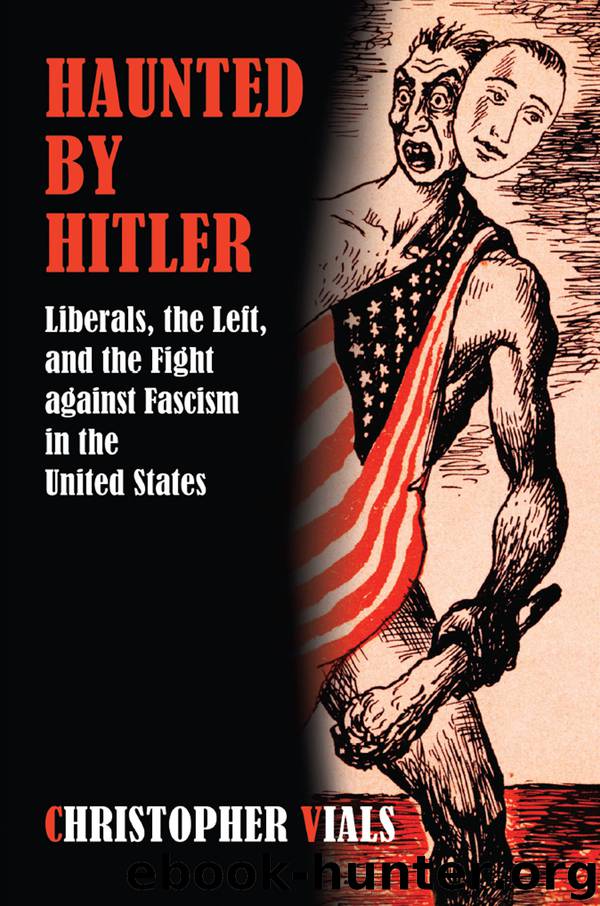
Author:Vials, Christopher;
Language: eng
Format: epub
Publisher: University of Massachusetts Press
Published: 2015-03-15T04:00:00+00:00
Janning’s testimony reflects two now-familiar facets of Nazism which the film put back into public memory: its anticommunism and its genocidal racism. And in large measure the film succeeded in this respect. Few reviewers failed to note its connections between 1930s Germany and 1950s McCarthyite America or its allusion to the unfolding civil rights struggle. Janning’s use of the phrase “racial minorities” is telling, as it had no commonly used German equivalent in Weimar discourse. Mann viscerally produces continuity by putting the arguments of the Cold War establishment into the mouth of the convicted Nazi judge Emil Hahn, who says in his closing statements, “We were a bulwark against Bolshevism. We were a pillar of Western culture. A bulwark and a pillar the West may have wished to retain.”
Kramer’s broad application of the lesson of the Second World War has been viewed more critically with the passage of time. A number of later scholars in Holocaust studies have criticized Kramer and Mann for supposedly universalizing the Holocaust. In this reading, the film deemphasizes the specificity of the Jewish victims in favor of an unproductive, ecumenical interpretation of the genocide that applies its meaning too widely. Judith Doneson writes, “Judgment makes the Jew a victim among victims, universalizing becomes shared history; the Holocaust is not a uniquely Jewish event.”54 A crucial point of contention here is the lengthy film within a film. In a shocking scene remarked on by almost every reviewer, the prosecutor Lawson presents to the court a graphic documentary newsreel shot by Allied forces at the liberation of Buchenwald and Bergen Belsen. The newsreel is composed of actual footage shown in movie theaters across the United States for a brief moment in 1945, then quickly taken out of public circulation. In 1961 audiences were shown—some as reminders, most for the first time—documentary images of heaps of bodies bulldozed into mass graves, charred skeletons in ovens, heaps of gold taken from tooth fillings, objects made from human skin, and the shrunken heads of Polish laborers. During the courtroom presentation, when Lawson states that even children were hung, the camera cuts momentarily to the disturbed face of an African American guard in the courtroom, a clear evocation of southern lynching which came through loud and clear to contemporaries.55
The focal point of later critical controversy among Holocaust scholars is Lawson’s analysis of the newsreel, in which he states, “Who were the bodies? Members of every occupied country of Europe. Two-thirds of the Jews of Europe. Exterminated.” Alan Mintz sees this statement as indicative of a larger failing by Kramer. He writes, “The Jews are mentioned among others, and that is the solitary reference.”56 I concur that the bodies of the victims need to be granted a specific identity, and I share the critique that the film includes no Jewish characters. However, it is not true that Judgment at Nuremberg presents the Jews as only one victim among many. Jews are mentioned more frequently than any other category of victim: for example,
Download
This site does not store any files on its server. We only index and link to content provided by other sites. Please contact the content providers to delete copyright contents if any and email us, we'll remove relevant links or contents immediately.
| Anthropology | Archaeology |
| Philosophy | Politics & Government |
| Social Sciences | Sociology |
| Women's Studies |
The Secret History by Donna Tartt(19467)
The Social Justice Warrior Handbook by Lisa De Pasquale(12293)
Thirteen Reasons Why by Jay Asher(9118)
This Is How You Lose Her by Junot Diaz(7056)
Weapons of Math Destruction by Cathy O'Neil(6466)
Zero to One by Peter Thiel(5951)
Beartown by Fredrik Backman(5935)
The Myth of the Strong Leader by Archie Brown(5623)
The Fire Next Time by James Baldwin(5582)
How Democracies Die by Steven Levitsky & Daniel Ziblatt(5322)
Promise Me, Dad by Joe Biden(5229)
Stone's Rules by Roger Stone(5186)
A Higher Loyalty: Truth, Lies, and Leadership by James Comey(5087)
100 Deadly Skills by Clint Emerson(5023)
Rise and Kill First by Ronen Bergman(4890)
Secrecy World by Jake Bernstein(4877)
The David Icke Guide to the Global Conspiracy (and how to end it) by David Icke(4850)
The Doomsday Machine by Daniel Ellsberg(4619)
The Farm by Tom Rob Smith(4611)
