Ground Crew by Daniels Maurice Charles;
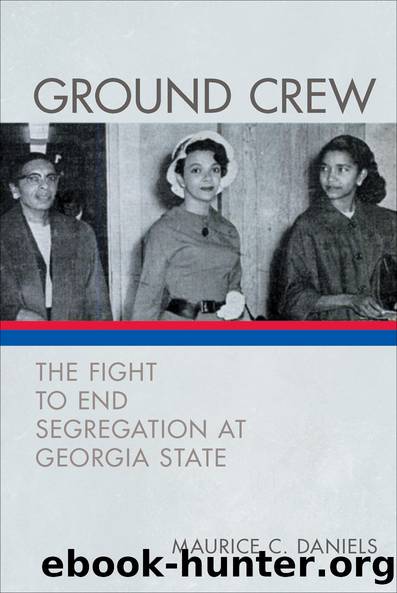
Author:Daniels, Maurice Charles; [Неизв.]
Language: eng
Format: epub
Publisher: Lightning Source Inc. (Tier 3)
Published: 2019-10-01T21:00:00+00:00
CHAPTER 5
âThe Higher Dictates of Justice and Equityâ
Judge Sloanâs Verdict
In his âLetter from a Birmingham Jail,â Martin Luther King Jr. wrote, âFreedom is never voluntarily given by the oppressor; it must be demanded by the oppressed.â1 On January 9, 1959, despite the defense attorneysâ predictions and their unequivocal insistence that Georgia Stateâs admissions practices were administered âin good faith,â Hunt, Dinsmore, Welch, and their attorneys prevailed in a legal victory against the oppressive conditions that banned blacks from so-called white public institutions of higher education. The plaintiffs and their legal team won a federal injunction that declared segregation at Georgia State unconstitutional and forbade the centuries-old racial discrimination in Georgiaâs colleges and universities.
In issuing his unprecedented ruling overturning segregation in higher education in Georgia, Judge Sloan accepted the plaintiffsâ argument that âthe policy, custom, practice and usage of the defendants in maintaining and operating Georgia State College of Business Administration on a racially segregated basis [was] violative of the rights secured to plaintiffs, and of rights secured to other Negro students of Georgia, who [were] similarly situated.â2 Sloan declared that the racially discriminatory policy and practices violated the due process and equal protection clauses of the Fourteenth Amendment.
Repudiating the stateâs claim that the admissions process was not racially discriminatory, Sloan agreed with the plaintiffsâ argument that the policies demonstrated preferential treatment for white students. Sloan enjoined the regents âfrom continuing to limit the college to white students onlyâ and admonished the defendants for some of their ludicrous tactics.3 He declared that the entrance requirement created by the Board of Regents and implemented by Georgia State officials requiring blacks to obtain character recommendations from white alumni was unconstitutional.
Using language that was practically identical to Moore, Hollowell, and Motleyâs argument, Sloan struck down the requirement, noting, âIt is not customary for Negroes and whites to mix socially or to attend the same public or private educational institutions in the state of Georgia, and ⦠by reason of this presently existing social pattern, the opportunities for the average Negro to become personally acquainted with the average white person, and particularly with the alumni of a white educational institution, are necessarily limited.â4
Sloan ruled that the effect of the alumni certificate requirement, simply put, was to prevent blacks from gaining admission to all-white state colleges and universities. Accordingly, and in precise accordance with the plaintiffsâ contention, Sloan declared: âThe alumni certificate requirement is invalid as applied to Negroes because there are no Negro alumni of any of the white institutions of the University System of Georgia, and consequently this requirement operates to make it difficult, if not impossible, for Negroes to comply with the requirement, whereas white applicants do not face similar difficulties.â5 He consequently ordered the college to end the policy and practice of requiring black applicants to furnish character certificates endorsed by white alumni.
Moreover, Sloan declared that the scholarship program that shunted black students out of state to attend college did not meet the requirement of equal protection.6 Sloanâs seventeen-page ruling thoroughly examined
Download
This site does not store any files on its server. We only index and link to content provided by other sites. Please contact the content providers to delete copyright contents if any and email us, we'll remove relevant links or contents immediately.
The Secret History by Donna Tartt(19090)
The Social Justice Warrior Handbook by Lisa De Pasquale(12190)
Thirteen Reasons Why by Jay Asher(8910)
This Is How You Lose Her by Junot Diaz(6887)
Weapons of Math Destruction by Cathy O'Neil(6281)
Zero to One by Peter Thiel(5802)
Beartown by Fredrik Backman(5754)
The Myth of the Strong Leader by Archie Brown(5508)
The Fire Next Time by James Baldwin(5446)
How Democracies Die by Steven Levitsky & Daniel Ziblatt(5219)
Promise Me, Dad by Joe Biden(5153)
Stone's Rules by Roger Stone(5088)
A Higher Loyalty: Truth, Lies, and Leadership by James Comey(4964)
100 Deadly Skills by Clint Emerson(4926)
Rise and Kill First by Ronen Bergman(4789)
Secrecy World by Jake Bernstein(4753)
The David Icke Guide to the Global Conspiracy (and how to end it) by David Icke(4720)
The Farm by Tom Rob Smith(4514)
The Doomsday Machine by Daniel Ellsberg(4490)
